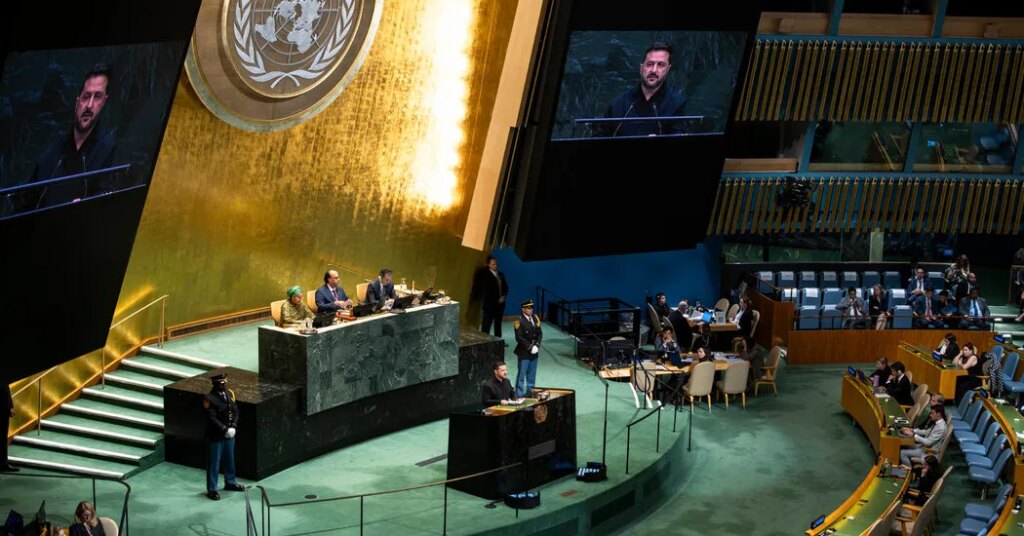
President Volodymyr Zelensky of Ukraine called on Wednesday at the U.N. General Assembly for more sanctions and other measures to halt Russia’s “ridiculous and never-ending war” before it entered another deadly winter. If the fighting isn’t ended, he warned, Russian aggression would soon spread to other parts of Europe.
“Russia’s finances and Russia’s production are what must be stopped if Putin is to be stopped,” Mr. Zelensky said, referring to the Russian leader, Vladimir V. Putin, and arguing that Poland, Moldova and other neighboring countries would be next. Artificial intelligence could soon make the war more deadly and unpredictable, he said, adding, “We need peace before we reach that point.”
Mr. Zelensky said that Ukraine had no choice but to escalate its attacks against Russia, whose military has increasingly targeted energy and civilian infrastructure. “Ukrainians understand that this winter could be very harsh for us,” said Zelensky. “In response, we will have no choice but to make it painful for Russia, too.”
Mr. Zelensky had met with President Trump earlier on Tuesday, on the sidelines of the General Assembly, and had said then that Ukraine hoped for a cease-fire “before winter.”
Still, Russia’s foreign minister, speaking at a Security Council meeting on Ukraine before Mr. Zelensky’s speech, made clear that the likelihood of a cease-fire were slim.
The minister, Sergey V. Lavrov, rejected the possibility of an interim peace agreement or a pause in fighting, while blaming Europe for the full-scale Russian invasion of its neighbor in 2022 that set it off.
“We are not going to have a pause in our special military operation,” said Mr. Lavrov, using Russia’s preferred euphemism for the war. He said a cease-fire would only allow Ukraine to shore up its defenses. “Europe, whatever it thinks, just wants to get a pause and just wants to pump the Kyiv regime with weapons,” he said.
Mr. Lavrov’s statements appeared to dash hopes for diplomacy between Russia and Ukraine, even as the United States has been working on getting the two sides to the negotiating table.
Earlier this month, President Trump’s special envoy Steve Witkoff and son-in-law, Jared Kushner, traveled to Moscow to meet with President Putin and then made their first trip to Ukraine to speak with officials there.
The war in Iran, which the United States started with Israel in late February, has dragged on much longer than Mr. Trump had initially pledged it would and has pushed the fighting between Russia and Ukraine lower on his administration’s list of diplomatic priorities.
Mr. Trump has called for Russia and Ukraine to halt strikes on energy sites, and his administration appears intent again on persuading both sides to restart negotiations.
At the Security Council meeting, Ukraine’s foreign minister, Andrii Sybiha, reiterated a call for a cease-fire but noted that there was a limit to the usefulness of statements and meetings. “So many speeches have been made in this council, so many right words, but the war drags on,” he said.
Mr. Sybiha said the war was a concern beyond Ukraine’s borders. “We must stop this war now before Putin enters your home,” he said. “He is already at the entrance.”
Other officials at the Security Council meeting castigated Russia. France’s foreign minister, Jean-Noël Barrot, accused Russia of “lashing out at Europe in its entirety,” and of violating international law by attacking Ukrainian civilians and civilian infrastructure and by flying drones into the airspace of European nations.
Ed Miliband, the British foreign minister, called for Russia to engage in diplomacy, arguing that it was failing in the war. “Even if morality does not sway the Russian government, reality should,” he said.
Mike Waltz, the U.S. ambassador to the United Nations, said that “the world is losing” as long as the conflict continued, and sought to persuade the Council that Russia and Ukraine had areas of “common ground” that could lead to “reasonable, incremental” steps toward peace. He did not directly address Mr. Lavrov’s statement rejecting any sort of pause in the fighting.
Mr. Zelensky had said ahead of his visit to New York that he planned to discuss “de-escalation proposals” with Mr. Trump. Before he addressed the General Assembly on Wednesday afternoon, he posted on social media about a series of Russian attacks on the Ukrainian capital, Kyiv, and in other parts of the country overnight.
“At every meeting during the U.N. General Assembly, we are working to ensure continued support for Ukraine,” he wrote. “Equally important is the fair pressure exerted on Russia through sanctions.”
Reporting was contributed by Farnaz Fassihi, Max Bearak and Pranav Baskar.
The post Zelensky Warns Russia’s War Will Expand if It Is Not Ended Soon appeared first on New York Times.