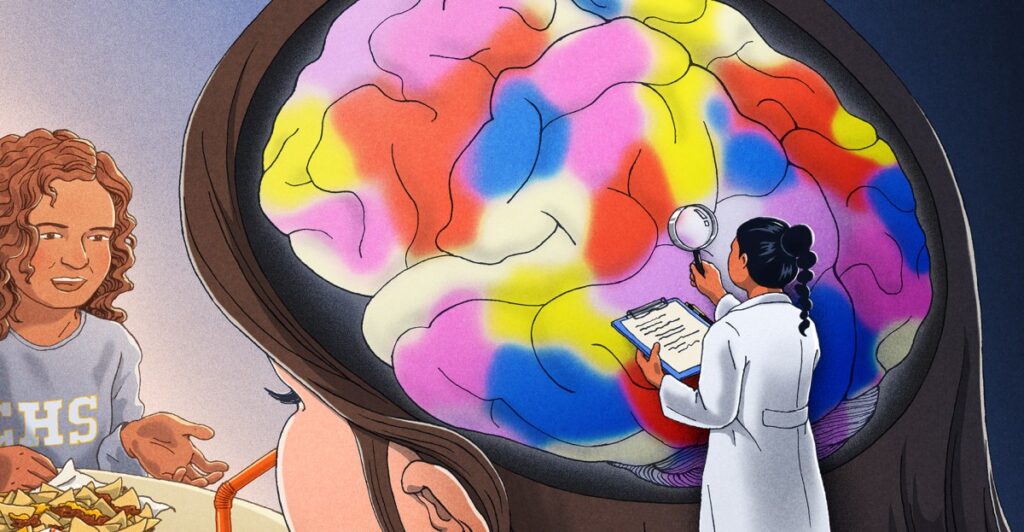
What’s actually going on in a teenager’s head? What happens in peoples’ brains as they transform from children into adults? What makes young brains so quick to pick up, say, instruments or languages? And why on Earth do teenagers make some of the absurd choices they make? What were they even thinking?!
These questions might sound like the domain of parents or teachers, but they’ve also been explored by scientists. And a fair warning that should be pretty obvious: Scientists don’t have perfect answers to any of these questions. But, they do have some really interesting techniques for trying to better understand teenaged brains. They’ve even been taking away some lessons from developing brains that they’ve tried to apply elsewhere.
In our latest series from Unexplainable, Vox’s science podcast, we’ve picked several researchers’ brains to understand what we know — and what we are still trying to figure out — about teen brains and how best to study them.
How do you even go about understanding teenaged brains?
And a little over a decade ago, the National Institutes of Health wanted to figure out what kind of risk factors lead kids down the road to substance abuse. It was a question that Raul Gonzalez Jr., a professor of psychology at Florida International University, had been studying for years at that point. But, as he told Vox, the studies he was doing were often small.
“There was this recognition that to really move the field forward and understand what is a risk factor as compared to a consequence of substance use,” he said. “We really needed to start with a huge study that started with adolescents before they started experimenting or using drugs.”
And so, the NIH ultimately decided to kick off a massive project: the Adolescent Brain Cognitive Development study, or “ABCD.” The plan was to follow thousands of kids — starting at age 9 — for a decade. At regular intervals, researchers would give them questionnaires and brain scans and track their progress as they went through their teens.
“It was going to be the study that anybody would ever want to do, but nobody would ever have the resources to do,” Gonzalez said.
Gonzalez wound up becoming the head of the Florida site, one of 21 ABCD sites across the country. And he says that, once other adolescence researchers got wind of just how many kids were going to be studied (about 12,000 at this point) and for how long, they wanted to add their own questions.
Now, a decade into the project, they’ve collected a treasure trove of data on everything from adolescent screen time to sleep and exercise regimens to family situations. They’ve collected data on how the kids approach various games, and they scanned their growing brains in MRI machines. Already, this study has led to over 1400 papers, teasing out different aspects of teen brain development. But Gonzalez says data is still coming in, and he’s looking forward to pouring through it to keep understanding what’s going on in the minds of teenagers.
What might we learn from developing brains?
There are some things we do know about developing brains, though.
In the first few years of our lives, our brains make lots and lots of synapses, connections between our neurons that let them pass signals to one another. And then, as we get older, brains prune a lot of those connections back. So, perhaps counterintuitively, in the period of adolescence when you’re learning a lot, it actually seems like your brain is eliminating some connections while strengthening others.
“Use it or lose it,” said Alison Barth, a professor of Biological Sciences at Carnegie Mellon. “If you don’t use it, maybe you’re just gonna get rid of it.”
This process might seem inefficient. Why build up HUGE numbers of connections…only to then get rid of them? This was, in fact, the question that two of Barth’s computer scientist colleagues raised when she told them about the brain’s synaptic pruning back in the 2010s.
But, when they all started working together exploring synaptic pruning in a mouse brain and trying to see what lessons it might have to teach them about building computer networks outside of a brain, they found that the brain’s counterintuitive technique for learning might actually be worth learning from.
This series was made possible by support from the Annie E. Casey Foundation.
The post The quest to solve the mysteries of teen minds appeared first on Vox.