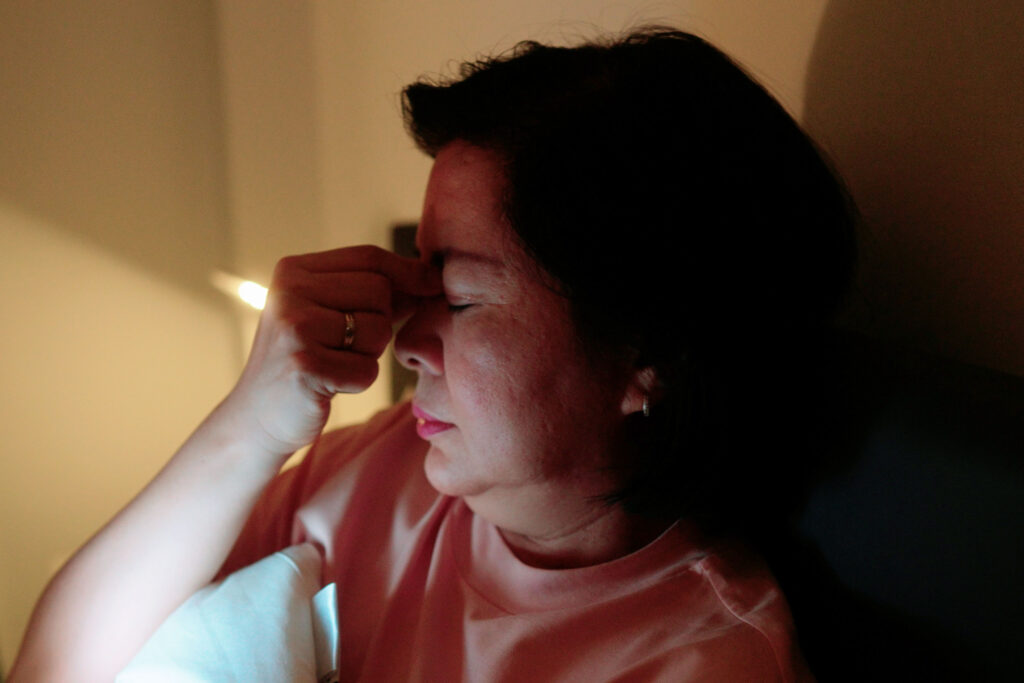
James Byczek was out to dinner with his wife and a friend when he noticed what he thought was a fly buzzing around the room. “I asked them if they saw it, too, and they said no,” he said. Later, at home, the floating spot had transformed into a thick, squiggly black line in his left eye. “I thought, That’s weird, I must have something in my eye,” Byczek, then 56, recalled. But he didn’t see anything when he looked in the mirror.
Byczek, who lives in Elmhurst, Illinois, booked an appointment with an optometrist, who referred him to the emergency room. Three days later, he was in surgery for a retinal detachment.
Developing a detached retina — when the light-sensitive tissue lining the back of the eye pulls away from its normal position — is fairly uncommon. The average person’s lifetime risk is less than 1 percent. However, if you are very nearsighted, have had a previous eye injury or have a family history of detachment, your chances of experiencing one are higher. Age increases that risk, too. “One of the main considerations with eye health is that age is a risk factor for nearly every eye disease,” said Teri Geist, president of the American Optometric Association and an optometrist at Midwest Eye Care, P.C., in Omaha.
Suddenly seeing floaters, as Byczek did, can be a sign that something’s wrong. But unfortunately, “so many eye diseases are quiet,” noted Geist, which is why the American Academy of Ophthalmology recommends all adults over 40 receive an eye disease screening every five to 10 years.
Older adults might consider more regular exams, said Seenu Hariprasad, a surgical retina specialist and chair of the Department of Ophthalmology and Visual Science at UChicago Medicine. “I think it’s wise that patients over the age of 55 have an eye exam every one to two years, and those over 65 every year, even in the absence of visual symptoms,” he said. More frequent visits are especially important if you have a family history of eye disease or certain health conditions, like diabetes or high blood pressure, which can damage the retina, he added.
In addition to scheduling regular eye exams, alert your health care provider if you experience any of the below vision changes. While some can be a normal part of aging, others can be signs of an underlying eye condition.
It becomes harder to read things up close
Losing the ability to focus up close — meaning those tiny letters on a pill bottle or even on your phone become unreadable — is “one of the first things people will notice as they get older,” said Andrew Iwach, clinical spokesperson for the American Academy of Ophthalmology and an ophthalmologist at the Glaucoma Center in San Francisco.
When you’re young, your eye’s clear lens is softer and more easily alters its shape to focus light onto the retina. As that lens hardens with age, it becomes less able to focus on nearby objects, leading to a condition called presbyopia. Around age 40, many people suddenly realize they can’t read as easily — books, menus and even texts or emails become impossible to decipher without stretching an arm out. “People in the presbyopic age range think they’re rapidly losing vision, but this is a very normal change of the eye,” Hariprasad said.
What to do: Even though “almost everyone” will experience presbyopia, Hariprasad said, book an eye exam if you notice it. Your doctor may recommend prescription lenses or over-the-counter reading glasses. “They’re not expensive, and it’s just like a breath of fresh air,” he said.
Your eyes feel drier
Staring at a screen all day can leave your eyes feeling dry and scratchy at any age, but dry eye becomes more common later in life. “As we get older, we tend not to produce as many natural tears,” Iwach explained. About 5 percent of adults may have diagnosed dry eye, a 2019 study found, and prevalence steadily increases with age.
What to do: Over-the-counter artificial tears can provide relief, but check with your eye doctor if dry eye is very bothersome. “If it’s persistent, you definitely want us to take a look with our microscope and make sure that there’s nothing more concerning,” Iwach said.
You have trouble seeing in low light
Picture this: You walk into a dark movie theater after being out in the sun, and it takes a minute for your eyes to adjust. As you get older, “that’s harder to do,” said Christine Curcio, professor emerita in the Department of Ophthalmology and Visual Sciences and director of the AMD Histopathology Lab at the University of Alabama at Birmingham Heersink School of Medicine. “People find it takes longer and longer to adjust after a bright light,” she said, and may also find it difficult to do everyday tasks in dim light.
This happens because rod-shaped photoreceptors in the eye degenerate with age, Curcio explained. These light-detecting cells convert light into signals the brain can understand.
What to do: Book an eye disease screening with an optometrist or ophthalmologist. Difficulty adjusting to low light can be associated with a greater risk of developing age-related macular degeneration (AMD), Curcio said. AMD is a common retinal disease and the leading cause of irreversible vision loss in people over age 50. Some forms are treatable, but intervention is important before the condition progresses.
Things don’t look as crisp
Vision that’s cloudy, blurry or “not as sharp as it used to be” is a common complaint among older adults, Hariprasad said, especially after age 60. This can be a symptom of cataracts, which develop gradually and can eventually cause blurry, distorted or double vision.
With cataracts, “the crystal clear lens that we’re born with becomes opacified, hard and turns into a whitish-brown color,” Hariprasad said. People with cataracts can also notice halos around lights: “When they look at a headlight, for instance, you get the light sort of speckling,” said Joan Miller, a professor of ophthalmology and former chair of the Department of Ophthalmology at Harvard Medical School, Massachusetts Eye and Ear/Massachusetts General Hospital and ophthalmologist-in-chief at Brigham and Women’s Hospital. Around two-thirds of U.S. adults over age 80 have cataracts.
What to do: It can feel scary to see your world become increasingly blurry and distorted. But unlike some eye conditions that develop with age, “here we can restore the vision,” Iwach said. In the early stages, prescription lenses may help improve vision, while surgery is an option as cataracts progresses.
Straight lines look curvy or wavy
Sudden vision distortion — for example, when objects that should be straight appear wavy or curved — is a more serious symptom of AMD. This distortion can occur when a blood vessel behind the eye’s photoreceptors bursts, creating a bump that alters vision, Curcio explained. Patients “may look out at a telephone pole and see that it looks wavy,” she said.
Wavy or curved lines can also occur with diabetic eye disease, said Hariprasad, or an epiretinal membrane, which is scar tissue that forms over the retina’s surface. Vision distortion should be considered “a warning symptom that something is going on in the retina,” Miller said.
What to do: “If you have lines that are supposed to be straight and all of a sudden there are wavy lines, that is absolutely something that you should have evaluated,” said Geist, especially if it’s only occurring in one eye.
You experience eye floaters, flashes or dark spots
Aging also affects the vitreous, a substance that fills the back of the eye and is gel-like at birth but becomes more liquid over time. “As the vitreous liquefies, you develop a mix of solids and liquids, and that’s where you perceive floaters,” Iwach said. They may look like dots, circles, lines, cobwebs or little specks.
Floaters may eventually fade on their own, but they can be a sign of posterior vitreous detachment, which occurs when the vitreous pulls away from the back of the eye; diabetic retinopathy, a diabetes complication that causes damage to the retina’s blood vessels; or retinal detachment, as Byczek experienced.
What to do: Always reach out to an eye specialist if you suddenly see many new floaters or flashes of light, Hariprasad said. Certain retinal detachments are medical emergencies; the longer a person goes without treatment, the greater their risk of permanent vision loss.
Your peripheral vision starts to narrow
Unlike macular degeneration, which usually affects the center of your vision, glaucoma typically starts at the edges. The disease damages the optic nerve, gradually creating blind spots and narrowing peripheral vision. Because these changes happen slowly and central vision often remains intact until the disease is advanced, many people don’t realize anything is wrong.
Glaucoma “is one of the scarier” eye conditions, Hariprasad said. “By the time patients come in, oftentimes, sadly, it’s so advanced,” he added. Without treatment, glaucoma can cause permanent vision loss or blindness.
What to do: Glaucoma is treatable, but because there are often no symptoms, about half of people with the disease don’t know they have it. This is a big reason the American Academy of Ophthalmology recommends those regular eye exams after age 40, “even if you think everything is fine,” Miller noted. Regular exams are “screening for a lot of different things, but the biggest one is glaucoma.”
The post 7 common age-related eye changes you shouldn’t ignore appeared first on Washington Post.