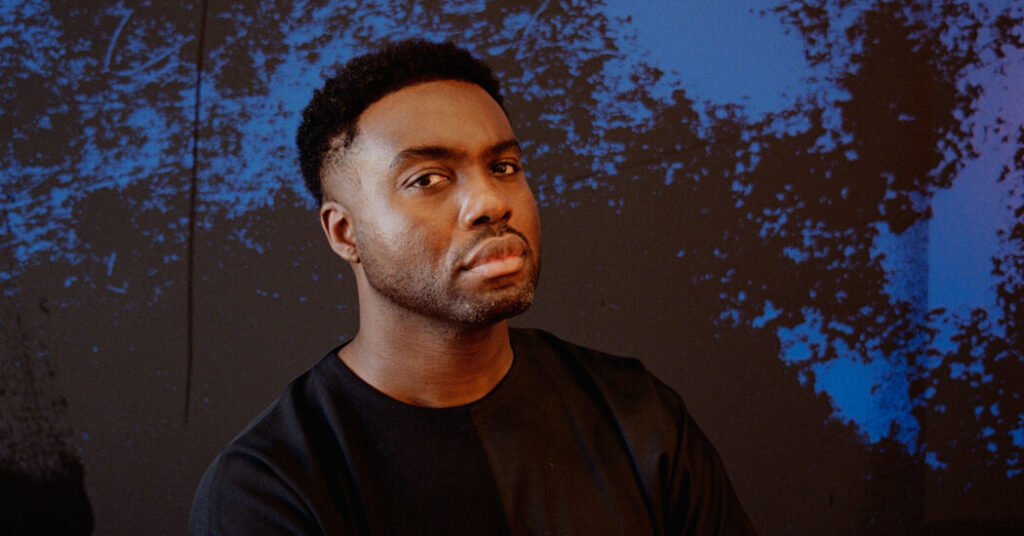
Adam Pendleton’s art studio in Clinton Hill, Brooklyn, is a pristine white-cube gallery, with an office and a narrow library filled floor to ceiling with art books.
All the creative work takes place in a single large, light-filled room, where colors are splashed across tables, dripping down the walls, and bleeding into strips of paper, as prismatic rain.
Pendleton could easily be seen as a Neo-Expressionist painter who works mostly in shades of black. He starts all his drawings and paintings with a black ground, which acts as his primer, and then adds marks, colors, and sometimes lettering in a range of hues. Then he might erase all of that, smudge it out, and leave a few traces. Then it’s back to black.
He has called his long-term artistic project “Black Dada,” a term he borrowed from Amiri Baraka’s 1964 poem, “Black Dada Nihilismus,” a radical rejection of Western art and a call for a Black aesthetic.
The term points Pendleton in a range of political and philosophical directions, but is best defined by his own artworks, which usually emerge from literal blackness, and are marked by fragments of language and erasure.
In person, Pendleton is hyperverbal — unlike many artists who wish the work to speak for itself. He just wants those words to be as fleeting and intangible as his marks on the canvas. It’s a trait that is both liberating and occasionally confounding. One of the words he uses a lot is “upend” — as in, upending expectations or perceptions.
On Oct. 10, Pendleton’s latest exhibition, “Some Wild Kind of Language,” opens at the Stedelijk Museum Amsterdam, one of Europe’s first white-box museums. At its center is an architectural highlight, a grand 19th-century stairway that creates a sense of drama as visitors climb to the main exhibitions halls. Pendleton plans to paint it all black, for what the museum says is the first time since 1895.
Around the stairway, he’ll display 8 large-scale drawings, gold ink on black paper, and there will be 10 abstract paintings in another exhibition hall in various hues. Some have lettering or partial sentences such as, “We Are Not.”
I met Pendleton in his Brooklyn studio over the summer to discuss the show, and his radical act of reversal. (This conversation has been edited).
Let’s start with your choice to change the white cube museum into a black cube, if you will. Why?
I like to make interventions into spaces, sometimes subtle, sometimes more explicit, that reorient people’s senses and expectations of the spaces. I do not believe that stairway has ever been painted black before. [The museum agrees.] This kind of complete upending or transformation of the space, I think, is novel.
Are you in some way referring to “Black Dada” when you are painting a space black? Are we meant to take that as a metaphor for racial issues, or political ideas?
I’m certainly pointing toward the prospect of blackness as a kind of open-ended signifier. Yes, that points to Black Dada, which is something I’ve been thinking about, and rethinking, for more than 20 years now.
When I think of Dada, I tend to think of collage, unusual juxtapositions, a kind of randomness. The Dada movement was a response to the chaos and madness of the First World War. When I look at your work, I see Abstract Expressionism, minimalism and post-Pop. How is it Dada?
Dada was an artistic and also philosophical response to World War I, yes, chaos, trauma. What does art have to do with it? The response was not that art would be a kind of balm. Art was not there to heal the wounds, it was not there to create structure or order. It was there to remind people of their creative capacity. That’s what “Black Dada” is to me. It created — and it creates — space for me.
You concurrently have a show at the Hirshhorn Museum and Sculpture Garden in Washington, D.C.,“Adam Pendleton: Love, Queen.” How is it similar to, or different from, the upcoming Stedelijk exhibition?
They’re both explorations of an approach to abstraction, primarily through painting. There are 30 paintings and one video in the Hirschhorn, and 18 paintings and drawings in the Amsterdam show. My concerns are very much rooted in the disciplines of painting, and how it changes through time.
This show is titled “Some Wild Kind of Language.” How did you become interested in language as art?
When I was growing up, my first sense of what art could be emerged through encounters with the written word. People like Adrienne Rich and Audre Lorde, Toni Morrison. Art can cast a spell through an idea. Think about the fact that a book can change culture, that a single painting can upend 100 years of history.
What is a single artwork you feel has done that?
[Kazimir] Malevich’s “Black Square.” That painting opens up everything. It’s about as reductive as one can get — it is literally a black square — and I like the sheer perversity of that sense of possibility. To reduce something to “nothing” is actually to unleash its unlimited potential. From a historical standpoint, that is so often what has happened to different people, in certain political times. People have often been reduced to nothing.
Books have that same ability to create change?
One of the things that excites me most about reading is actually our capacity to remember and forget at the same time. Because when you read a book you don’t remember every word, right? In fact, two hours later you’ll be like … hmm. It’s like the blackboard being erased. In my paintings, it’s the gesture or the mark slipping into darkness. Often what we are left with is the residue of something, even when we’ve created it ourselves. That’s wild, when you think about it.
It’s interesting that you mention the blackboard. When I look at your work, I think of Cy Twombly’s Blackboard paintings. Is that a fair comparison?
Yes, that’s very fair. Cy Twombly is one of the very few painters who used black grounds. All of my works have black grounds. For me, the white ground announces itself as the surface and things are placed on top of it, whereas the black ground announces itself as space, and you can move into it.
Do you love Cy Twombly?
I do love Cy Twombly. We’re both from Virginia and I think he figured into my imagination or my consciousness early. There’s a willingness or desire to touch all of the possibilities of the gesture, the mark.
Where did you see his work?
The first time was at the Virginia Museum of Fine Arts, because of the Sydney and Frances Lewis Collection, which had examples of a Kiefer, a Warhol, a Twombly, alongside conceptual artists like Robert Morris and Sol LeWitt, and minimal and conceptual artists like Donald Judd. My work is caught between that more expressive space, and also the deliberateness of that which is minimal or conceptual. It’s this articulation of both at once.
You also have printed out photos of graffiti on city walls here in your studio. What’s the influence of graffiti on your work?
Graffiti is very beautiful and I think it creates these visual environments that we don’t really notice. Sometimes it’s a black canvas with white marks on it, like so much of my work, caught somewhere between legibility and illegibility, language and non-language.
Twombly was the first Abstract Expressionist who really spoke to me. I was drawn in by Mark Rothko but Twombly felt so much warmer.
Yeah, I think Rothko teaches one how to feel, but then Twombly teaches us how to think and feel.
What kind of thought trajectory would you like viewers to experience at the Stedelijk Museum?
I like that idea of a “thought trajectory.” I want an exhibition to be a dialogical space. I want to be everywhere all at once, but also to disappear, so they can find themselves in the work.
I do want to ask you about politics, which is affecting the Smithsonian Institution, where the president, for example, is planning to place ideological warning signs accusing the institution of political bias. Do you feel that you somehow need to make a statement through your work?
We are all always engaged in politics. I’m not thinking about political realities when I’m in my painting studio — frankly, I think that would be very uninteresting. But I do think there’s of course a politics involved when you have an American artist showing in a European museum. An artist from New York showing in Amsterdam. It’s about the politics of expectation. This show is giving me, as a Black American artist, an opportunity to be in dialogue with a lineage of artists that one would not consider me alongside previously. There’s a politics to the fact that I can occupy or claim the same space as a Twombly or a Barnett Newman. That’s a huge shift, and it’s a recent one.
How recent?
I’m thinking about people who paved the way, like [the Abstract Expressionists] Frank Bowling, Jack Whitten or Alma Thomas. It probably started with Norman Lewis in the 1940s and 50s, and then Whitten, who was looking at Norman Lewis, and having these kinds of breakthroughs in the ’60s and ’70s. But then there’s a kind of disappearance of these artists in the 1980s. A lot of those artists would have had careers and a legacy, but their careers weren’t cultivated. Now there’s space for me, for people to look at my work in relation to Warhol or Whitten. That’s a new alchemy.
Is Black Dada still central in this upcoming exhibition?
It’s still very central. It allows me to be bad, very bad. I’m always in these situations where people are asking me: What does your work mean? When I’m bad, I can just go blah, blah dada, make the noise and engage with this overwhelming freedom of blackness. It allows me to be untethered and wild.
So it’s about playfulness?
Yes, it’s a playfulness, and also an element of not wanting to be self-serious. I’m astonished by the absurdity of things.
The post Adam Pendleton Is Painting the White Cube Black appeared first on New York Times.