
It could be easy to dismiss the work data-labeling firms do. Surge AI CEO Edwin Chen said that could stem from misunderstanding what they do.
“I think a lot of people think of data labeling as it relates to simplistic work, like labeling cat photos and drawing boundary marks around cars,” Chen told Lenny Rachitsky on his “Lenny podcast.”
Chen, who previously worked at Google, Twitter, and Meta, said that he’s “always hated the word data labeling.”
“Because it just paints this very simplistic picture when I think what we’re doing is completely different,” he said.
Surge AI, which Chen founded in 2020, competes in the AI data labeling space with companies like Scale AI and Mercor. Surge also has a partnership with Anthropic and also runs DataAnnotation.tech, where freelancers can sign up to get paid for training AI models. These remote workers are often referred to as “ghost workers” for their behind-the-scenes labor that is critical to AI’s development.
Beyond any rote work it can entail, Chen said data labeling is a much more creative endeavor. He compared what companies like Surge do to how parents instill lifelong values in their children.
“I think a lot about what we’re doing as a lot more like raising a child,” he said. “You don’t just feed a child information. You’re teaching them values, and creativity, and what’s beautiful, and these infinite subtle things about what makes somebody a good person.”
In this way, Chen said, companies like Surge AI are “raising humanity’s children.”
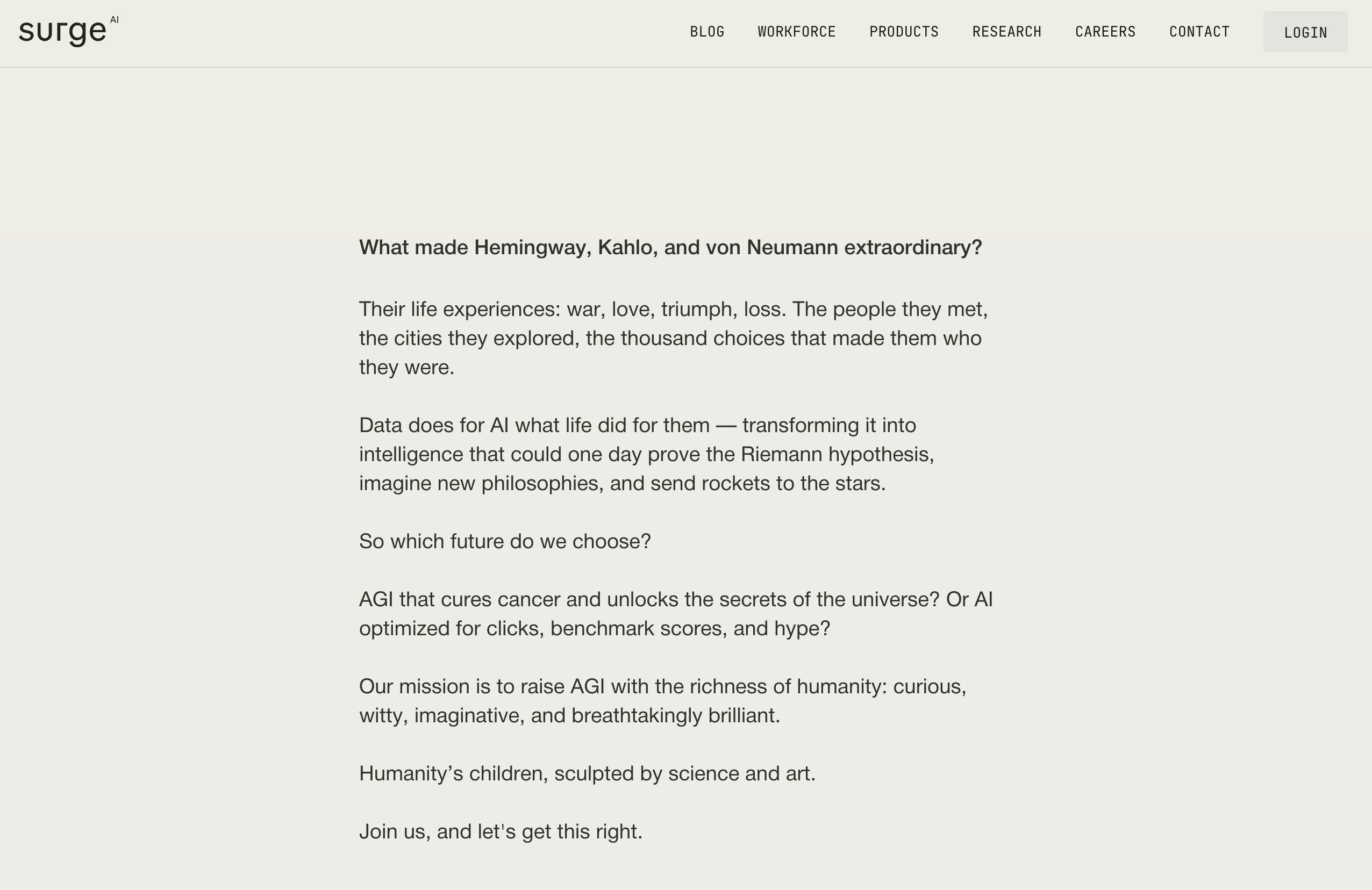
Chen’s view can also be seen when you navigate to Surge’s website, which greets visitors with the question: “What made Hemingway, Kahlo, and von Neumann extraordinary?”
“Their life experiences: war, love, triumph, loss. The people they met, the cities they explored, the thousand choices that made them who they were,” the website reads. “Data does for AI what life did for them — transforming it into intelligence that could one day prove the Riemann hypothesis, imagine new philosophies, and send rockets to the stars.”
‘You don’t need to become someone you’re not’
Chen previously worked in Big Tech at companies including Twitter, Google, and Facebook — and you might remember one of his Twitter projects.
While at the company, roughly a decade before Elon Musk would acquire it, Chen became known for making the “Pop vs. Soda” map by geo-tagging data from tweets around the US to illustrate which word users used to refer to soft drinks.
Looking back at starting Surge AI, Chen said he was surprised to find out that he never had to stop burying his head in the data.
“I thought if I started a company, I’d have to become a business person looking at financials all day, and being in meetings all day, and doing all this stuff that sounded incredibly boring, and I always hated,” he told Rachitsky. “So, I think it’s crazy that didn’t end up being true at all.”
Chen said he wishes he had known that you don’t need to spend “constantly tweeting and hyping and fundraising.”
“You don’t need to become someone you’re not,” he said. “You can actually build a successful company by simply building something so good that it cuts through all that noise. And I think if I had known this was possible, I would’ve started even sooner.”
Do you work in data labeling? Contact the reporter from a non-work email and device at [email protected].
Read the original article on Business Insider
The post Surge AI CEO explains why he hates the term ‘data labeling’ appeared first on Business Insider.