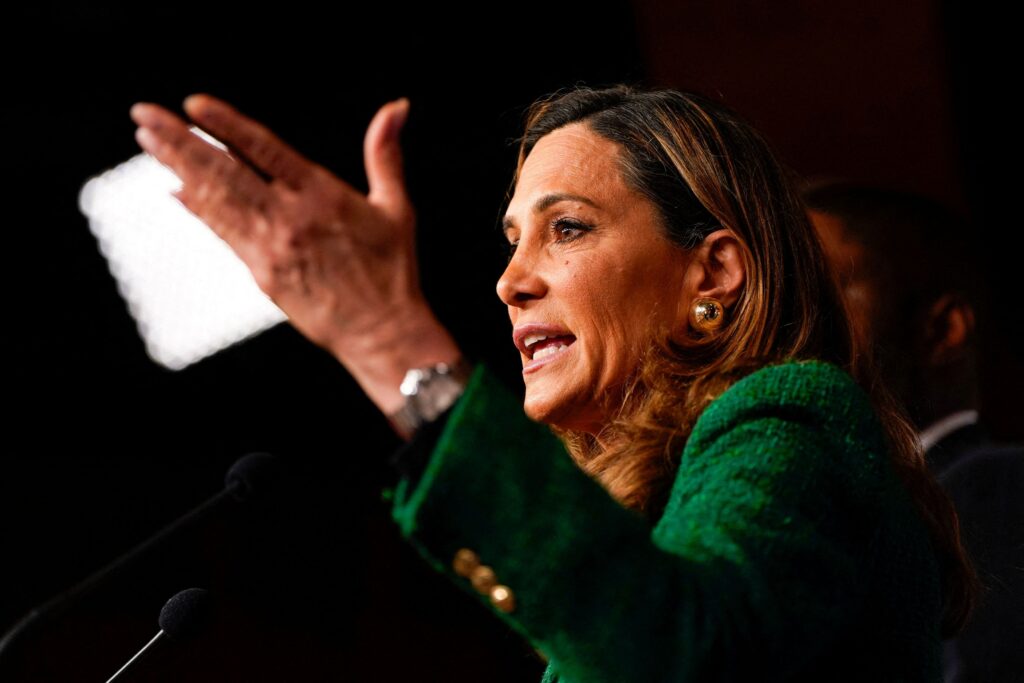
MIAMI — In South Florida, Rep. María Elvira Salazar’s latest campaign ad seems to be all voters can talk about.
The Republican’s video, released last week, was shot in front of the White House, not in the sun-blazed streets of Miami-Dade County. Though aimed at frustrated voters, it was framed as a direct appeal to President Donald Trump.
“Mr. President, some of your immigration enforcement efforts have gone too far,” Salazar says while looking directly at the camera. She goes on to tell Trump that his advisers are giving him bad advice, and that his immigration policies are weakening Republicans’ standing with the Latino voters who helped power GOP gains in 2024.
But many Latino voters in Salazar’s district said she has misread their sentiment and that their support for Trump has not wavered. Their support for their congresswoman, however, has waned, they said — and the ad did nothing to restore their confidence.
“She’s out of line,” said Hector Rubio, a resident of Miami’s wealthy enclave of Key Biscayne. Rubio, a longtime Republican voter who supported Salazar in the past three races, said in Spanish that Trump “is doing what he can, and he could do even more.” As he watched his wife shop in the neighborhood’s busy farmers market on Saturday morning, Rubio advised Salazar to stick close to Trump.
Even those who agreed with Salazar’s message seemed to find fault in it, with many saying the lawmaker should have made her appeal to Trump earlier.
“Her blind support of Trump has me very disturbed. She’s not thinking for herself,” said Charles Parsons, 83, another Key Biscayne resident who voted for Salazar in the past but said Saturday that he will not support her this year, even though he plans to vote for other Florida Republicans on the ballot. “All she’s thinking about is her political survival, and this ad … does nothing more than exacerbate the wound for me.”
In a statement to The Washington Post, Salazar defended her video, saying it “represents her long-standing conviction on the matter.”
Still, the ad suggests that what initially seemed like a relatively easy race for Salazar in a district Trump won by nearly 15 points in 2024 may be more complicated.
“[The ad] told me that she’s desperate,” said political analyst Ana Navarro, a former Republican strategist who became a fierce Trump critic, and a resident of Salazar’s district. “This was a pretty much ho-hum race. I think most people weren’t paying much attention to it. And all of a sudden this ad comes out, and it’s like: ‘Whoa, what’s going on here?’ And then you look at the polls, and you realize she’s tied.”
Salazar faces Democratic challenger Eliott Rodriguez who, like the lawmaker, is a former TV anchor. Both are well-known among Miami’s Hispanic population, with Salazar spending roughly 35 years at Spanish-speaking outlets like Univision and Telemundo. Rodriguez, meanwhile, spent 25 years at CBS Miami. He retired from the network in December, three months before launching his campaign.
The two are children of Cuban refugees who fled the island as communism took over the Caribbean nation — a history shared by many residents in southern Florida.
Their district spans wealthy waterfront communities like Key Biscayne, working-class immigrant neighborhoods like Little Havana, and tourist-heavy corners like Coconut Grove. Nearly 75 percent of the district’s residents are Hispanic — and more than half were born outside of the United States, according to the Census Bureau’s 2024 American Community Survey.
In 2024, Trump solidified years of Republican growth in Florida by drawing in a larger share of Hispanic voters in the state. But those gains are now being tested in districts like this as his popularity plummets nationwide.
Riding on a golf cart as he canvassed through Key Biscayne on Saturday, Rodriguez said he found Salazar’s ad “strange.”
“I was not expecting that, but it tells me that they’re nervous,” Rodriguez said. “She seems to have opened her eyes, but it’s too late. After you vote for all of this, after you vote to fund ICE, after you go ahead with Trump’s tariffs?”
Rodriguez questioned whether Salazar’s internal polling shows a race within the margin of error. He said that could be why she filmed an ad pushing back on Trump this close to the election, a hypothesis some analysts floated as well.
While Salazar’s campaign did not make her available for an interview, in a statement, Salazar dismissed speculation about what her polling shows.
“Every cycle around this time, the Democrat campaign will surface their polling analysis and come November the voters prove them wrong,” she said.
Democrats maintain the ad has been a boon. The Rodriguez campaign said it recorded a haul of about $120,000 last week, double the candidate’s take the week before. But he faces an uphill climb against the well-funded Salazar: According to Federal Election Commission numbers from July, the congresswoman is sitting on a war chest of about $2 million.
Democrats point out that it wasn’t too long ago that the area went blue — the county voted for their party in every presidential election between 1992 and 2020. A new congressional map has changed the shape of the district this year, however, and the area is now home to many of the Latino voters that helped lead Republicans to victory in 2024. The Cook Political Report still rates the race as “likely Republican.”
For his part, Trump chided Salazar for the ad on Friday, arguing that she would not have been elected had it not been for his endorsement. But the president notably spared Salazar from the louder, more aggressive reprimands he has unleashed against others in his party who have publicly criticized him.
Sunday, Salazar told CBS that she had “a fantastic conversation” with Trump following the ad, and that she reiterated the message she shared in the video. Salazar said Trump was “very receptive” to her message about the need for a new deportation strategy and broader immigration restructuring.
The Trump administration’s immigration enforcement activities have had a marked effect on Salazar’s district. Venezuelan, Haitian, Cuban and Nicaraguan immigrants make up a vast swath of the immigrant workforce in the area. Tens of thousands of these immigrants, who were living across South Florida legally under humanitarian parole programs and Temporary Protective Status, lost their immigration protections after the Trump administration ended them.
Residents complained about immigrant-owned businesses shutting down and neighbors being deported following intense Immigration and Customs Enforcement operations.
Nationally, the administration has said it deported 2.5 million people as of December 2025. The administration’s critics say the effort has been overly aggressive, and its deportation strategy drew widespread scrutiny following the deaths of Americans during enforcement actions in Minnesota in 2026.
Back in Salazar’s district, several Republican voters said that they approved of the Trump administration’s deportation efforts.
“The people who voted for Trump — the 70 or so million — one of the reasons was because they wanted to get all the illegal people out of here,” said South Miami resident Richard Santos, 80, in an interview outside of the city’s iconic Versailles restaurant. Santos said he voted for Salazar in the past but that he’s no longer supporting her because she challenged the president.
For many of the district’s Republicans, the calculus is very simple: You’re either with Trump or you aren’t. And to some of these voters, Salazar’s ad was proof that she’s trying to stay in power by having it both ways.
“She just did it because she wants to keep her seat in Congress,” said Julio Perez, 54, as he smoked a cigarette outside of Versailles alongside Santos.
The post A Miami Republican faces backlash after publicly giving Trump immigration advice appeared first on Washington Post.