In today’s edition … Republicans are breaking with Trump on Iran … We have an important season-related question … but first …
Want to understand how data center politics have changed? Look to Texas.
Just 10 months ago, Gov. Greg Abbott (R) celebrated Google’s planned $40 billion investment in Texas by calling the state the “epicenter of AI development.”
“We must ensure that America remains at the forefront of the AI revolution, and Texas is the place where that can happen,” Abbott said.
Oh, how times have changed.
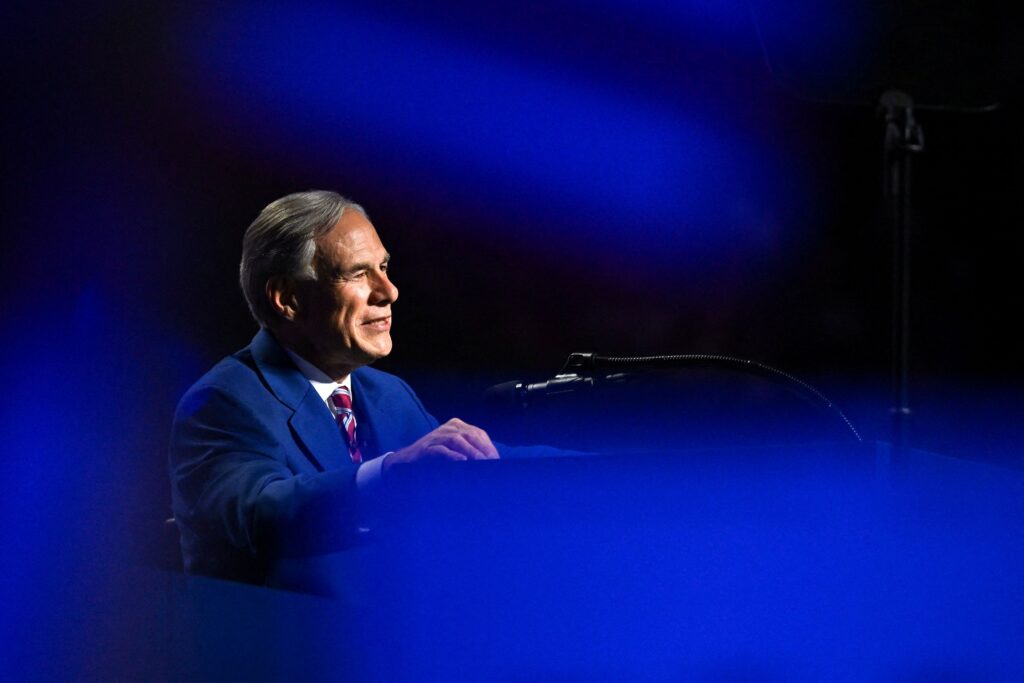
On Monday, Abbott — facing a stronger-than-expected reelection challenge from Democrat Gina Hinojosa and a growing bipartisan backlash to data centers — directed the Texas Commission on Environmental Quality to “halt all permits sought by data centers until the Electric Reliability Council of Texas (ERCOT) completes its audit.”
It was an about-face on one of the midterm’s most defining issues, something that has fired up not only Abbott’s opponents on the left, but voters who have backed him for years.
Take this finding from an NBC News poll released this week: After the outlet tested 15 different political characteristics to “see whether they would make voters more or less likely to vote for a candidate in November,” the pollsters found 64 percent of registered voters said they would be less likely to support a candidate who supported “building a data center in your community,” the strongest reaction of any characteristic.
“We don’t see many things in a cycle that have 64% [saying] I’m less likely to vote for somebody who supports that,” said Bill McInturff, the Republican pollster who co-produced the poll for NBC.
This shift from the Texas governor is not a one-off, either. Abbott, seemingly realizing that being pro-data center and on the ballot this November was a recipe for disaster, has made questioning data centers central to his pitch to voters, despite his position less than a year ago.
In June, Abbott directed the Public Utility Commission of Texas and the Electric Reliability Council of Texas to require all data centers to “pay for all of their electric infrastructure costs to ensure that no residential ratepayer is burdened by those costs.”
Later that month, the Texas governor said the state must prohibit technology companies from building AI data centers in rural Texas neighborhoods. He touted his anti-data center work as “fighting for East Texas values,” and said his administration was “pushing back against these AI data centers that are trying to build in our neighborhoods.”
And in August, he ordered the same Texas commissions to audit all data center projects in the state.
“Our top priority is to protect Texans’ safety and quality of life,” said Abbott.
One reason for Abbott’s flip is that Hinojosa has used data centers to lambast the governor on the campaign trail.
She has run ads on the topic, hitting Abbott for accepting over $20 million in campaign donations tied to data center executives.
She has attacked Abbott personally on the issue. “Greg Abbott has no credibility when it comes to reining in the data centers,” Hinojosa said. “The reason why they’re all here is because he invited them in with some of the richest tax breaks in this country.”
And she demanded the governor call an emergency special legislative session on data centers.
She is not the only Democrat hitting Abbott on the issue either.
Rep. Vicente Gonzalez, running for reelection in a competitive South Texas seat, told my colleague Jack Herrera that Abbott is the “biggest flip-flopper in America” because of his shift on data centers.
“He brags about them, and now he’s against them, because they’ve become really unpopular,” Gonzalez (D) said in Corpus Christi, a city that has been the subject of reports of towns running out of drinking water, in part, because of data centers.
Eduardo Leal, press secretary for Abbott’s campaign, responded to questions on Abbott’s shift on the issue by saying, “As the size and scope of data centers grew, Governor Abbott took decisive action to establish clear guardrails that put Texans first.”
Hinojosa remains a long shot. The last time the state elected a statewide Democrat was 1994. But the national environment is giving Democrats considerable momentum, and polls show a tight race in Abbott’s bid for a fourth term as governor.
My colleague Molly Hennessy-Fiske has done some outstanding coverage on Texas and data centers all year, including this piece from rural Centerville that found longtime Republican voters who support free markets, the energy industry and small government are “setting aside those principles to battle an onslaught of data center projects that pro-business GOP leaders initially welcomed.”
“The opposition to data centers is across party lines, across demographics,” Brendan Steinhauser, a Texas-based Republican strategist and CEO of Alliance for Secure AI, told Molly. And when it comes to the midterms, Steinhauser said, “I don’t think those voters have made up their minds.”
Molly has also found that data centers have become a way for Democrats in Texas to make the election about class, affordability and working people.
“The discontent with data centers is being mobilized in service of an argument — in a campaign sense — that says the leaders of this state have been choosing the rich and tech over average Texans,” James Henson, director of the Texas Politics Project at the University of Texas at Austin, told her.
Whether Hinojosa can pull off the nearly unthinkable and win in Texas is an open question. But if the Democrat does, it will likely be, in part, because of data centers.
Want this in your inbox?
Start your day with The Washington Post’s flagship political newsletter. Sign up here.
Our picks
- ‘I am the code’: Trump clashed with ballroom architect over safety issues, from Sarah Blaskey and Jonathan O’Connell.
- GOP appears deeply worried about Senate race in N.C., a once reliable state, from Natalie Allison and Dan Merica.
- A woman fleeing the Nazis left behind a painting. Her family just got it back, from Sophia Solano.
- Democrats are already making moves to run for president. Here’s who’s doing what, from Matthew Choi.
- AI leaders say U.S. and China need a deal. That probably won’t happen., from Ian Duncan, Riley Beggin and Cat Zakrzewski.
- ICE officer in Texas shooting was recruit not using a body camera, from David Nakamura and Maria Sacchetti.
- Trump officials cut 760,000 enrollees from ACA, claiming fraud, from Dan Diamond.
What we’re watching
I wrote yesterday about how Republican candidates in key battleground states are starting to break with President Donald Trump on Iran as polls show the conflict — and its domestic ramifications — are growing increasingly unpopular with voters.
Two Republicans in key Senate contests, former congressman Mike Rogers in Michigan and Rep. Ashley Hinson in Iowa, called for an end to the war this week, despite their earlier support for the conflict.
Rogers — who is facing Democrat Abdul El-Sayed in a competitive Senate race — was previously an outspoken supporter of Trump’s conflict in Iran, arguing it was needed to prevent Tehran from obtaining a nuclear weapon and defending giving Trump authorization to pursue the war.
Other Republicans are calling for the end of the war, too, including Reps. Zach Nunn and Mariannette Miller-Meeks, both in competitive House reelection campaigns in Iowa, and Rep. John James, the Republican gubernatorial nominee in Michigan.
More could be coming. The Senate is expected to vote on another Democratic-led war powers resolution this week — the same one the House voted on last week. This may provide other Republicans with a venue to break with the president on Iran.
The issue for Republicans is the war shows no signs of stopping, even as gas prices continue to tick higher and higher.
Trump told world leaders at the United Nations on Tuesday that he would “annihilate” Iran if its leaders do not make a deal, my colleague Michael Birnbaum wrote from New York, giving the leaders “a stark warning” even as the president appeared “frustrated by a war with Iran that has lasted long past his initial promises.”
And Trump drew a direct line between Iran and the midterms.
“They’re waiting to see how I do in the midterm election. What they don’t realize is that I’m not running,” Trump said, referring to Iran’s leaders.
That, however, directly conflicts with what he said to his supporters mere weeks ago.
“Pretend that I am on the ballot,” Trump said during the first night of his midterm convention in Dallas. “I’m on the ballot.”
In your local paper
Ohio Capital Journal: Immigration and Customs Enforcement detention of Haitian immigrants has more than doubled since the Trump administration ended their protected status.
Colorado Newsline: Voters in Colorado will decide this year whether transgender students can play school sports in the state. This outlet reports that the ballot measure is aimed at only a “few” trans students.
From you
It is an AI-heavy newsletter today.
We asked yesterday about the AI doomerism that has taken hold among voters, and about some of the extinction scenarios involving artificial intelligence.
Most of you are worried, but not everyone.
“The AI doom is marketing,“ wrote Tobin Lopes. ”The companies’ leaders believe that only they can save us from the coming AI apocalypse. But for that to happen, there has to be an apocalypse, which they are trying to convince people will happen.”
Matthew Floegel wrote that “apocalyptic AI scenarios have been around for decades.”
“The difference is that films like The Matrix and The Terminator were once considered purely science fiction,” he wrote. “Now, they could be categorized as realistic fiction. Today, we have tangible, visible pathways that could usher us into a sci-fi future, and ultimately bring about humanity’s end. Or maybe it stays aligned and solves all of our problems! Who knows!?”
And Ken Burleson added that “AI is a good thing although we again must guard against abuse, in many different ways. … It [can] be an opportunity to advance ourselves hopefully in the right direction.”
Send a reply
Fall has officially arrived in D.C. I walked my sweater-clad oldest to school today — my sign of fall’s arrival. Simple question: What is the best season and why? Let me and your fellow Early Brief readers know at [email protected].
Thanks for reading. You can follow me on X at @merica.
The post How have data center politics changed? Look at Texas’s Republican governor. appeared first on Washington Post.