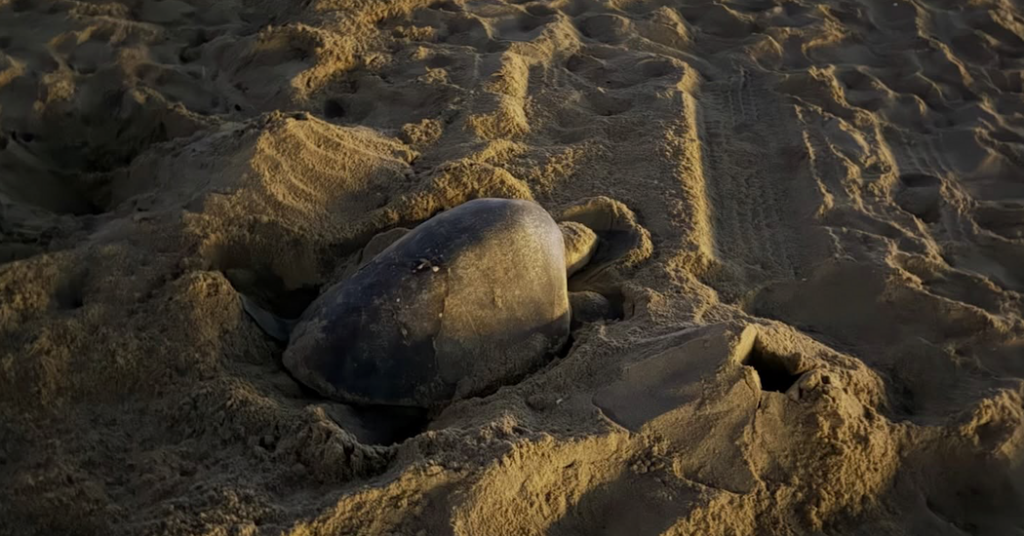
With a determined kick of her back flippers, a sea turtle made history on a California beach this month.
For the first time since recordkeeping began, a sea turtle has nested on the West Coast, digging a hole and laying eggs on Sept. 16 near Seal Beach, Calif., about 30 miles south of downtown Los Angeles. The mother was an olive ridley sea turtle, a threatened species most commonly found in tropical and subtropical waters off the coasts of Mexico and India.
Scientists said on Tuesday that the turtle’s arrival was a sign of things to come in California.
The waters off the West Coast have been heating up for years and attracting species accustomed to warmer climes, such as brightly colored tropical sea slugs and Humboldt squid. That trend has been supercharged this year by a major El Niño, a recurring climate pattern characterized by warmer Pacific Ocean temperatures.
Southern California in particular will be a hot spot for unusual sea critter sightings during this El Niño, given the region’s proximity to warmer waters off Mexico and the direction of the currents, said Greg Pauly, curator of herpetology for the Natural History Museum of Los Angeles County.
It could be a remarkable year for spotting marine animals that are rarely seen off the coast of California, such as yellow-bellied sea snakes and sport fish such as wahoo and dorado. Already, local residents this year have observed several hammerhead sharks and two whale sharks, all of which likely were drawn to Southern California by the unusually warm water.
“This is the epicenter,” Dr. Pauly said. “In terms of these things that are pretty spectacular and pretty easy to monitor, this is kind of the place for that.”
Olive ridley sea turtles can live for 50 years and are the smallest type of sea turtle, weighing up to 100 pounds and measuring about three feet in length. Their populations are threatened by commercial fishing nets, habitat loss, changing environmental conditions and other factors.
Sea turtles have been seen in Southern California before and are expanding their range northward as oceans warm, experts say. But none had ever been seen nesting on a beach in Southern California.
Three days after the turtle was seen laying her eggs near Seal Beach last week, a sea turtle was again spotted laying eggs a few miles south, near the Huntington Pier. It is unclear whether it was the same turtle.
Scientists are monitoring the turtle nests through the eggs’ incubation period, which can last for about two months, according to National Oceanic and Atmospheric Administration Fisheries. The nests have been fenced and protected, according to the agency.
The expansion of sea turtle nesting sites to new regions is generally viewed as a positive development, since many species are endangered. But there remain many unknowns, such as what will happen when the Southern California waters cool again or how the eggs will be impacted by cooler beach temperatures.
The survival of the hatchlings depends on the temperature of the sand, and even their gender is affected by it. The sex of a turtle isn’t set at fertilization, but determined by the temperature of the egg during incubation, with cooler sand producing more males.
Exciting as it may be, the rare nesting sites come amid a concerning rise in ocean water temperatures because of El Niño, experts say. The temperatures are already breaking records and are still building, with a peak expected later this year.
Peter D. Roopnarine, a California Academy of Sciences paleoecologist who studies how changes in environmental conditions affect ecosystems, said he never expected to be able to study large swings in ocean temperature in real time when he began his research decades ago.
A rise in ocean temperature by a few degrees is considered extreme, and it was once viewed as quick if that took place over thousands of years.
“To actually see this happening within a generation and see El Niños that are sort of kicking up their energy, the only word you can use for it is alarming,” Dr. Roopnarine said.
Scientists say they expect the coming months to bring yellow-bellied sea snakes, a venomous species that is commonly found around the world but typically doesn’t travel as far north as California.
Only six such snakes have ever been collected in the state, five of which came during an El Niño year. And this year, there has already been an unofficial report of one washing ashore in Orange County.
The warming ocean temperature could also be harmful to some species that are native to California. Giant kelp, for example, thrives in cool waters and will likely suffer, as will the southern sea otters that rely on the kelp.
Seals and sea lions could also be harmed because they feed on fish that eat plankton that live in cold, nutrient-rich water and may not be as abundant in warmer temperatures. Already this year, sea lions have washed ashore on California beaches after falling sick from eating fish that had consumed toxic algae that flourishes in warmer water.
“These are really abnormally warm temperatures,” Dr. Pauly said.
The post Tropical Sea Turtle Lays Eggs on Southern California Beach appeared first on New York Times.