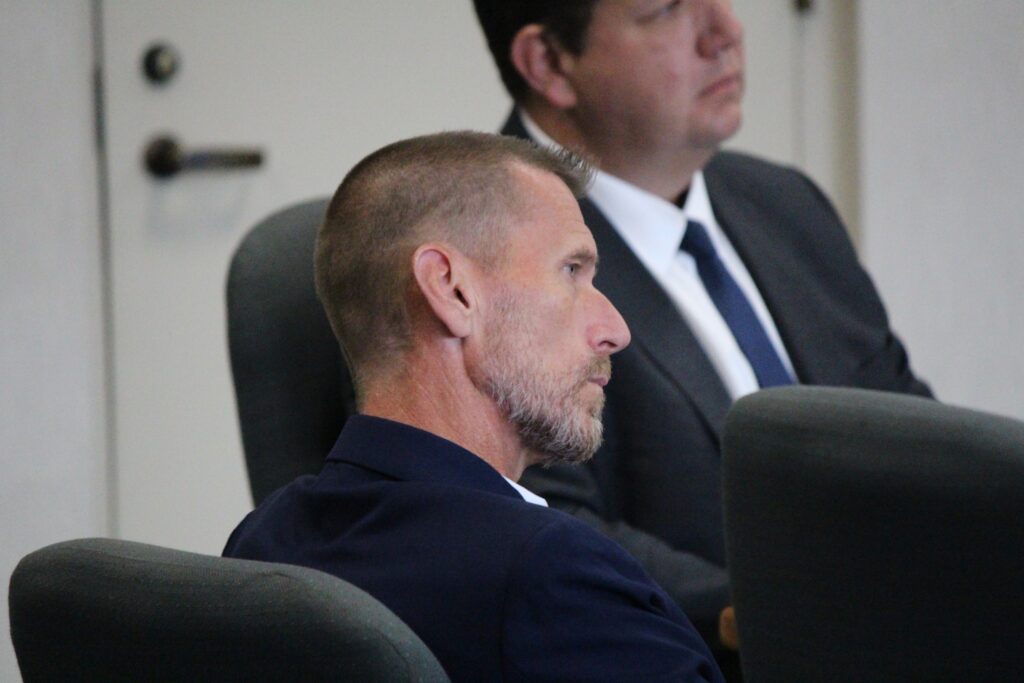
A Vermont jury convicted a man Monday of attempted murder in the 2023 shooting of three Palestinian college students that left one of the victims paralyzed.
Jason Eaton, 51, faces a maximum sentence of life in prison. Eaton did not deny shooting the students — two of whom are U.S. citizens — but had pleaded not guilty by reason of insanity.
During the week-long trial in Burlington, Vermont, jurors heard how Eaton stepped off his porch and shot the three men without uttering a word on the evening of Nov. 25, 2023.
The victims — Hisham Awartani, Kinnan Abdalhamid and Tahseen Aliahmad — were out for a stroll, speaking a mixture of Arabic and English. Two were wearing kaffiyehs, the checkered Palestinian garment often worn as a scarf.
The three friends were visiting Awartani’s relatives for the Thanksgiving holiday a month and a half after the Oct. 7, 2023, Hamas attack on Israel.
“Justice has been rendered for Hisham, Kinnan and Tahseen,” Elizabeth Price, Awartani’s mother, said outside the courtroom Monday afternoon. “After three years of sorrow, loss and struggle, our families finally feel relief.”
The 2023 shooting shook Burlington, a city on the shores of Lake Champlain, and spread fear through Arab and Muslim American communities across the country.
While Vermont officials described the shooting as a “hateful act,” prosecutors ultimately declined to charge Eaton with a hate crime. During the trial, jurors heard recordings of Eaton saying that he was getting messages from the CIA and an Israeli intelligence agency through his FM radio, and that a voice told him to shoot the three men.
Eaton was arrested the day after the shooting when federal agents looking to speak with witnesses knocked on his door. Eaton told them he’d been waiting for them, one of the agents testified, and held out his hands as if to surrender. Agents found several weapons at his home, including the legally purchased handgun used in the shooting.
The trial turned on the testimony of two expert witnesses who presented contrasting assessments of Eaton’s mental health. A forensic psychiatrist testifying for the prosecution acknowledged that Eaton showed signs of a personality disorder but said he was not delusional, local media reported.
The psychiatrist testifying for the defense, meanwhile, said that at the time of the shooting, Eaton could not distinguish right from wrong and was not criminally responsible for his actions.
The three victims, who were 20 at the time of the shooting, testified in court. The trio grew up together in the West Bank and came to the U.S. for college.
Awartani, a student at Brown University at the time of the shooting, was paralyzed from the chest down by a bullet that hit his spinal cord. Aliahmad, a Trinity College student, and Abdalhamid, who was attending Haverford College, were also shot but suffered less serious wounds.
Jurors heard a recording of the 911 call Awartani made after being shot. “I think I’m going to die,” he said. Awartani told the dispatcher he wasn’t sure where he had been hit. “I can’t feel anything,” he said.
Eaton had a history of mental health issues and bounced from job to job. His politics were not easy to categorize. His sister testified that she last spoke to him more than a year before the shooting.
After the crime, he told his attorneys that he had been keeping watch over the home of a Jewish family across the street, which he called a kibbutz, a type of intentional living community found in Israel. He also described the three students as having been dressed “like terrorists.”
Eaton repeatedly tried to represent himself in court proceedings. Midway through last week’s trial, he asked the judge to replace the public defenders representing him. The judge denied the motion.
The post Man convicted of shooting Palestinian students in U.S. after Oct. 7 attack appeared first on Washington Post.