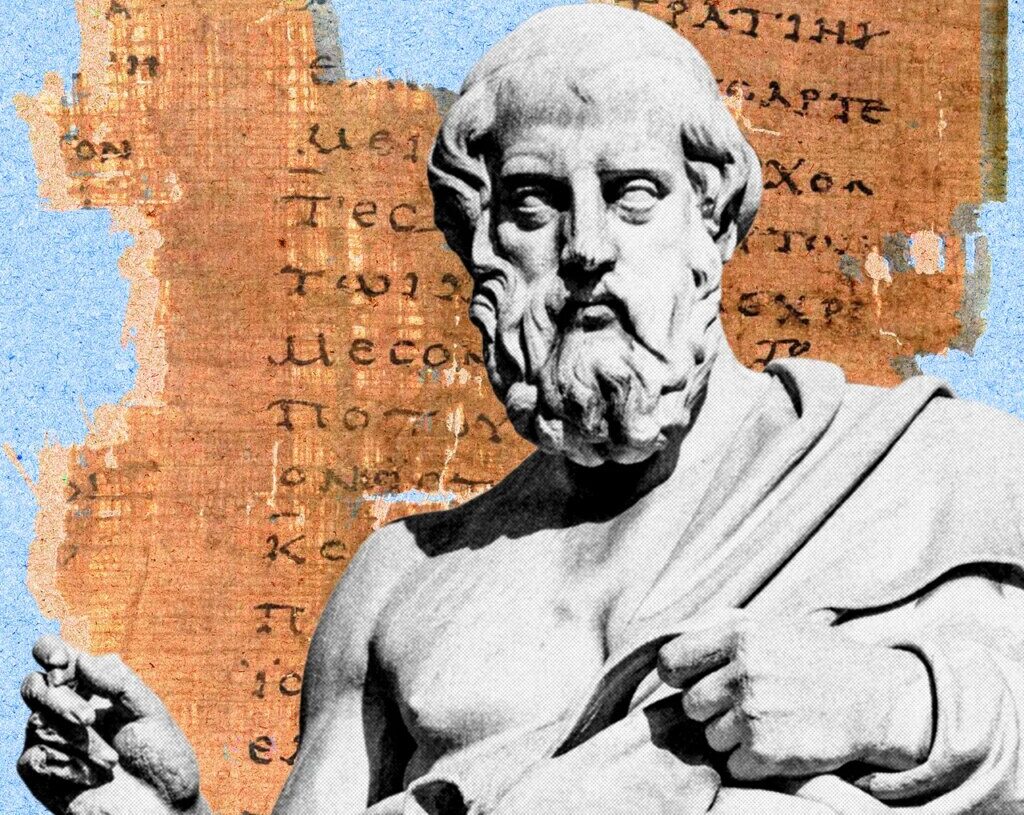
Academic libraries across the globe are stuffed with hundreds of thousands of Ancient Greek papyrus fragments. Though many are so damaged that their meaning is probably lost, scholars have the ability to restore the rest by methodically filling in missing words or phrases. To accelerate that laborious task, researchers have turned to artificial intelligence.
On Wednesday, the Austrian Academy of Science will release “the world’s first advanced large language model for Ancient Greek,” developed in partnership with French AI lab Mistral and technology services firm Sail Reply. The model, Apollo, is trained on roughly 600 million historical Greek words drawn from manuscripts, papyri, and inscriptions.
The model will be freely available to academics through a chatbot interface. The ambition is to help scholars to more rapidly identify papyrus fragments relevant to their specific sub-disciplines, as well as promising new avenues of research. Where documents are tattered and torn, Apollo is built to fill in the blanks with the most statistically likely words or passages, potentially revealing hidden details about historical events and practices.
Dimitris Vlitas, partner at Sail Reply, tells WIRED that unlocking knowledge in this way “was unthinkable a year ago.”
Until now, restoring a tattered piece of papyrus has required a skilled academic to first identify the word divisions—there are no gaps in Ancient Greek writing—then accurately date the document, weigh the appropriate socio-political contexts, and consult reference materials to help choose suitable words to fill in the gaps. “There are very few people in the world who are that good at Greek history,” says Stephen Colvin, a professor of classics and historical linguistics at University College London.
But all of that specialized knowledge is baked into Apollo. “When it sees Homer, it supplements Homeric Greek. When it sees an inscription in Doric dialect, it uses Doric dialect,” says Anna Dolganov, a historian and papyrologist at the Austrian Academy of Science.
Academics who find themselves bogged down in painstaking reconstruction work expect Apollo to accelerate things, allowing them to focus on the implications of historical documents, rather than figuring out what they say.
“I think it’s very exciting,” says Armand D’Angour, a professor of classical languages and literature at the University of Oxford, home to the world’s largest ancient papyrus collection. “If I had a machine telling me, ‘Here are the three possible words that could fit into that gap,’ it would speed up matters considerably.”
Apollo is unlikely to change the broad-strokes understanding of the ancient world; many papyri are yet to be restored precisely because they are mundane—personal letters, marital contracts, civil service papers. “If you were a layperson, you might think suddenly we’ll get a few new plays by Sophocles, but that’s not going to happen,” Colvin says. However, the model could help to uncover new details about life in antiquity and substantiate existing scholarly assumptions. “Every time something is produced, it adds a tiny element of knowledge about the ancient world,” D’Angour says.
If Apollo is a success, says Vlitas, the same technique could be readily applied to other ancient languages—Latin or Egyptian, say—or any other academic discipline that would benefit from the distillation and indexing of a large corpus of material. AI has had notable success in some areas; OpenAI recently said its AI models solved a 200-year-old math problem, while Google DeepMind released a vast dataset that maps how genetic mutations affect molecular biology, which it compiled using AI.
One concern might be that relying on a language model—which deals in probabilities—to fill in gaps in ancient documents risks polluting the historical record with errors. But to head off that issue, Apollo is built to propose a selection of word options for a scholar to select between. “The crucial point is that human competence needs to remain,” says Dolganov. “If we become totally reliant on AI transcriptions and interpretations of historical material, that’s when the problems start.”
The post A New Chatbot Wants to Unlock the Secrets in Tattered Ancient Greek Records appeared first on Wired.