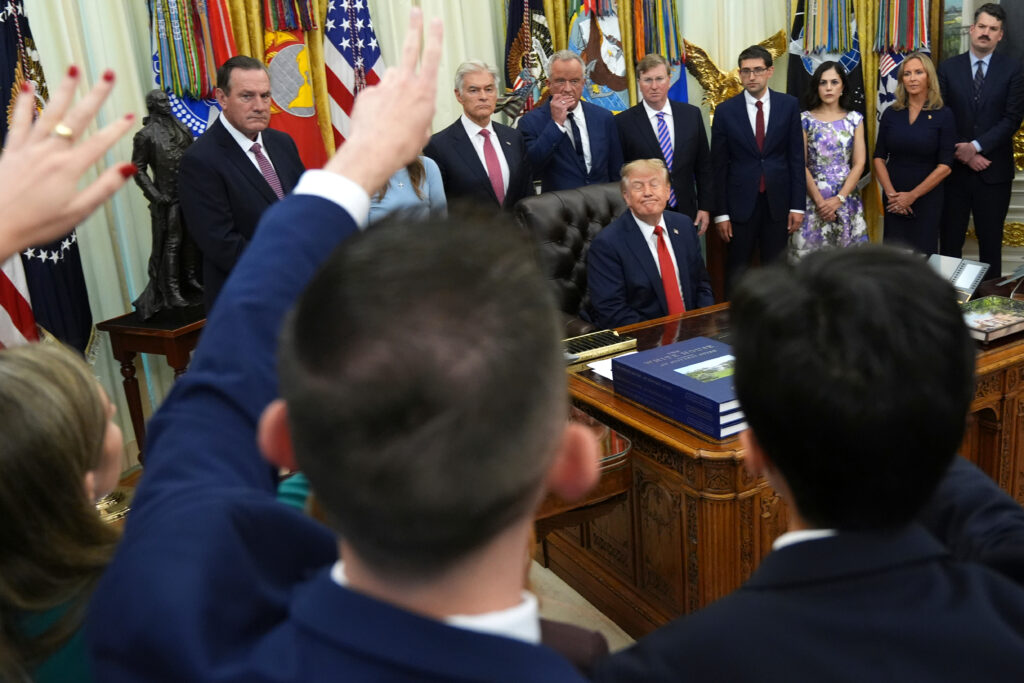
President Donald Trump’s decision to ban CNN, Politico and MS NOW journalists from the White House grounds has triggered a fresh wave of questions about whether he is violating the Constitution by freezing out certain media organizations.
The three media organizations collectively sued Trump and administration officials on Monday, adding to a long list of legal clashes between the White House and the media that has often ended in the journalists’ favor.
“Fundamentally, federal actions against reporting, like the ones that this White House has repeatedly made, are unlikely to get the benefit of the doubt from most judges,” said G.S. Hans, a clinical professor of law and a First Amendment expert at Cornell University.
This is not Trump’s first attempt to restrict press access. Media organizations have sued the second Trump administration multiple times over similar efforts at the White House and Pentagon.
U.S. courts have consistently ruled that denying or restricting a journalist’s entry to the White House on the basis of their reporting violates the First Amendment. Failure to provide a clearly stated justification for any denial risks violating the Fifth Amendment’s due process clause.
Legal experts said they are skeptical that Trump’s case will hold up.
“The White House will have to argue that it can deny access without notice, procedural protections, and based entirely on the content of coverage,” Jonathan Turley, a law professor and constitutional law scholar wrote Sunday. “In other words, it will have to argue that it can engage in viewpoint discrimination.”
Previous administrations have faced legal action after attempts to restrict reporters’ access — many of the cases have helped to establish the legal precedent CNN, Politico and MS NOW are citing in court.
Sherrill v. Knight (1977)
Robert Sherrill, a Washington correspondent for the Nation, wanted a press pass to access the White House grounds. He applied for one in 1966, during the presidency of Lyndon B. Johnson, and was turned away. When he asked the Secret Service why he was being denied access, he said they told him, “We can’t tell you the reasons.”
The Secret Service would later say in court that they determined he was a security risk, but they did not inform Sherrill of his denial or the reasons for it in writing.
After being turned away by two subsequent administrations, Sherrill was represented by the American Civil Liberties Union in a lawsuit against the Secret Service, and the D.C. Court of Appeals ruled in his favor.
The court found that denying a reporter access to the White House infringes on freedom of the press and if the White House denies access to a journalist, it must inform the person of the reason for the denial, give the applicant an opportunity to respond and provide a final written statement detailing the reasons access was denied.
The court also prohibited “content-based criteria for press pass issuance,” meaning access cannot be denied based on what a journalist reports.
CNN v. Trump (2018) and Karem v. Trump (2020)
During Trump’s first term, the White House banned then-CNN reporter Jim Acosta after a contentious exchange with Trump during a news conference.
The White House had no written code of conduct stipulating what could result in access being revoked and no review or appeal process for a denial.
Acosta was banned without notice, and the White House offered a shifting rationale as to why, attempting to use his conduct during the exchange as the basis for his revocation.
District Court Judge Tim Kelly, a Trump appointee, found that a lapse in due process, including the lack of written standards, the lack of notice to Acosta and the White House’s failure to inform him of its reasoning, made the decision unconstitutional.
The White House was ordered to temporarily restore Acosta’s press pass, and CNN dropped the lawsuit before a final verdict could be reached.
In 2019, the White House attempted to temporarily ban Brian Karem, then a reporter for Playboy, over a verbal altercation with former White House aide Sebastian Gorka. Citing due process issues similar to the ones in Acosta’s case, a D.C. appellate court ruled that because the White House did not have written rules about conduct that could result in a hard pass being revoked, the White House was violating Karem’s Fifth Amendment rights by restricting his access.
Ateba v. Jean-Pierre (2023) and Ateba v. Leavitt (2025)
Under President Joe Biden, White House press secretary Karine Jean-Pierre issued written rules about how a reporter could obtain a press pass and what kind of conduct could result in revocation of that pass.
The White House stipulated that any journalist who wanted to obtain a “hard pass,” a credential that allows reporters to enter the White House grounds at will without an escort, had to first be credentialed by the press galleries of the Supreme Court or the U.S. Capitol.
Simon Ateba, a Cameroonian journalist, sued the Biden White House after he lost access, claiming a First Amendment violation. A D.C. District court judge ruled in favor of the White House, finding that its denial of Ateba was fair.
In 2025 a D.C. appellate court affirmed the lower court’s ruling in the White House’s favor, again finding that the White House’s viewpoint-neutral denial of Ateba over his inability to meet vetting requirements was fair.
New York Times v. Department of Defense (2026)
Earlier this year, Secretary of Defense Pete Hegseth and the Trump administration lost a court battle over rules the Pentagon attempted to implement that multiple news organizations and free speech advocates said would limit journalists’ ability to cover the Department of Defense.
The rules announced last year would have given the Pentagon the ability to revoke press passes for any reporter that Defense officials deemed a security threat. A reporter possessing confidential or otherwise unauthorized information would have been grounds for the journalist’s press pass to be revoked.
“The ‘press’ does not run the Pentagon — the people do. The press is no longer allowed to roam the halls of a secure facility,“ Hegseth said at the time. “Wear a badge and follow the rules — or go home.”
Dozens of outlets refused to sign onto the new rules. The New York Times sued and was successful, and it sued the Defense Department again after the Pentagon issued new rules requiring all reporters to have official escorts during every visit. A judge issued a temporary ruling loosening the restrictions as the case works its way through court. On July 17, an appeals court ruled that the escort policy will remain on the books while the case is considered.
Associated Press v. Budowich (2025)
The Associated Press has refused to refer to the Gulf of Mexico as the “Gulf of America” after Trump said he was renaming it. In response, the White House banned the wire service from participating in media events in the Oval Office, flying on Air Force One and attending other White House events.
The AP has said the ban amounts to a violation of the news service’s constitutionally protected rights and sued the Trump administration.
The White House has argued in court that since the White House decides who is in the “pool,” the rotating group of journalists who attend media events and accompany the president while traveling, it can restrict an outlet’s access at its discretion, as it does with one-on-one interviews with Trump.
A district court ruled in favor of the AP, but that ruling is on hold while an appellate court considers the case.
Cable News Network Inc. v. Trump (2026)
In a lawsuit filed Monday, CNN, Politico and MS NOW argue the White House has violated their right to due process for Trump’s failure to link his decision to clear standards, and their First Amendment right, because Trump has linked the ban to the content of their coverage.
“The President has made no attempt to hide that his ban punishes protected speech, stating expressly that he decided to ban CNN, MS NOW, and POLITICO for their ‘cumulative’ coverage over the past two years of him and his administration — coverage that in his view is ‘fake,’ ‘sick,’ ‘purposely negative,’ ‘one-sided,’ and ‘never good,’” the companies wrote in the lawsuit.
Hans, the law professor, told The Washington Post on Monday that “courts tend to be skeptical when it appears that the government is making choices based on messages or perspectives they approve of or disapprove of.”
The post White House media bans have been tried before. They rarely hold up in court. appeared first on Washington Post.