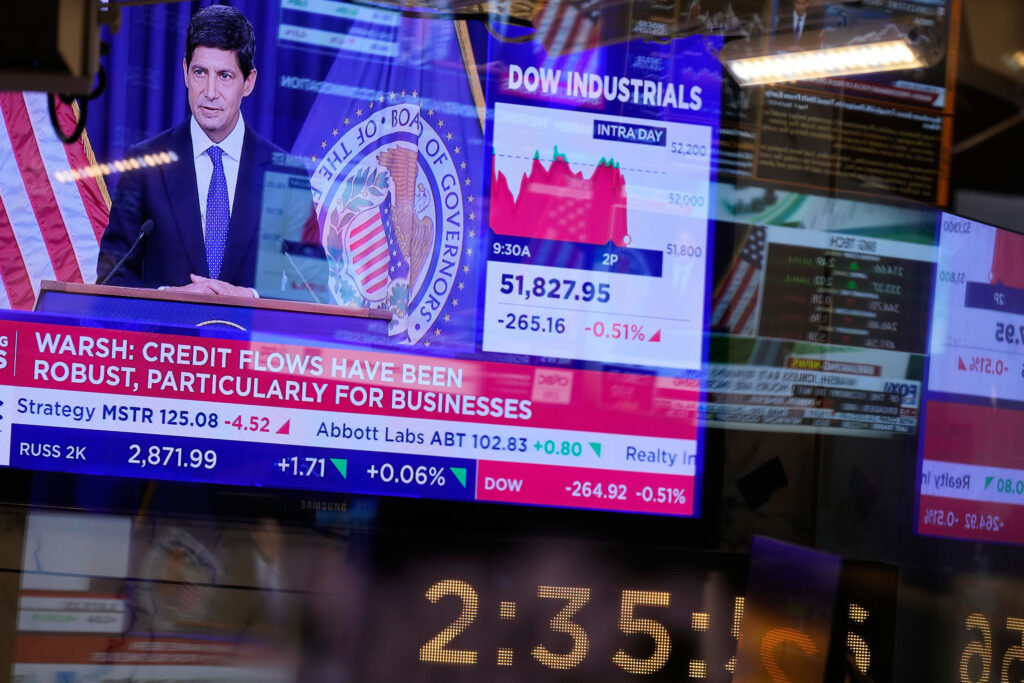
Kevin Warsh aspires to be a Federal Reserve chair of few words. He doesn’t think the central bank should provide as much “forward guidance” about the path of interest rates as it has in recent years. He believes Fed policymakers should give fewer speeches and possibly hold fewer meetings. He wants the institution to own fewer assets and to leave a lighter footprint on the economy.
There are good arguments for this humble approach, but that silence could have a cost: Markets won’t know what to expect from Warsh and his colleagues in the future, which might undermine the credibility of the policies they’re pursuing today. When the Fed raised interest rates on Wednesday for the first time in three years, the yield on Treasury bonds rose, too: a sign, as economic analyst Marcus Nunes wrote, that markets doubt the Fed’s commitment to keep rates high enough for long enough to bring inflation back down to its target of 2 percent a year.
Thinking bigger might help the Fed’s communications. Some economists have for years advocated that the Federal Reserve adopt a nominal spending target. Their main argument is that this approach would better stabilize the economy and also allow the central bank to convey what it needs without any hint of micromanagement.
Under the new target, the Fed would commit to keeping the economy growing at a steady rate, as measured by the number of dollars U.S. households and businesses spend and make in a year. This is different from trying to ensure that the amount of goods and services the country produces expands at the same rate each year. The Fed can’t control this “real” growth rate and shouldn’t try.
A reasonable goal would be 4 percent spending growth, which would permit inflation to fluctuate within confined bounds. In a year with strong output, real growth might make up 3 of that 4 percent and inflation the other 1. In a weaker year, real growth might run at 1 percent with inflation at 3.
This approach automatically handles unexpected economic jolts. If an oil shortage drove up gas prices, a central bank targeting inflation would usually feel pressure to raise interest rates, adding to the pain the economy is already enduring. Under a spending target, the Fed would stand back and let prices adjust without crushing total incomes.
Conversely, if an artificial-intelligence productivity boom drove prices down, the Fed wouldn’t make the boom bigger to hit an inflation target. It would keep spending steady in either case, which is what central bankers say they want when they speak about “looking through supply shocks.”
That is what the Fed implicitly did from 1990 to 2007, a time of relative macroeconomic stability. Subsequent departures from that practice have had unhappy consequences. In 2007 and 2008, the Fed paid too much attention to oil-price spikes and not enough to weak spending, delaying its response to what became a deep recession. A severe drop in spending growth made servicing debts and maintaining payrolls impossible. The Fed made the opposite mistake after the covid pandemic. It delayed reining in accelerating spending while it agonized about the extent to which supply shocks were raising prices.
The forward guidance that Warsh dislikes has asked Fed governors to predict both the course of the economy over coming quarters and how they would respond to it. They frequently erred, as anyone would have, which undermined the Fed’s credibility. A commitment to steady spending growth wouldn’t require such predictions.
Adopting a policy rule would allow the Fed to communicate more while saying less. It would keep reactions simple: The central bank would increase the money supply when spending is growing too slowly and cut back when it is growing too fast. A productivity boom, supply shortages, higher or lower tariffs, job growth faster or slower than expected, rising or falling stock prices: The Fed would stick with 4 percent spending growth no matter what.
Economists have proposed other possible rules, such as a version of a “Taylor rule” that attempts to set interest rates based on an equation involving the “neutral” interest rate and the gap between the economy’s actual and potential output. But nobody can observe those variables. A spending commitment requires much less speculation. The key data point — how much have people and businesses been spending? — is easier to gauge than the inflation rate, which requires a lot of debatable technical specifications.
A common objection to a total-spending target is that the public won’t understand it. But only a small portion of the population follows monetary policy, and, in any case, “We’re aiming to achieve steady income growth” isn’t that difficult to explain. The current policy sometimes makes people wonder why the Fed is deliberately seeking higher inflation.
Warsh has established several task forces to review what the Fed does. One will consider the central bank’s communications and another its framework for dealing with inflation. Their work can naturally dovetail: A better policy framework can be a better communications strategy. Make a lot of Fed commentary unnecessary and uninteresting for markets, and adopt a policy that speaks for itself.
The post How Warsh can be a Fed chair of few words appeared first on Washington Post.