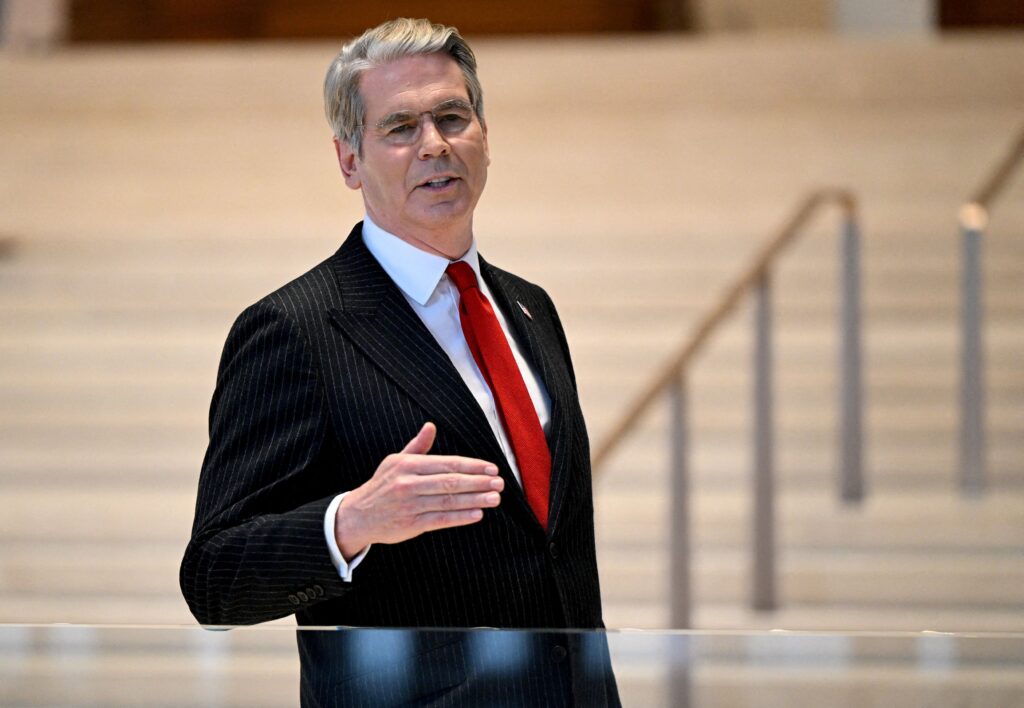
The United States and China are considering a “notification mechanism” to monitor national security incidents involving artificial intelligence, Treasury Secretary Scott Bessent said Sunday night.
Bessent and U.S. Trade Representative Jamieson Greer met on Sunday with Chinese Vice Premier He Lifeng in New York ahead of a summit between President Donald Trump and Chinese President Xi Jinping this week.
The two countries “want a shared vision of common goals and common threats,” Bessent told reporters following the meeting, which was held at the JP Morgan headquarters in Manhattan. “We think that, just like any cross-border activity, that moving from more opaque to more transparency between the number one and number two AI powers in the world is very important.”
The proposal reflects growing unease about potential security risks of the new technology.
Warnings from Anthropic researchers this month that “AI could kill all humans” within the decade ignited debate in Washington about the federal government’s role in creating guardrails for its development.
Leading AI companies such as Anthropic, OpenAI and Google have disclosed that their models have escaped restrictions and hacked into other companies during testing, raising concerns about models running out of control. (The Washington Post has a content partnership with OpenAI.)
President Donald Trump has resisted calls to slow down AI development, arguing that beating China at developing cutting-edge AI models is more important.
“We’re leading China in AI, we’re the most sophisticated country in the world, and frankly I want to keep it that way,” he said on the sidelines of the Irish Open golf tournament last week. “Whoever wins AI wins.”
The Chinese ambassador to the United States, Xie Feng, wrote on X that the two teams had “candid, in-depth and constructive” meetings, including on AI issues. His post did not say whether China supported the proposed notification system.
Greer said the United States and China had formalized a “board of trade,” discussed during meetings earlier this year, that would identify nonsensitive goods that could be traded at lower tariff rates.
He said the two sides are still discussing what those goods could be but suggested that consumer goods, low-tech items, energy and agricultural products and medical devices might qualify.
“There is a world where you have a relatively small subset of American and Chinese goods that can be traded in a balanced way that are nonsensitive,” he said.
Computer chip export controls were not discussed, Greer added.
The post U.S. proposes AI incident alert system in talks with China appeared first on Washington Post.