Michael Auslin is a historian at the Hoover Institution and the author of “National Treasure: How the Declaration of Independence Made America.”
The nation’s 250th birthday has come and gone, but the battle over American history continues unabated. Fortunately for those who are tired of the political fireworks and simply want to enjoy outstanding presentations on the Declaration of Independence and the uniqueness of the American experiment, several current exhibitions offer precisely that.
Two in Washington, D.C., running through July 2027, offer an unvarnished — and unbiased — look at our past and present.
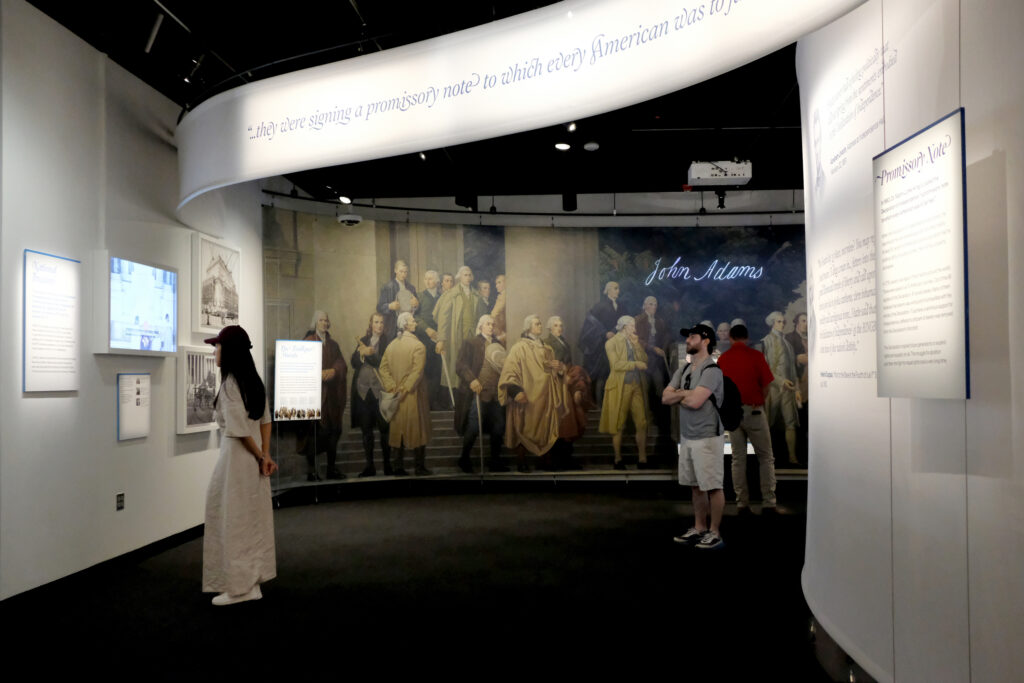
At the National Archives, where the official parchment Declaration has been kept since 1952, “Free and Independent” examines the origins and afterlife of the founding document, beginning with the roots of rebellion in the 18th century and moving through celebrations of the document and the country during both the centennial and the bicentennial.
Put together by the National Archives Foundation, the exhibition presents rare artifacts from the vaults. These include the very piece of paper on which Richard Henry Lee of Virginia wrote out his resolution for independence, introduced to the Second Continental Congress on June 7, 1776. Also included is the Continental Congress’s copy of the Dunlap Broadside — the first printed version of the Declaration, produced on the night of July 4 by congressional printer John Dunlap — which was inserted into Congress’s handwritten journal.
Biographies of the signers and other Founding Fathers displayed along the walls reintroduce these patriots to a new generation, while a presentation on Frederick Douglass, Abigail Adams and other Black and female Americans of the day is a reminder that the promises of the Declaration took generations to be fulfilled.
Particularly innovative is the second half of the exhibition: an upbeat look at how Americans celebrated independence and the Declaration in the 19th and 20th centuries. It includes magazine covers, posters, comic books, knitted items, hats and other ephemera. Using original artifacts, “the exhibit highlights the astonishing bravery of our revolutionary founders, who put their lives on the line to create a new nation,” the new archivist of the United States, Bradford Wilson, wrote to me in an email.
Meanwhile, on the other side of the U.S. Capitol, the Library of Congress is hosting “The Declaration’s Promise” with its own set of treasures. Ranging from the English Enlightenment through the 20th century, the exhibition takes a sweeping look at American aspirations and achievements. From a first edition of John Locke’s “Two Treatises of Government” to an original print of Paul Revere’s engraving of the Boston Massacre, and from the “Nicolay copy” of the Gettysburg Address in Abraham Lincoln’s hand to a first edition of Walt Whitman’s “Leaves of Grass,” the collection explores themes of integration, assimilation and striving. The weightier items are leavened by the inclusion of comic books, political cartoons, posters, video clips from such cultural icons as “Schoolhouse Rock and items as interesting as the late Chief Justice Earl Warren’s reading copy of the Brown v. Board of Education opinion.
But perhaps the real draw of the exhibition is Jefferson’s handwritten, hand-edited rough draft of the Declaration, which has not been on public display for more than a quarter-century. The Library of Congress was the home of the original Declaration and Constitution from 1921 to 1952, and it was at the library that the Declaration was first enshrined, drawing a million visitors a year. Yet it is Jefferson’s fascinating draft, noting edits by Benjamin Franklin and John Adams, that remains the library’s greatest gem. Covering two double-sided leaves, the draft is being exhibited one page at a time, each for three months. Seeing Jefferson’s draft is truly a rare opportunity, not to be missed.
In an era of acute political partisanship and social media outrage, both the National Archives and the Library of Congress are to be congratulated for mounting such comprehensive and objective exhibitions, eschewing editorializing in favor of enthralling displays that serve to deepen Americans’ appreciation for the nation’s past in all its inspiring, messy and sometimes tragic glory.
Meanwhile, for those who happen to be in Philadelphia before January, a bonus exhibition awaits. “These Truths,” at the American Philosophical Society, presents a fascinating array of Declaration prints through the first half-century of American history. Curator David Gary has put together a stellar sampling from the society’s archives, including one of the very rare drafts that Jefferson hand-copied to send to political associates and all the important facsimiles, in addition to an original Dunlap Broadside.
Other objects include the almost-never-seen copperplate painstakingly engraved by publisher John Binns for his famous 1819 reproduction of the Declaration, a first printing of Thomas Paine’s “Common Sense” from 1776 and the chair Jefferson sat in while writing the Declaration just a few blocks from the society’s headquarters.
Taken together, these three exhibitions — all with free admission — are by far the best to be seen this year on the Declaration of Independence and its enduring influence. Acknowledging both the achievements and the complexity of our past, they wisely avoid “problematizing” the Declaration, not to mention the rest of American history. They acknowledge division and conflict, but ultimately, and appropriately, stress unity and accomplishment. And while they nod to the international influence of the Declaration and the Revolution, they properly put the focus where it belongs — on the United States and its people.
After all the noise of the 250th birthday festivities, perhaps the best way to celebrate America’s semiquincentennial is in quiet contemplation, at these excellent exhibitions, of how we became the people we are — and of the document that started it all.
The post For the 250th, quiet contemplation of the document that started it all appeared first on Washington Post.