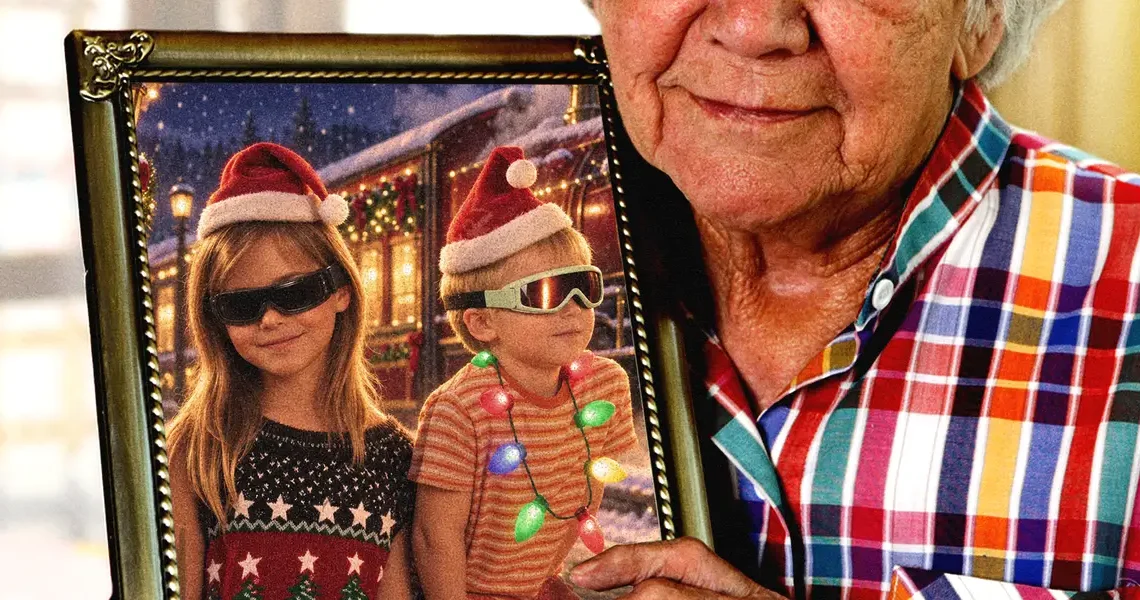
When Ben Metcalfe recently visited his grandparents, he was greeted by an AI-generated caricature of one of their family photos hanging on the kitchen wall. “I understand that there was good intention behind doing it,” says Metcalfe, a Gen Zer who works in AI governance. “At the same time, it’s a major privacy concern.”
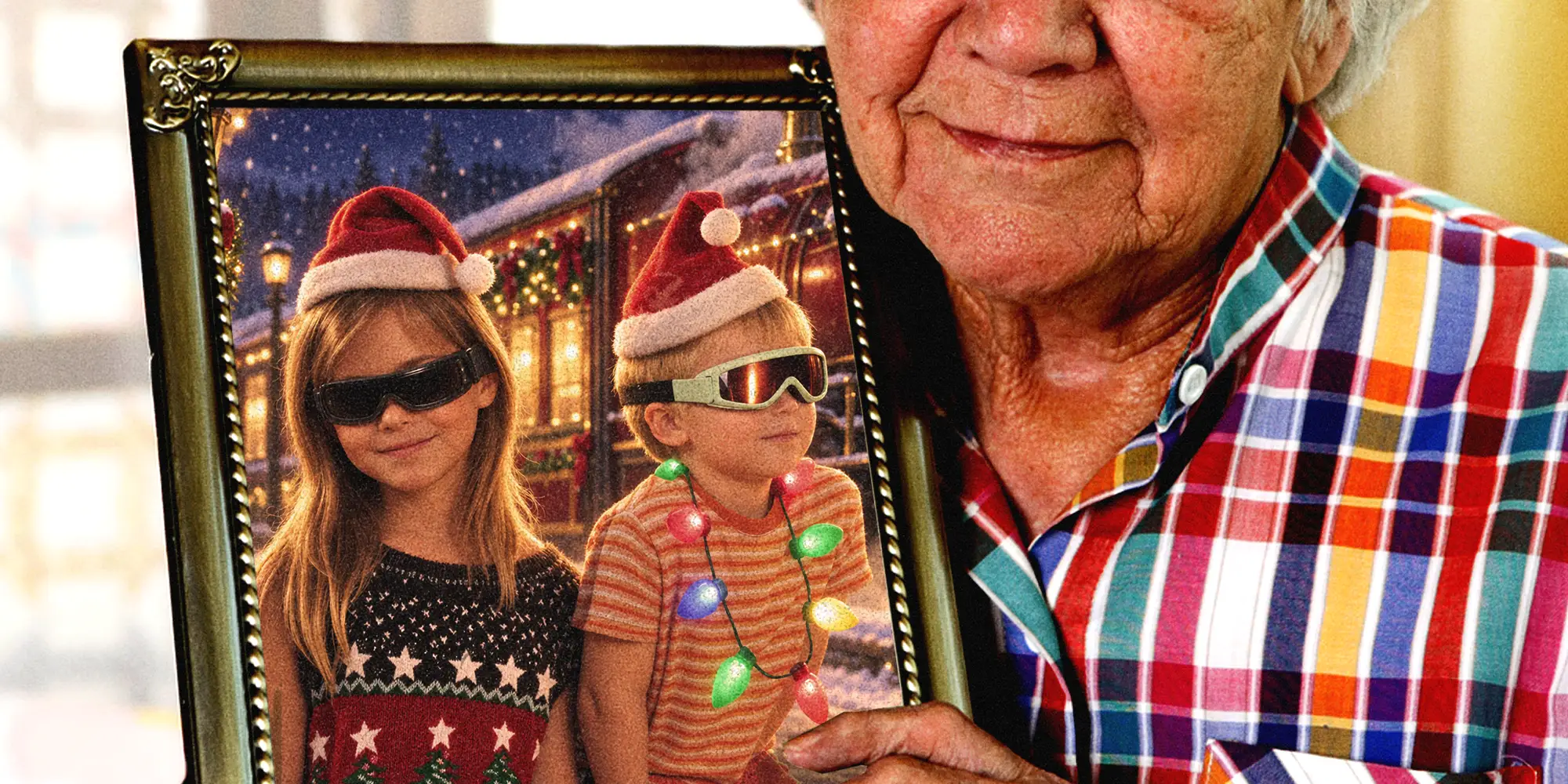
Jen, a 32-year-old mom, tells me that last Christmas her mom texted her a series of adorable images: Jen’s two toddlers sitting in Santa’s lap, then riding the Polar Express. Their cheeks were fuller than she knew them to be, their eyes glossier, the lighting pristine — all thanks to Grok, xAI’s chatbot. “It’s so cute. And I want to love it,” she tells me. But it was too unsettling to embrace.
Jen, whose name has been changed to avoid sparking more family drama, says she’s read news about Grok generating sexual abuse material, and worries about how the bot could use her children’s faces in the future.
It’s not just her mom. For Mother’s Day, a friend sent her a coloring sheet with her kids’ faces, and her brother-in-law used AI to add one of her kids to a family photo who had been covered by a stroller, napping, when it was taken, she says. Everyone means well, Jen says, but they’re walking blindly into a big risk, and the technology is so new, she isn’t even sure what boundaries are best to set around how loved ones use her children’s images with AI. “We all aren’t educated enough about what AI companies are doing with our content,” she says.
Welcome to the intergenerational slop fight.
In one corner are growing ranks of lawmakers calling for kids to be booted from social media, and parents concerned about data privacy opting to share less with AI companies and social media platforms. Europe is considering regulations that would limit chatbot and AI companion access to those younger than 15.
In the other corner are parents, grandparents, aunts, uncles, and friends who are uploading millions of images of kids into AI generators, delighting at the uncanny output, and sharing them far and wide. They use AI to make custom gags, generating portraits of the family, sending eCards and making toys, T-shirts, tchotchkes, and children’s books through websites that encourage and profit from this very oversharing, making personalization a selling point. To some, it’s endearing; to others, a privacy nightmare that may come with just a quick laugh, but long-term implications that aren’t fully realized.
The more people see photos like this on social media, the more it’s normalized, says Metcalfe. “It’s this effect of, well if they’re doing it, then we can do it as well, and then it becomes a chain reaction of everyone else is kind of doing it.”
We’re losing the tenuous grasp over our own images. And for some, their families are the first ones to give that control away.
The sites once exclusive to college-enrolled Millennials have become family trees. Six generations cram onto social media now, from the Silent Generation (not so silent on Facebook) to Gen Alpha. Different generations have varying consensus about what the point of social platforms even is anymore: Is AI-generated imagery the playground of the future, is it cringe, or can it lead images to be used for something far more nefarious?
Some parents of young children have pushed back against family members posting their kids for years. AI has raised the stakes, as social media sites have come under fire for misuse of young people’s images in AI generators. xAI faces a lawsuit brought by a woman who is a child sexual abuse survivor and alleges Grok created new deepfake exploitive images of her after real images of her abuse were uploaded. xAI did not respond to a request for comment, but Elon Musk has called the exploitation of children on X “priority #1” when he bought the platform in 2022, and xAI has sued users who are facing criminal charges for allegedly using Grok to create explicit images of children. X told The New York Times this month that it blocks users who post or engage with such material, and reports them to authorities, and that it uses automated filters to block exploitative material from being uploaded. Posting photos to social media sites has become riskier, as platforms roll out new AI tools. Meta faced fierce backlash this summer when it launched out a Muse Image tool, allowing users to generate images based on other publicly posted photos. The company shut it down in less than a week.
The differences in how generations perceive social media stems from their own relationship to privacy and context collapse, rather than their technical ability, says Paromita Pain, a professor of global media at the University of Nevada, Reno. Posting a photo to show your friends your new grandson or niece can lead to unintended consequences that are hard to conceptualize when presented with the ease of social media photo sharing. As Baby Boomers grew up, there was less emphasis on privacy because, aside from a few celebrities and politicians, privacy was the default.
Millennials saw the switch from an anonymous internet with AOL chatrooms to the very on-the-record days of Facebook, Instagram, and LinkedIn. They and now Gen Z have grown to see the evolution of cancel culture. Those experiences that influence how Millennials and Zoomers want to use the internet can confound their Boomer parents.
And despite risks, posting may have some real benefits for older users that keep calling them back to post. Research published by Pennsylvania State University in 2021 found that older adults who posted more photos to Facebook described feeling more competent, and that led to a higher sense of wellbeing. Commenting and receiving comments created a feeling of connection. When it comes to AI, Boomers have been slower to adopt it than younger generations — about a fifth said they have ever used a standalone AI tool, compared to 76% of Gen Z who used AI in 2025, according to a report from Deloitte. They’re more likely to use them for entertainment purposes (possibly skewed by a significant portion of the demographic being out of the workforce).
Welcome to the intergenerational slop fight.
Some parents have tried to set boundaries to no avail. Leah, a Millennial who had her first baby a year ago, doesn’t feel tied to the pics-or-it-didn’t-happen ethos of social posting. Her daughter is the first grandkid in the family, and Leah, whose name has been changed so she can talk freely without creating more problems with her mom, doesn’t want her baby’s image online. Her mom is a Baby Boomer, and regularly complains about the social media ban on pictures of her granddaughter. Leah says she’s tried to explain her safety and privacy concerns, and told her mom that images online can be used to create deepfake child exploitation material. Her mom, she says, seems to see her arguments as the worst case scenario: that Leah is coming up with monstrous examples of things sick people could do — and her Facebook friends aren’t among them.
“We’re on totally different pages,” Leah says. “I haven’t figured out a way to bridge the gap. It’s almost like neither of us have a place where we can compromise.” Leah says she tried the closest trade-off she could offer: allowing her mom to post pre-approved photos where her baby isn’t the focal point (like a large photo of the whole family, ones where her daughter’s face isn’t visible). But Leah’s mom has already broken her rules twice. She thinks she’s just sharing the photos with her friends, but Leah argues that can be done over text. “We don’t need to share it with Mark Zuckerberg,” Leah says. “He’s not our friend.”
On TikTok and Reddit, young people reveal the AI-generated family-made photos that make them recoil. There are flawless photos edited for graduation posters, renderings showing how potential grandchildren could look, and absurdist videos generated as birthday eCards. They ask advice for how to talk to family members about the possible consequences of making all this slop, attempting to set new social norms for a technology that is rapidly becoming commonplace.
A TikTok trend is what caught Brandon, a 22-year-old who asked I not use his full name, looking at an image of himself in an ’80s themed outfit his mom had generated with AI. She was laughing hysterically; he was immediately uncomfortable. “In her mind, it was a way to have entertainment, to do something fun,” Brandon says, noting that he rarely uses AI, never inputs personal information, and doesn’t upload photos of himself or others to social media.
“I decided to tell her that I was uncomfortable with my image being shared without my consent,” he says. “You just don’t know what that data is being used for.” And for now, there’s no taking those images back, or for someone like Brandon to know how they’re being used in an open source AI model. “I would hope that there’s a way in the future to legally fight that and permanently remove your biometric data.”
Clawing back your image once it’s online is nearly impossible. It’s getting harder in an era where smartphones, camera-equipped smart glasses, and surveillance tech capture so many moments to maintain control over your image. When every fleeting family portrait, custom children’s book about princesses, or moments on the Polar Express might have ties than they seem, there may be more reason for everyone to take pause.
Read the original article on Business Insider
The post Grandma slop is tearing families apart appeared first on Business Insider.