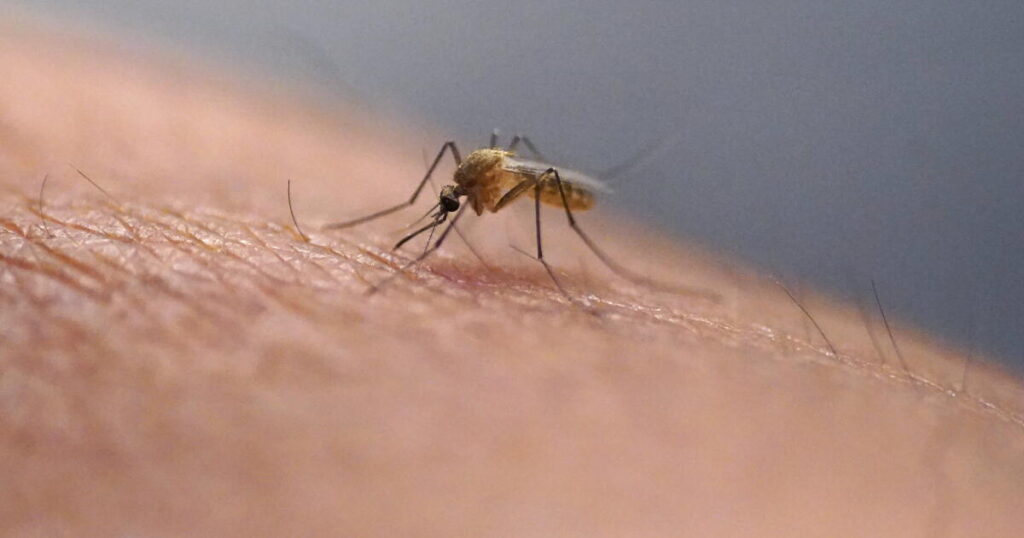
Two weeks ago, after a hot and humid summer of mosquito-induced hell, I decided I would spend whatever amount it took to get rid of the rapacious little creatures.
Which is how I found myself in the bug aisle of Home Depot, staring at a wide array of products under a banner that read “Mosquitoes.”
By the time I had finished loading up my cart, I had about $300 worth of chemical repellents for my skin, citronella candles, mosquito coils, a lantern-size ultraviolet zapper, a tennis-racket size ultraviolet zapper, two rechargeable Thermacell anti-mosquito misters and one butane-powered Thermacell mosquito banisher.
Overkill? I think not!
As I type this in my (unairconditioned) dining room, next to an open sliding glass door, I am running an electric fan pointing directly at my ankles in order to discourage the mosquitoes known as “ankle-biters” from attacking my bare legs.
It didn’t used to be like this. Twenty or so years ago, our local mosquitoes were pretty mellow. But new, invasive species have exploded across Southern California in the last decade, making life hell for those of us who want nothing more than to sit on our decks in the shade enjoying our enviable weather.
No time of day is safe.
The tiny ankle biters are diurnal, which means they are active during the day — usually at dawn and dusk, said Karthikeyan Chandrasegaran, a UC Irvine ecologist who studies the bloodthirsty little beasts. The mosquitoes that carry West Nile virus and malaria, by contrast, are nocturnal. And they are wily.
“If you swat at a mosquito and miss it, they are likely to understand something about it,” Chandrasegaran told me. “The next time they are going to try to bite you, they’re probably going to attack you in a different region. And they modify their flight trajectory depending on where they expect the swat to come from.”
The biological response to a bite is well understood: When a female mosquito sticks her proboscis into, say, my ankle in search of tasty blood to nourish her eggs, her saliva unleashes an anti-coagulant that makes it easier to drain me.
My body perceives her saliva as a foreign object and releases a counter-measure in the form of histamines, which send a signal to my brain that I am under attack, which my brain then interprets as an intense almost full-body itch, and screams that only an insane amount of scratching will help.
And so I scratch and scratch against my ever-thinning, soon-to-be-bloody skin. I slather the bites with hydrocortisone cream. I rub on lidocaine. And I continue to itch and scratch until I slap on an ice pack to freeze my discomfort away. I have literally walked around my house this summer with baggies full of ice cubes taped to my legs, ankles and arms. I look ridiculous.
While I am worried about my comfort, I should probably be even more worried about contracting a deadly disease. Mosquitoes can carry malaria, yellow fever, dengue, Zika, chikungunya and, of greatest concern in these parts, West Nile virus.
“This year has been really bad in Southern California,” Chandrasegaran said. So far, Los Angeles County public health officials have documented at least 100 cases of West Nile virus and five deaths linked to mosquitoes.
Worry all you like about lions, tigers and bears — and maybe charging hippopotamuses — but the mosquito is in fact humankind’s apex predator, responsible for hundreds of millions of infections globally, and about a million human deaths a year.
“The mosquito has killed more people than any other cause of death in human history,” writes historian Timothy Winegard in “The Mosquito,” his sprawling 2020 book. “The mosquito remains the destroyer of worlds, and the preeminent and globally distinguished killer of mankind.”
Winegard implicates mosquitoes in the extinction of the dinosaurs, weakened by the pests before the meteor hit. Mosquitoes may have been a factor in the deaths of King Tut, Alexander the Great and Genghis Khan.
Around the world and across the centuries, untold numbers of soldiers have fallen to mosquitoes, which have repeatedly altered the course of major military campaigns, including the siege of Yorktown during the American Revolutionary War and the Haitian Revolution, which overthrew French colonial rule and indirectly led to Napoleon selling the Louisiana Territory to the United States. (Haitians had some resistance to the yellow fever-carrying mosquito; French soldiers did not.)
Rome’s mosquito-infested Pontine marshes — drained eventually by Benito Mussolini — played an outsized role in the history of the eternal city, forming a deadly natural barrier against invading hordes over the centuries.
Mosquitoes, unsurprisingly, played a part in the transatlantic slave trade. Malaria was so prevalent in prehistoric Africa that people evolved sickle-shaped red blood cells as a genetic shield against malaria. Sadly, the ability to survive malaria made Africans more appealing and valuable to enslavers.
In 2010, Janet Fang, a young intern at the science journal Nature decided to investigate what a world without mosquitoes would look like. The scientific consensus was that the abrupt extinction of mosquitoes would save so many human lives that it would outweigh whatever ecological damage their absence would create. Scientists speculated that mosquito-eating fish and birds would simply switch to other forms of protein.
“Life would continue as before,” Fang wrote,“or even better.”
Not everyone applauded the idea.
“People were mad,” Fang told me Thursday from Silver Lake, where she and her toddler have been plagued all summer by mosquitoes. West Nile virus was recently discovered in one of the reservoirs near her home.
“I never once super said, ‘Let’s kill all the mosquitoes.’ I thought it was clear that it was a thought experiment,” Fang told me. “But I was villainized.”
Personally, I think she deserved a Pulitzer Prize.
Bluesky: @rabcarian Threads: @rabcarian
The post Mosquitoes are making Los Angeles summers a living hell appeared first on Los Angeles Times.