President Donald Trump’s ambassador to the United Nations said Sunday he would not put a timeline on the end of the Iran war, which has dragged on for nearly seven months despite Trump’s initial insistence that it would be over within four or five weeks.
“I think time — with the president’s strategy and Operation Economic Fury — is on the president’s and on the United States’ side,” Mike Waltz told CNN’s “State of the Union” on Sunday.
Waltz said the U.S. naval blockade was having the intended effect of ratcheting up the pressure on Iran’s economy.
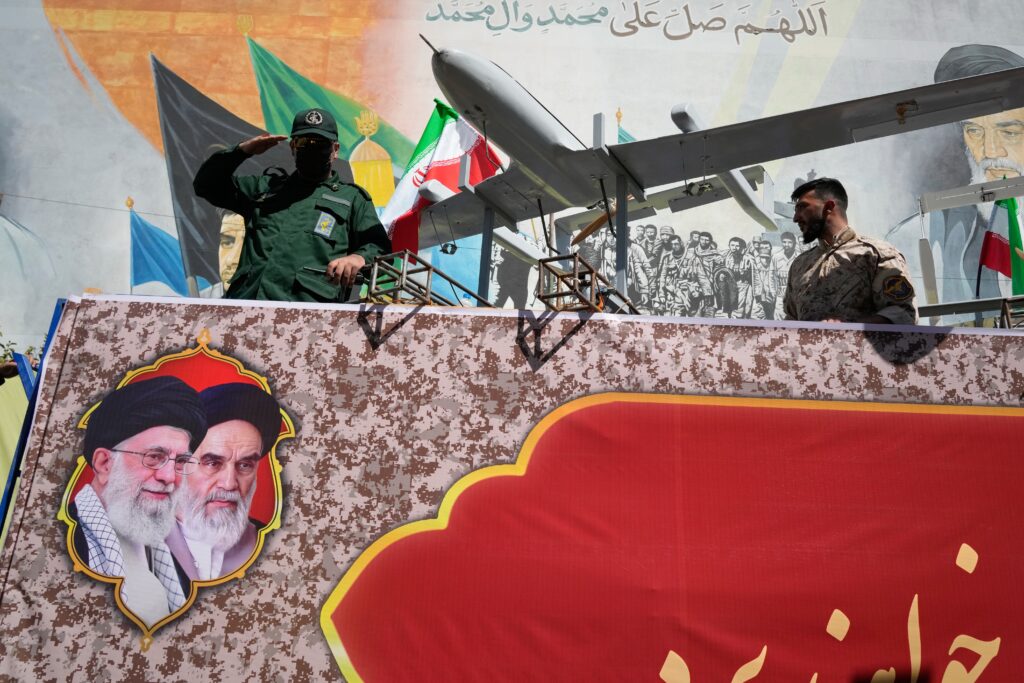
But Iranian officials said this weekend they have no intention of backing down, adding that, to end the war, Washington must agree to its demands, including releasing frozen Iranian assets and lifting the blockade on Iranian shipments.
On CNN, news anchor Dana Bash pressed Waltz on a Sept. 9 report in the Wall Street Journal that top White House advisers privately raised with Trump the prospect that the war could continuethrough the rest of his term, which ends in January 2029.
Waltz responded, “I wouldn’t necessarily put a timeline on it.”
His comments came as Iran-aligned Houthi militants escalated their attacks in the region with strikes Saturday on Saudi Arabia’s capital, Riyadh. Yemen’s Houthi forces claimed that they hit “sensitive sites,” as a plume of black smoke was seen coming from near Riyadh’s international airport.
The Saudi military later confirmed the attacks but said its forces had intercepted a ballistic missile launched by the Houthis toward Riyadh.
The U.S. State Department issued a security alert for Saudi Arabia on Sunday, saying U.S. government employees in the country require special authorization to travel to the Saudi cities of Taif and Yanbu, which the Houthis have targeted in recent days.
The Houthis have ramped up a ground offensive along the Red Sea coast this month, capturing key territory surrounding the Bab al-Mandab Strait, a transit point for shipments of cars, oil and other commercial goods.
The Houthis’ aggression on the Red Sea coastline has added to concerns about rising disruptions to the global economy and spiraling energy costs.
On the other side of the Arabian Peninsula, the Strait of Hormuz — a vital waterway for shipments of oil and gas — has been at the center of a bitter standoff between Iran and the United States.
Ahead of the Nov. 3 U.S. midterm elections, anger over rising inflation and the unpopularity of the Iran war have dragged down Trump’s poll numbers, creating a grim landscape for his Republican allies as they struggle to hold onto control of Congress.
When Trump launched the war on Iran alongside Israel in February, he predicted a quick end to the fighting, saying it would be over in four or five weeks. More recently, he has suggested that Iran was seeking to assert leverage over the United States ahead of the midterms but that the war could end soon afterward.
“That war is going to end very soon. Watch, you just watch. Trump was right about everything, you watch,” Trump said at a rally in North Carolina last week.
“They want to make a deal so badly,” Trump said of Iran.
Khatam al-Anbiya Central Headquarters, the command center of Iran’s armed forces, said that if the U.S. “makes any mistake against” Iran, then Tehran will retaliate with “painful attacks,” the semiofficial Tasnim News Agency reported.
Iranian Supreme National Security Council Secretary Mohsen Rezaei wroteSaturday on X that if the United States wants to “extricate itself from the predicament it has created,” it must agree to Tehran’s conditions.
The post Trump’s ambassador to U.N. says there’s no timeline on Iran war’s end appeared first on Washington Post.