For years now, scientists have been puzzled by the existence of “little red dots” first showing up in observations by NASA’s James Webb Space Telescope. These objects appeared in a region they believe dates to just hundreds of millions of years after the Big Bang, one of the oldest known neighborhoods of the universe.
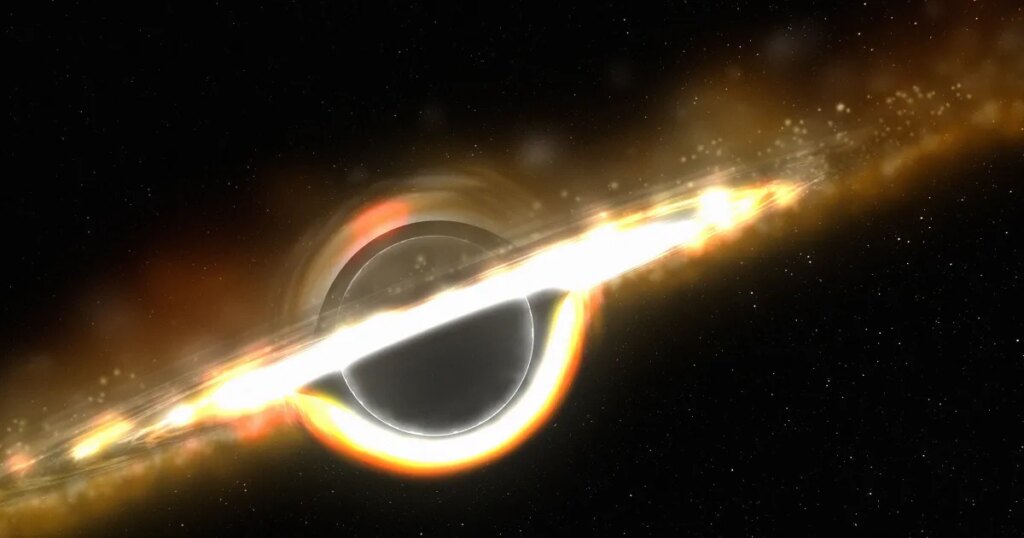
Several possible explanations have since emerged, with some arguing they could be emerging galaxies. Others suggested that the red dots could be the earliest stages of supermassive black holes, which are enormous cosmic objects that have gravitationally collapsed and are often lurking at the center of galaxies.
In a new paper published in the journal Nature this week, Max Planck Institute astrophysicist Sunmyon Chon and his colleagues delve into this possibility by simulating the earliest stages of the universe. They found that the rapidly-forming black holes could be emitting light while accreting material, appearing as the mysterious red dots, or “seeds,” picked up by the James Webb.
Despite lurking pretty much everywhere we look in our known universe, the nature of black holes remains mysterious. Scientists are still actively exploring new types of them, leaving the possibility that the red dots could be a kind we have yet to characterize.
Chon and his colleagues propose that the newly-formed “overmassive” black holes “rapidly develop dense, optically thick disks whose strong electron scattering produces broad [hydrogen-alpha] emission comparable to that seen in little red dots.”
Hydrogen-alpha is a specific visible spectral line in astronomical observations that focuses on a specific deep-red part of the spectrum.
Chon’s team suggests that these black holes evolve into “overmassive” quasars — extremely bright celestial objects that are powered by gas being absorbed by a supermassive black hole — that were detected by the James Webb.
The scientists posit they could be the “progenitors of today’s supermassive black holes,” in an evolutionary process they suggest could take less than a billion years.
“At 500,000 years, it looks like a little red dot, but after maybe one million years or so, the surrounding gas is mostly accreted into the black hole,” Chon told the New York Times.
While the broader scientific community has yet to come to a consensus, some aren’t convinced. For instance, University of Cambridge astrophysicist Roberto Maiolino told the NYT that he prefers a more familiar explanation. He suggests the red dots are simply part of the evolution of a regular black holes.
And Chon remains very open-minded about the viability of his theory.
“We don’t want to claim that all the little red dots come from what we’ve modeled,” he told the newspaper. “So many new kinds of findings are coming out and it’s good news for new simulations.”
More on black holes: Astronomers Discover an Entirely New Type of Object: a “Black Hole Star”
The post Strange Seeds Appear to Be Growing Into Massive Black Holes appeared first on Futurism.