Just over three years ago in Guatemala, a coalition of young and Indigenous voters helped propel Bernardo Arévalo, a reformer who campaigned against corruption, to an astounding presidential win. Guatemala had not only refused the global trend toward populist authoritarianism; it had also defied what its citizens called “the pact of the corrupt,” a loose alliance of politicians, judges, criminal networks, and crony capitalists that had gained control of the country’s institutions.
Today the mood in Guatemala is less hopeful. Some of Arévalo’s former allies, and many of those who voted for him, are dejected, convinced that the president missed a once-in-a-generation opportunity to transform the country. When I met with Arévalo in Guatemala City in May, he defended the pace of his administration’s progress and suggested that the alternative would have been to abuse the powers of a government he was elected to reform.
In Latin America, “we never truly got used to understanding that the rule of law is fundamental,” he told me. “Rule of law is not the same as rule by law. Rule of law is when we all accept that we are subject to the law and we operate within that framework to solve problems. Rule by law is when I use the law that’s at my disposal as part of my political arsenal.”
Had he crossed that line, Arévalo insisted, he would have risked being ousted by his opponents and replaced by someone willing to do much worse. His critics disagree.
Arévalo’s personal integrity is undisputed. But some of the reformers who helped elect him now argue that he may be too scrupulously rules-respecting to deal effectively with the “pact of the corrupt” and the institutions it captured—too much of a liberal democrat to save democracy. When he leaves office in 2028, they fear that the pact will quickly retake control of the few institutions it has lost, or that voters will choose an autocrat who promises to crush crime without concern for legality.
Guatemala’s predicament points to a more universal problem. Can liberal reformers unwind authoritarian state capture without, themselves, engaging in at least a little bit of illiberalism? The dilemma is not Guatemala’s alone. Move too aggressively, and you risk being branded an autocrat, or even becoming one. Move too cautiously, and you risk obstruction, sabotage, and ineffectuality. South Africa’s Cyril Ramaphosa chose a gradualist approach to reversing Jacob Zuma’s state capture and disappointed many of his supporters. Placing the opposite bet, Poland’s Donald Tusk bent rules to try to undo the damage done by the right-populist Law and Justice party—and stood accused of undermining the rule of law. Hungary’s post-Orbán leader, Péter Magyar, seems to be following Tusk’s example.
[Read: How to defeat a mafia state]
In a way, both Arévalo and his critics are right. Guatemala has avoided a democratic breakdown. But the president’s rules-bound approach has also left many Guatemalans feeling that he has not fought for them forcefully enough. The question now is whether Arévalo has preserved democracy as an ideal that Guatemalans believe in and, if necessary, will defend.
In Guatemala City, I watched as hundreds of people gathered outside the country’s public prosecutor’s office, a bunker-like building ringed by a huge black-steel fence put up three years before, allegedly to shield the occupants from nonviolent democracy protesters. The crowd had come to celebrate the long-awaited end to the term of María Consuelo Porras, the country’s attorney general and, to many citizens, the personification of the pact of the corrupt.
For the past eight years, Porras had been a figure of fear. She used the power of her position to investigate and jail critics of state corruption. When Arévalo was elected in 2023, her office tried to overturn the results, alleging irregularities that international observers found baseless. That effort looked likely to succeed—until indigenous Maya communities organized peaceful demonstrations that lasted 106 days and drew the participation of nearly 2 million Guatemalans. Arévalo was inaugurated.
That he did not take extralegal action to remove Porras from her post has given rise to some of the fiercest criticism against him. She opened an investigation into Arévalo’s party, the Seed Movement, for relatively minor party-registration irregularities. Although the probe did not produce formal charges, it led to the party’s dissolution and thus thwarted any hope of its controlling Congress. Porras also brought more than 75 legal cases or complaints against the president and his supporters, including the arrests of two of the Indigenous leaders behind the 2023 protests, and even a cabinet minister. Now Porras was finally leaving, and a new attorney general was taking over.
The Guatemalans gathered outside the office had waited for this moment. What they had not anticipated was how long Porras’s departure would take, and how few people would come out to celebrate it. Thousands had massed in the same street just a few years before.
When I met Arévalo a few days later, he justified the delay by explaining that his government had arrived “with an enormous level of public legitimacy, but without control of the Congress, and with the justice system positioned against us.”
Legally, he had no authority to simply eject the attorney general. He sent a bill to Congress to grant him that power, but the opposition blocked it. “If, in that scenario, I make a political miscalculation, the result isn’t that I go with a hundred people to pull Consuelo Porras out of that building and that this is sustainable and produces results,” he said. It was that “I go to prison or into exile, and someone else comes in, one of them, to take power.”
Like much else in Guatemala, the colossal, mint-green presidential palace where Arévalo sat down with me is a holdover from a bygone era of authoritarianism. It was built by Guatemala’s Hitler-admiring, yet U.S.-backed dictator, Jorge Ubico, who rose to power in 1931 and was forced to resign amid mass protests in 1944.
Arévalo, before winning the presidency, was best known as the son of the man who succeeded Ubico, in Guatemala’s first truly free elections. Juan José Arévalo, an educator and a social democrat, returned to Guatemala from exile in 1944 to run for president against the ex-dictator’s favored candidate. As his son would later, he won by a landslide, and Guatemala’s “democratic spring” began, a time of expanded rights and education. But after his freely and fairly elected successor, Jacobo Arbenz, went further, carrying out a land reform that threatened the interests of wealthy families and the powerful U.S.-based United Fruit Company, the United States organized a coup that put the military in power in 1954. Nine years later, a guerrilla leader asked Arévalo to help spearhead armed resistance to the regime, and the former president refused, saying that confronting the military head-on would turn Guatemala “into a lake of blood.”
He was right. In the name of crushing the greatly outnumbered guerrillas, the military and its allies killed or disappeared more than 100,000 Guatemalans over the next three decades. It massacred leftists, labor leaders, and residents of more than 400 Maya villages suspected of supporting insurgents. Guatemalan courts eventually deemed the latter crime a genocide.
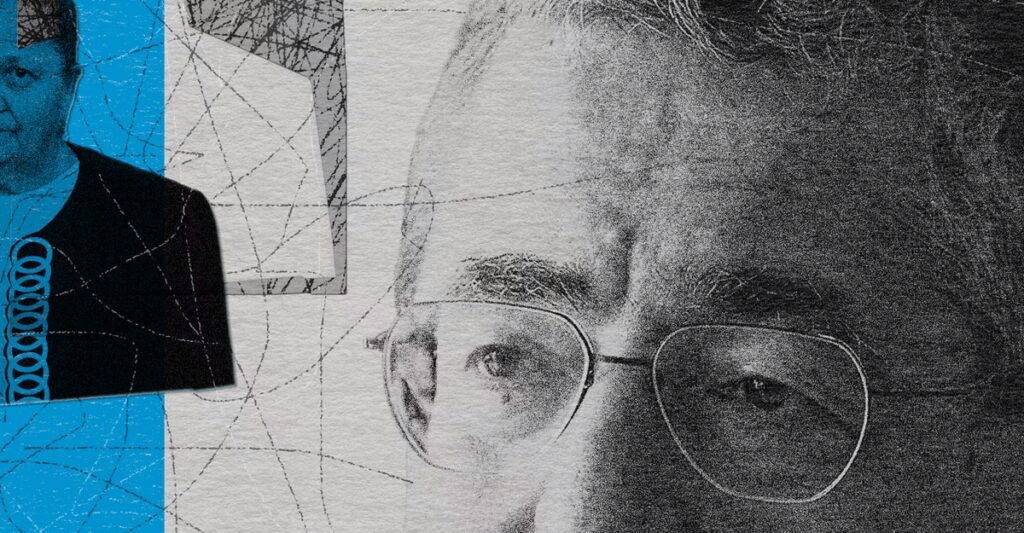
Bernardo Arévalo, born in exile in Uruguay, returned with his family in the middle of the dictatorship period, and he began a career as a diplomat at its tail end, as the country formally returned to elections and civilian rule in 1985. He later left the diplomatic service, earned a Ph.D., and worked in international peace-building.
The wood-paneled presidential office where we met was decorated only with two portraits: his father’s, in black-and-white, and his own, beside it, in color. Arévalo’s demeanor was professorial.
“We are in a process of recovery,” he said. “Democracy doesn’t develop in a linear, unidirectional way; it has leaps and twists, not only here, but everywhere in the world.” For much of the 1990s and 2000s, Guatemala had been twisting its way toward democracy, but corruption networks and drug traffickers had insinuated themselves into the country’s institutions. “Part of what we set out to do is to recognize the serious damage this had caused the country—this corrosion, this penetration of political-criminal networks” that served no “ideological interest,” Arévalo said, but rather “the highest bidder: whoever could pay for impunity.”
Dislodging these forces from the machinery of the state has been neither swift nor straightforward, and even those most anxious for change are hard-pressed to offer practical solutions. The president told me that some supporters had asked him to use the military to remove Porras. He found the suggestion unsettling: “Are you really asking us to go back to the years of military dictatorships of the 1970s, when armies were the only solution?”
[Read: A new history of the Western Hemisphere]
I asked Arévalo about the Indigenous protest leaders, Luis Pacheco and Hector Chaclán, who had then been imprisoned for more than a year while under investigation on terrorism charges. “I would like the people who say ‘But the government could have done something else’ to tell me what,” Arévalo replied, exasperated. “What they’re venting is the frustration we all feel.”
He assured me that the pact of the corrupt was weakening incrementally as its networks lost access to the state: first the executive branch, then the public-works contracting system, now the prosecutor’s office. “Without tools, they aren’t powerful. And our task is to keep removing those tools from them.”
Arévalo can point to some successes. Young lawyers have worked to clean up corruption in the judicial selection process. Appointed in March, the new bench of the Constitutional Court, which rules on the constitutionality of laws and policies, is more favorable to reformers than the one it replaced, as is the new electoral tribunal, which oversees elections. I spoke with the new attorney general a few days after he assumed his post: He was so busy firing Porras’s apparatchiks and preparing for the institution to resume serious criminal investigations that he was sleeping only four or five hours a night. An anti-corruption commission that Arévalo formed early on has already filed more than 200 criminal complaints against former officials.
Arévalo was tasked with not only freeing a state captured by kleptocrats, but also strengthening one that was fundamentally weak. The bureaucracy he inherited had little capacity to provide public services, reduce poverty, or fight organized crime. In this, too, his administration has made some progress. It has hired more than 15,000 new teachers, and built or refurbished more than 150 rural-health clinics (his predecessor built just six in four years, Arévalo said). The government has also replaced dirt floors with cement in more than 75,000 households in the country’s poorest rural municipalities, and has distributed water filters and cleaner-burning stoves.
Still, much else that Guatemalans had hoped for has failed to materialize. Congress, which remains dominated by the old-guard pact forces, has blocked or stalled bills aimed at curbing corruption—for example, bills to modernize public-works contracting, require shell companies to disclose who owns them, and protect whistleblowers. Partly because the contracting system remains dysfunctional, the government has made little visible progress toward repairing the country’s crumbling highways. And, unwilling to buy votes in Congress outright, as his predecessors did, Arévalo has resorted to pork-barrel spending and raising congressional salaries to win legislative support. Such tactics are deeply unpopular with the public.
Another limiting factor has been the Trump administration. Although Arévalo’s cooperation on crime and drugs has kept the relationship cordial, his opponents have courted President Trump to try to tip the scales against reformers. In April, the U.S. ambassador to Guatemala personally called reluctant Guatemalan lawmakers to pressure them to approve a Constitutional Court judge favored by pact elites and conservatives, a top lawmaker, Luis Aguirre, told me. This tied the court between reformers and their opponents, leaving Arévalo without a reliable majority.
The young reformers who campaigned with Arévalo knew that he would face constraints, but some wish that he had more often tested those limits.
Samuel Pérez, 34, is a member of Congress; he was also the head of the Seed Movement bloc in Congress before it was dissolved. I went to see him in a building plastered with missing-persons flyers for those who were disappeared during the military dictatorship decades ago. The flyers are a common sight in Guatemala City, posted and reposted by the victims’ families.
Pérez told me that Arévalo was elected not only “to overthrow the regime, but also to construct something new, and that isn’t happening.” Now Pérez was creating a party, called Raíces, to which most of the lawmakers formerly associated with the Seed Movement had defected. They would still support Arévalo, but they would advocate for a more confrontational approach. “The president interprets power and good government as doing things a little better and a little more than what already existed. For me, no. You don’t use power to administrate what’s already there, but to transform what isn’t working,” Pérez explained.
I’d last seen Pérez during Arévalo’s presidential campaign in 2023. He’d told me then that if the Seed Movement won, the government’s greatest difficulty would be managing popular expectations. But he hadn’t predicted that he himself would be among the disappointed. Arévalo should have rallied the public to pressure Congress to pass the law removing Porras, Pérez said. He should have conceded less to business elites, and done more to free Pacheco and Chaclán. Pérez was particularly upset that the police had come to arrest the two men in a white van with tinted windows—a symbol of the dictatorship, which used such vehicles to disappear its victims—and that the government had not stopped this.
Several young Guatemalans in the reform movement suggested to me that the political caution of their parents’ generation was a product of the fear instilled in them during the years of military rule and internal armed conflict. Some speculated that Arévalo’s aversion to escalation emanates from that experience, too, given his youth in exile and the persecution of many of his father’s supporters in the years after the 1954 coup. “I think he is a son of his circumstances,” said Andrea Reyes, a young lawmaker helping Raíces organize.
Arévalo readily locates his most formative influences in that era—as a source not of fear, but of strengthened conviction. He spoke to me of his father’s refusal to abandon democratic principles: “Even when the world began to change around him, he kept his convictions, which today we see were the correct convictions, after all, 80 years later.”
Arévalo, too, has found his convictions under pressure—not only from former allies who worry that his reforms have gone too slowly, but also from constituents and conservative politicians who want a government that will ignore constitutional limits in cracking down on crime. In this they compare him unfavorably with the autocrat next door: Many Guatemalans who live in daily fear of extortion and kidnapping see gangs, not illiberal state capture, as the biggest threat to their basic freedoms, and they see President Nayib Bukele’s El Salvador as a beacon of safety.
[Read: El Salvador’s exceptional prison state]
Bukele, first elected in 2019, took an almost opposite approach from Arévalo’s to governing. He purged institutions of his political rivals, packed them with loyalists, and then cut secret deals with gang leaders before cracking down on their followers. His mass roundups virtually eliminated violent crime in his country, by jailing more than 90,000 people suspected of gang ties, many without due process. Arévalo is unwilling to pursue such methods. He has, however, seized record quantities of cocaine, extradited crime bosses, hired thousands of new police officers, and begun building the country’s first new maximum-security prison in 40 years. But murder and extortion rates have proved stubborn, and many are now demanding more-radical methods.
“Guatemalans are searching for their Bukele,” said Alvaro Arzú Escobar, a conservative lawmaker sanctioned by the Biden administration for allegedly trying to undermine Arévalo’s inauguration. Arévalo “isn’t radical in his ideas or his actions,” Arzú told me. But, he added, “the country’s biggest problem right now is a lack of authority. As president, he doesn’t exercise the power he holds. There is a lot of rhetoric, but little action.”
The Mariscal Zavala military prison sits on a pine-covered ridge on the outskirts of Guatemala City. A former army base, it houses the state’s highest-profile prisoners. I went there to meet Pacheco and Chaclán, the Indigenous leaders who’d played such an instrumental role in safeguarding the 2023 presidential election. Both had been on the board of the 48 Cantones of Totonicapán—one of the country’s oldest Indigenous self-governing bodies, in rural western Guatemala—when the attorney general’s office had moved to annul the vote. Pacheco and Chaclán canvassed rural villages on foot, helping gather some 50,000 signatures calling for Porras’s resignation. Later they helped organize protests in the capital.
“The 48 Cantones is also a democracy, with elected leaders and term limits,” Chaclán told me. “For us, democracy is sacred, and although Guatemala often doesn’t reflect it much, we must respect it.”
In April 2025, Porras ordered him and Pacheco into pretrial detention. After that, their court hearings were repeatedly delayed, seemingly intentionally, and when I met them in May, they had no idea when the next one would be.
I asked them whether they believed Arévalo should have rallied protesters or found some other tool to remove Porras, and thus to free them. Pacheco responded, “I would have liked it at first, but later I realized it would have only changed the person, not the form of doing justice.” Chaclán added, “This is nothing simple, and surely he is doing what is best for the country. We have faith we have already passed the majority of our time here.”
Chaclán was right. On August 5, a judge released Pacheco and Chaclán to house arrest, reuniting them with their families. Around the same time, the prison-like, black-steel fence was taken down from around the public prosecutor’s office.
Guatemala’s next presidential election is just nine months away. Right-wing candidates are beginning to emerge, some imitating Bukele, and many sure to court the White House, in the hope that Trump will try to tip the scales. Arévalo’s and Pérez’s reformists claim that they will join forces behind a unity candidate, but such a figure has not yet surfaced. Democracy is twisting its way forward, in Arévalo’s words. No one thinks it is leaping.
But the passage of time may provide a different perspective. On one of my last days in Guatemala City, I walked by a cathedral I had passed dozens of times before. I had never previously noticed the tiny engraved names of more than 13,000 victims of the internal armed conflict, so small as to be illegible from even a short distance, on its stone columns.
For much of the 20th century, Guatemalans who advocated for self-government, equality before the law, and the welfare of the majority—that is, social democrats—knew that the state might try to kill them. Today, social democrats govern. Reformers may disagree as to whether Bernardo Arévalo made the most of the opportunity he was given. But that such an opportunity could ever arise is more than many members of his father’s generation likely thought possible.
*Image Sources: Luis Soto / AP; Johan Ordonez / AFP / Getty; Arnulfo Franco / AFP / Getty.
The post Guatemala’s Democracy Dilemma appeared first on The Atlantic.