“The U.S. Lead Over China in AI Is All But Gone.”
“China Is AI-Maxxing.”
“China Just Erased America’s AI Lead.”
Those assessments of the artificial intelligence rivalry appeared in U.S. publications recently, and Xi Jinping will be pleased to have them in the air as he arrives in Washington this week for a state visit. Under Mr. Xi’s leadership, China has made huge strides in developing the most consequential technology of our times. What will be less discussed is that he is also the leader of an economy in its worst shape in decades.
The two facts are related.
Economists in China — even those closest to the state — have openly warned that the government is pouring too many resources into a technology that creates relatively few jobs, while doing too little to save the broader economy.
And it’s an economy in crisis: The country’s youth unemployment rate, excluding students, reached 18.9 percent in August. Consumers are not spending. During the first half of the year, domestic car sales fell markedly 20 percent from a year earlier, and housing sales fell another 14 percent, adding to years of decline. The country is in a deflationary spiral.
This summer, the economists’ warnings became a chorus. Li Daokui, a former adviser to the country’s central bank and a professor at Tsinghua University, said in July that China’s economy was “running too cold.” Its booming high-tech sectors, he said, could not lift the larger base.
Liu Shijin, another former adviser to the central bank, proposed at a forum in June to raise basic pension payouts, from $30 to $150 per month, for rural residents to shore up consumer demand.
At the same forum, Huang Haizhou, an adviser to the central bank, said Beijing must foster mild inflation and corporate profitability before sustained technological advancement could occur. “A country mired in deflation cannot achieve technological innovation,” he said.
The economists’ comments were earlier reported by Bloomberg and Chinese media.
The exact amount of government support for artificial intelligence is difficult to know. Stanford’s AI Index Report noted that state-initiated investment funds deployed an estimated $184 billion into A.I. firms from 2000 to 2023. Last year, Mr. Xi instructed the government to use every tool at its disposal, including tax breaks, government contracts, financing and access to infrastructure, to advance A.I. And, according to Bloomberg, China is preparing to spend around $295 billion over the next five years to build data centers across the country, which will be operated by state-owned firms.
The Chinese economists’ bluntness was itself revealing, as was the timing, just ahead of the regular midyear meeting of China’s ruling Politburo. They have been warned against sounding too pessimistic, and some have been censored or silenced for doing so. That these establishment figures were speaking so starkly right before the leadership was about to calibrate economic policy suggested how alarmed they had become.
Taken together, their message was clear: the Chinese economy was in trouble and an A.I.-centered allocation of resources could prove costly to ordinary people’s livelihoods and the country’s economic future.
The leadership gave their warnings little heed. When the Politburo meeting ended on July 30, the party acknowledged the need for “proactive” measures to boost the economy, but stuck with incremental stimulus policies and vowed to develop “an intelligent new economy.” State media reports broke with previous practice and did not announce a target for domestic growth.
Fixed-asset investment, including infrastructure, real estate and equipment, fell 4.1 percent in the first five months of the year. Mr. Li, the former central bank adviser, said a similar contraction happened only twice in the history of the People’s Republic: in 1961, at the height of the Great Famine, and in 1967, at the height of the Cultural Revolution. (It also fell in 1989 following the Tiananmen Square massacre, but it probably wouldn’t be wise to mention that at a meeting in Beijing.)
Mr. Xi has offered a revealing explanation of how he measures economic progress.
“We cannot look only at G.D.P. growth,” he said in a speech in March. What mattered, he argued, was China’s growing “hard power” and its development of advanced industries. In Mr. Xi’s view, slower growth does not necessarily signify failure if technological advancement proceeds “upward step by step.”
Rather than boosting household disposable income with cash or shopping vouchers or expanding the social safety net, as many economists have suggested, Mr. Xi believes that state-led technological rollouts will modernize traditional industries and unlock future economic value. But those gains could take years to materialize.
China cannot afford to sit out the A.I. race. And in the first half of 2026, investment in information services, a sector the National Bureau of Statistics said was being propelled by A.I., jumped 19.2 percent. The technology could transform its economy and strengthen its position in its competition against the United States.
But at what cost?
Xu Chenggang, a Chinese economist at Stanford, put plainly what his peers in Beijing could only imply. China has more fiscal and monetary flexibility than most countries because Beijing controls the banking system. Every yuan going into state-backed technology is a yuan not spent on employment and consumption.
“When you have only this much money, what do you spend it on?” he said.
In a crisis similar to what China is facing, many governments would use stimulus to create jobs, Mr. Xu said. When people have jobs, he said, they spend more, creating a positive economic feedback loop. Instead, Beijing is concentrating its investment in A.I., a technology that may exacerbate high unemployment by reducing demand for workers.
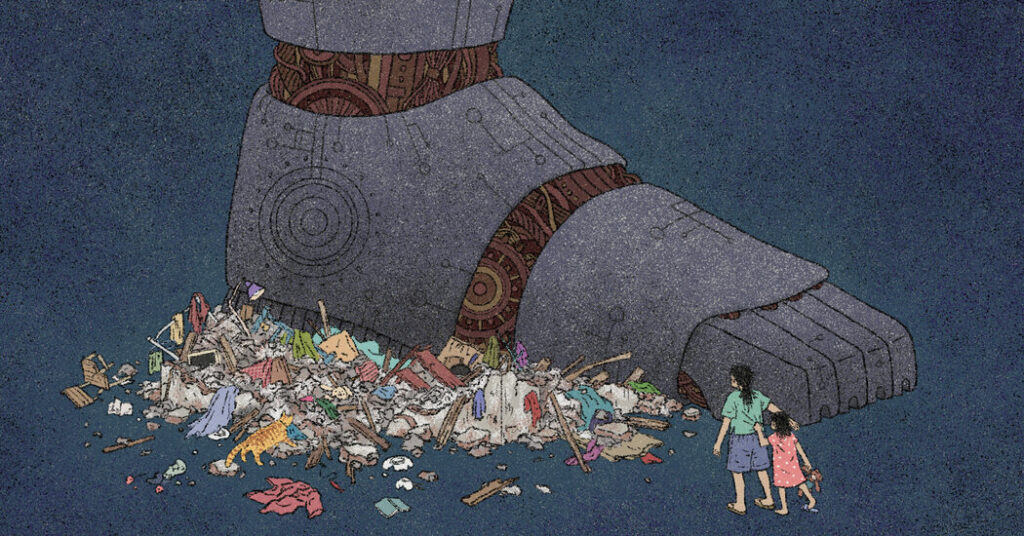
Some Chinese internet users are already calling the investment rush an “A.I. Great Leap Forward,” invoking Mao Zedong’s disastrous campaign of politically driven industrialization.
A.I. companies ultimately need more than government support. They need businesses and consumers willing and able to pay for their products, Mr. Xu said. By weakening household demand and business vitality, Beijing may be depriving its A.I. industry of the market it needs to become commercially successful.
China has repeatedly demonstrated that an authoritarian state can keep an unsustainable model operating longer than outsiders expect. But history also demonstrates that “longer” does not mean forever.
Sun Liping, a prominent sociologist in Beijing, invoked the Soviet Union. At its peak, its economy was roughly 70 percent the size of America’s, and it surpassed the United States in some fields of science and technology.
Yet its centrally managed economy eventually stalled.
China can produce vast quantities of increasingly sophisticated goods, Mr. Sun wrote in an article. But who in China will be able to afford them? Without buyers, products go unsold, businesses earn no profits, household incomes cannot rise and employment cannot improve.
“That,” he wrote, “is the fundamental problem with China’s economy today.”
The post China’s A.I. Makes a Great Leap Forward. But Its Economy Is Falling Behind. appeared first on New York Times.