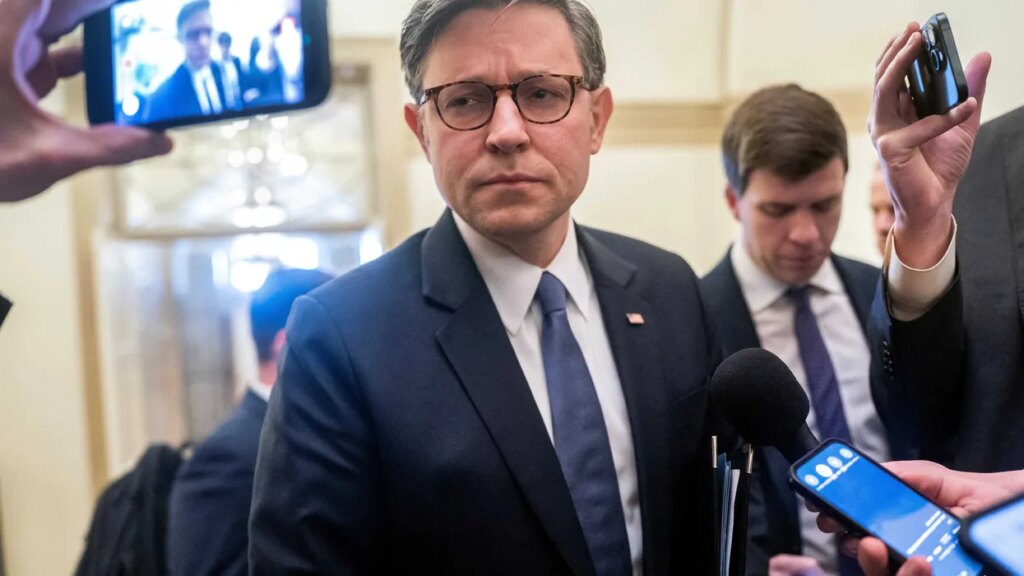
There are plenty of ways to exercise power in Washington. Pass legislation. Kill legislation. Twist arms. Control committees. Bury investigations. Force votes. Block votes.
And then there’s Mike Johnson’s preferred method:
Everybody go home.
Under Speaker Johnson, the House has repeatedly canceled scheduled voting days and headed for the exits when the political terrain became uncomfortable. In 2026 alone, the House cut 28 scheduled days while adding four — a net loss of 24 legislative days, roughly one-fourth of the originally scheduled total. In September, Republican leaders canceled another two weeks of planned votes before the November midterms, giving members considerably more time to campaign instead.
This week, Johnson did it again.
On September 16, Johnson recessed the House early, sending members home before the scheduled end of the week and leaving unfinished business behind. Republican Rep. Thomas Massie — not exactly a Democratic operative — responded incredulously from the House floor:
“We’re calling off Congress? And we’re in the majority?”
That may be the perfect epitaph for this hapless Congress.
Johnson argues that the House has been extraordinarily productive, pointing to hundreds of bills passed and major Republican legislative accomplishments. His critics counter that he has repeatedly canceled voting days when his razor-thin majority faced difficult votes or internal divisions. Even Republicans have complained. In 2025, the House held just 105 voting days — barely above the COVID-era 2021 total of 104.
Congress, of course, isn’t paid by the hour. Members work in their districts, hold hearings, meet constituents and conduct legitimate business away from the House floor.
But let’s not pretend a congressional recess is politically meaningless.
The speaker possesses enormous power over what reaches the House floor — and when the floor itself effectively closes, legislation doesn’t pass, subpoenas don’t get enforced, investigations don’t advance and members don’t have to cast votes they’d rather not explain back home.
That brings us to a much larger question — one Democrats should be prepared to confront if they regain congressional power.
Every member of Congress takes an oath to support the Constitution. Article VI explicitly requires federal and state officials to be bound by oath or affirmation to support it. Federal law requires members to swear that they will “support and defend the Constitution” and “well and faithfully discharge the duties” of their offices.
But there is no general federal crime called “violating your oath of office.”
Maybe Congress should finally have a serious debate about whether that gap makes sense.
Not a law criminalizing political disagreement. Not a law allowing a Democratic administration to prosecute Republicans for conservative votes — or a Republican administration to prosecute Democrats for liberal ones. Not some vague statute allowing the Justice Department to decide which politicians are sufficiently patriotic.
Something far narrower.
Congress could examine whether federal law adequately covers intentional abuses of official power designed to obstruct constitutionally mandated governmental functions — and, where it does not, whether precisely defined criminal statutes are warranted.
The distinction is crucial. Members of Congress receive substantial constitutional protection for legitimate legislative activity under the Speech or Debate Clause. Any new statute would have to respect that protection and survive serious constitutional scrutiny.
But Democrats should stop treating institutional guardrails as though they magically enforce themselves.
If they regain power, they will face a choice.
They can hold hearings.
They can issue sternly worded statements.
They can appear on cable television and announce that they are “deeply concerned.”
They can spend another congressional term telling Americans that certain conduct is unprecedented, dangerous, outrageous and unacceptable — and then accept it.
Or they can legislate.
They can examine the weaknesses exposed over the past several years and ask a straightforward question: What happens when an officeholder knowingly abuses the powers of his office to frustrate the constitutional system he swore to support?
If the answer is merely “voters can punish him eventually,” Congress should decide whether that is sufficient.
Because accountability cannot depend entirely upon shame when the people involved have demonstrated that shame is not particularly high on their list of concerns.
And Democrats should understand something else: writing enforceable rules is not political revenge. Properly drafted laws would apply to Democrats too. They would apply to whoever holds power next year, 10 years from now or 50 years from now.
That is precisely the point.
Democracy cannot survive indefinitely on the assumption that everybody entrusted with power will voluntarily respect norms. Norms work only when the people breaking them fear consequences. When those consequences disappear, “norms” become suggestions.
So if Democrats take Congress in November, don’t just investigate what happened.
Don’t just televise it.
Don’t just condemn it.
Write the rules. Define the offenses. Establish the penalties. Put constitutional guardrails into federal law wherever Congress legitimately can — and make those laws apply equally to everybody.
Do it carefully. Do it constitutionally. Make the prohibited conduct specific. Protect legitimate legislative activity and political disagreement. Build in demanding intent requirements so prosecutors cannot criminalize ordinary politics.
But do it.
Because an oath of office should be more than ceremonial wallpaper recited on the first day of Congress and forgotten by lunchtime.
And if Congress concludes that certain intentional abuses of public power really do constitute a betrayal of the duties officials swear to perform, then it should have the courage to say so in law.
Otherwise, stop calling it an oath.
Call it what it has become:
A suggestion.
The post This law would send Mike Johnson straight to prison appeared first on Raw Story.