First, President Trump wanted to buy their homeland.
Then he threatened to seize it by force.
On Friday, he announced that he had worked out an “Infinite Life” deal between the United States, Denmark and Greenland, the gigantic Arctic island and semiautonomous Danish territory that has been an obsession of Mr. Trump’s for years.
As news of the deal spread across Greenland on Saturday, some Greenlanders expressed relief. But there also seemed to be confusion, anxiety and a nagging question: What, exactly, had been agreed to?
“My immediate reaction is that it makes me nervous and skeptical,” Ellen Frederiksen, a retired teacher in Narsaq, a town in southern Greenland, said by telephone.
“The way Trump presents it, it sounds as if he is being given a monopoly over Greenland,” she said. “I sincerely hope that isn’t the case.”
For months, Mr. Trump’s aides had been tasked with finding a way to defuse a crisis the president himself provoked last year among America’s NATO allies, especially Denmark, when he threatened to take over the island. On Friday, American officials said the new deal would expand the U.S. security presence on the island. But the details of the agreement are not expected to be revealed until next week.
Mr. Trump asserted that the United States had secured “permanent control over security, and all other needs” in Greenland. But Greenlandic and Danish officials were much more measured about what the deal portends, and they have said little about it.
On Saturday, Lars Lokke Rasmussen, Denmark’s foreign minister, said the agreement could end “a long period of uncertainty” and that “next week could be a good week.”
Some analysts suggested that Mr. Trump could be exaggerating the deal’s importance. Under a defense treaty that dates to the 1950s, the U.S. military already enjoys sweeping access to Greenland. Greenlanders and Danes have never questioned that. And Greenlanders had already said they were interested in doing more business with Americans.
“In terms of rights, they were already allowed quite a lot under the original agreement,” said Mikkel Runge Olesen, a researcher at the Danish Institute for International Studies in Copenhagen.
Mr. Trump said on Friday that the new deal would prevent Russia and China from ever establishing military bases in Greenland. But Mr. Olesen made the point that since Greenland is a NATO territory, there had never been a realistic possibility that China or Russia would put troops there.
“Is there anything here that one could not have achieved without this crisis?” Mr. Olesen asked.
It’s been an exhausting year and a half for Greenlanders. Ever since Mr. Trump threatened to seize the island in early 2025, his administration’s threats and warnings have seeped into everyday life.
Many people became newshounds, constantly scanning the headlines for any word out of Washington. Some said they struggled to sleep, worried about what might happen next.
Aka Hansen, a filmmaker and member of an opposition political party in Nuuk, the capital, said that earlier this year she had been told to prepare for the worst. She even stored five days’ worth of water, in case the Americans invaded.
“Now, suddenly, everything is fine,” she said. “What happened in between?”
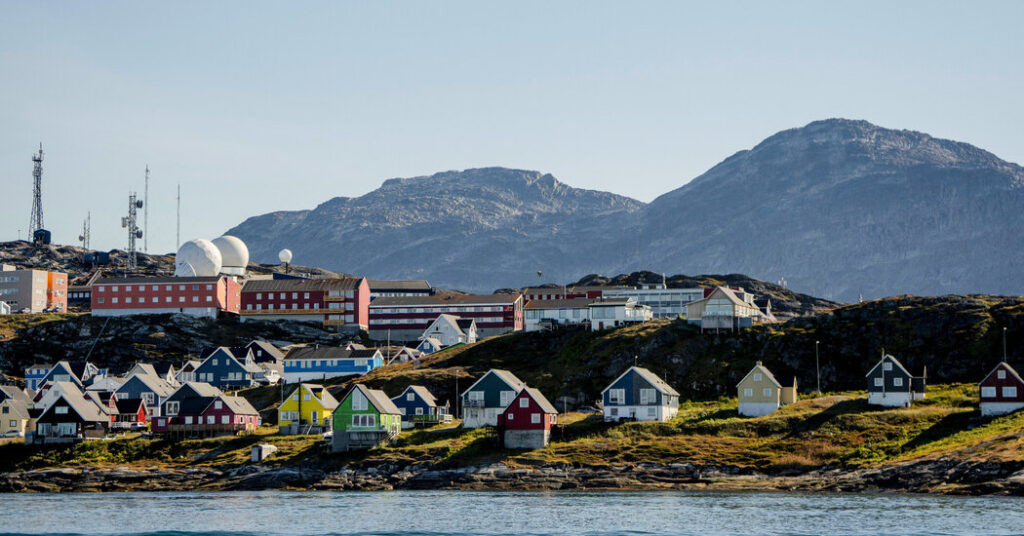
The answers matter deeply in Greenland, where questions about sovereignty and outside influence have never been abstract. The island is bigger than Mexico but home to fewer than 60,000 people.
For more than 300 years, it has been part of the Danish kingdom, and today, many Greenlanders follow a blended lifestyle — part Scandinavian, part Indigenous Inuit culture. Many people still hunt seals, for instance.
Large parts of the island, with their glistening snowfields, dramatic fjords and icebergs and ice mountains, are stunningly beautiful. Protecting the environment has always been a priority, which is why some Greenlanders said they didn’t feel comfortable with Mr. Trump’s talk of expanding America’s military presence.
Already, the Pentagon has taken the first steps toward a bigger buildup. Just this week, American soldiers were spotted surveying an airstrip in Narsarsuaq, a town in southern Greenland.
“If it becomes a daily routine for them to fly around here near us, then it will be a complete change,” said Aana Uulat Bach, a retired teacher living in Nuuk. “We are not soldiers. We are people of nature, and we want to preserve that.”
Still, some people were hopeful.
“If the agreement is finalized, it will create all the conditions needed to restore more normal relations,” said Naaja Nathanielsen, one of two Greenlanders in Denmark’s Parliament. “I don’t think there can be much disagreement that this would be a good thing.”
The post ‘Nervous and Skeptical,’ Greenlanders Question the New Deal With Trump appeared first on New York Times.