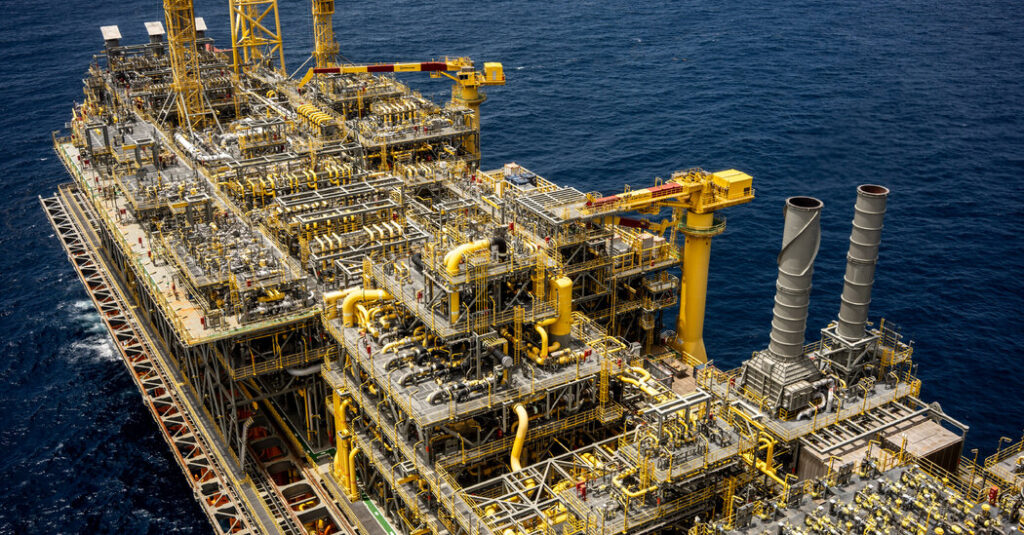
An hour by helicopter from Guyana’s capital, Exxon Mobil’s deepwater production hub in the churning Atlantic Ocean reflects the scale of the company’s wager that Guyana has the makings of a new world oil power.
The helideck comes into focus first, then the mazelike piping and multistory processing equipment that make up the floating, futuristic vessel anchored near the Equator, where more than 160 people work around the clock in 12-hour shifts.
“This could be the closest someone can get to living in an off-world colony,” said Faudia Ramjohn, 28, a Guyanese control room operator who races motorcycles in her spare time.
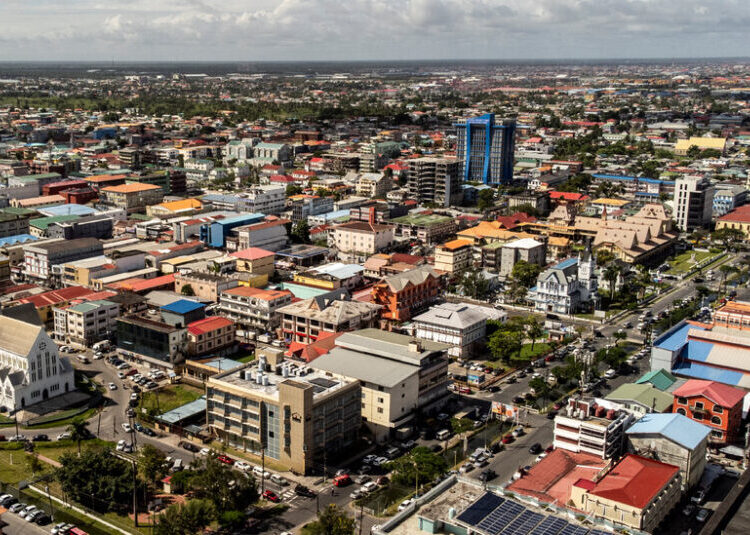
Exxon’s oil discovery in these waters more than a decade ago ranks among this century’s most significant finds, catapulting Guyana, a former British colony with 1 million inhabitants, into the world’s fastest-growing economy.
The country now produces almost 1 percent of the world’s oil, plugging holes left by geopolitical conflicts. Much of Guyana’s oil flows to Europe, replacing a portion of what the continent used to get from Russia, and some has been making its way to Asia during the Iran war, according to Kpler, a maritime data firm.
As important as Exxon has been for Guyana, the country has also been transformational for the largest U.S. oil company, giving it a lucrative new growth engine at a critical time. Rapidly accelerating production in Guyana helped push Exxon’s overall production to its highest level in more than 40 years last year, contributing an estimated 15 percent of the company’s operating income.
“It’s often said that Exxon saved Guyana,” said Richard Rambarran, a Guyanese economist. “One could also say that Guyana saved Exxon.”
But as Guyana’s oil industry has grown, so have the risks facing Exxon. They include infighting in Guyana’s political system and a territorial feud with neighboring Venezuela preventing Exxon and its partners from exploring in certain areas, as well as the potential for resource nationalism to flare.
Time and again across Latin America, private oil companies have been haunted by political movements seeking to assert greater sovereign control over oil riches.
“Guyana has a terribly bad deal,” said Thomas Singh, an economist at the University of Guyana, referring to the 14.5 percent take that Guyana was getting from the consortium Exxon leads. He and other critics point out that oil-producing countries like Norway or Brazil get a much higher cut.
Alistair Routledge, who leads Exxon’s Guyana operations, said the contract was fair.
“We take all the financial risk,” Mr. Routledge said. “If we don’t find oil and end up developing commercial projects, we never recover that money.”
Attractive as Guyana may now be, Exxon considered dropping the project before striking oil in 2015, worried that investing in a country riddled with failed wells wasn’t worth it, former employees said.
Mr. Routledge also emphasized that while Guyana’s initial take may seem low, the deal includes an escalation mechanism: Exxon’s consortium recently recouped development costs, meaning Guyana’s proceeds will rise, potentially doubling or more from earlier levels.
As for the feud with Venezuela, the United Nations’ top judicial body is expected to rule on the dispute by early next year. However, the decision will address only the land border, according to lawyers representing Guyana. Where that border meets the ocean will determine the beginning of the maritime border, but where it goes from there will be left to the countries to negotiate, they said.
Even as that feud clouds prospects in Guyana, Exxon is considering returning to Venezuela, where it lost control of assets two decades ago in a nationalization.
Mr. Routledge said he expected Venezuela to remain a “very complicated story,” and that returning would hinge on contract terms and conditions allowing Exxon to plan operations as far as 30 years in the future.
Still, citing Venezuela’s colossal oil reserves, which are far more bountiful than Guyana’s, Mr. Routledge added: “We should be there. I mean, this is a large resource. We were an operator there in the past.”
Exxon is also on the hunt for oil and gas in the waters off Trinidad and Tobago, a nearby island nation that has been getting more attention from the world’s biggest oil companies since U.S. forces captured Venezuela’s leader, Nicolás Maduro, in January. Like Guyana, Trinidad shares a maritime border with Venezuela.
In the meantime, expectations have been growing in Guyana for Exxon to do more to raise living standards. Exxon already supports biodiversity research and efforts to boost food production. The company and its partners are also investing $100 million to develop the local work force and improve health care.
Calls for Exxon to expand such initiatives point to a delicate balancing act.
If Exxon refrains from taking on a greater role in assisting Guyana’s government, the company could be seen as neglecting its responsibilities in the country. But if it adopts a more assertive role, Exxon could be accused of infringing on national sovereignty.
“It’s not our job,” Mr. Routledge said regarding the nation-building question. “We’re not elected. We’re not representatives of the people.”
The post How Guyana Is Feeding the Profits of the Largest U.S. Oil Company appeared first on New York Times.