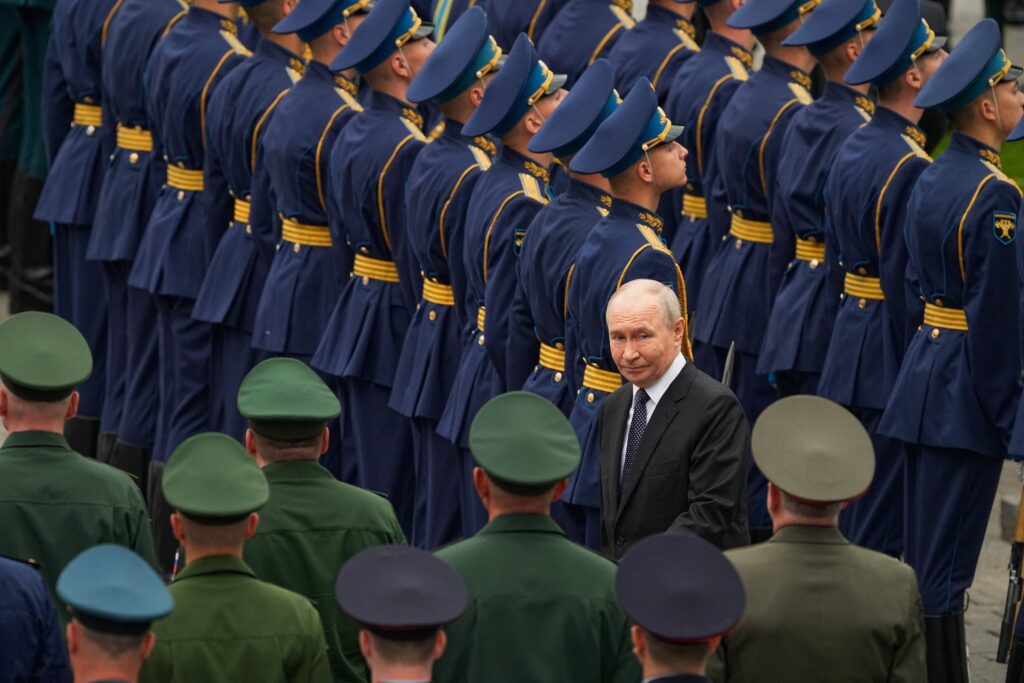
Russian President Vladimir Putin will win yet another election Sunday. United Russia, the party that has long supported the country’s modern “forever leader,” will once again win a majority in the Duma, the lower house of parliament.
It will be the latest in a quarter-century string of elections that Putin always wins. Even after four and half years of full-scale war in Ukraine and hundreds of thousands of casualties, Putin’s grip on power is as tight as ever. But the 73-year-old former KGB director will not live forever.
Putin has fielded questions in every election cycle about who might someday replace him, but has purposefully kept his nation and the world guessing.
The power structure he created, in which he alone makes big decisions, ensures that no one accumulates enough power to challenge him directly. But it also leaves the country with no heir apparent. Instead, Russia is ruled by clans representing the security services, the military and competing business elites.
And while some, at least among the opposition-minded, are eager for the post-Putin era, Putin’s successor, should he retire or die in office, is far more likely to be shaped in his image than that of those who oppose him.
Here are seven leading contenders who fit that profile:
Mikhail Mishustin
Prime minister, 60
First in the official line of succession is Prime Minister Mikhail Mishustin, who automatically assumes the presidency, under Russia’s constitution, should the need arise — which is how Putin became acting president upon Boris Yeltsin’s resignation on Dec. 31, 1999.
When Mishustin was appointed in 2020, he was seen as a purely pragmatic pick — a technocrat who had headed the Federal Tax Service with a reputation as an effective but apolitical manager, well-known among business elites but largely unknown to Russians.
His lack of political weight set him apart. He had no party affiliation, no public profile, wasn’t part of the security service elites close to Putin and had never shown much interest in higher office. This combination made him a low-risk choice.
Since then, Mishustin’s mandate, particularly on the economy, has grown, and he was put in charge of a council tasked with military procurement. However, to the most important camp — the security service elite known “siloviki,” who wield immense influence in foreign policy and security — he is still an outsider, which may limit his chances at claiming the top job.
Alexei Dyumin
Ex-bodyguard, now secretary of the State Council, 54
A former Putin bodyguard who joined the president’s security detail in 1999 and spent years in the Federal Protective Service, Alexei Dyumin moved up through the ranks to hold key security and military positions, making him among of some of the most “battle-hardened” candidates in the mix.
He served as the deputy head of Russia’s military intelligence, the GRU, and led Russia’s Special Operations Forces, where he oversaw the illegal annexation of Crimea in 2014. Later, he did a stint as deputy defense minister. He was tapped to be governor of Tula in 2016 and secretary of the State Council in 2024.
Dyumin has long been viewed as a serious contender for succession, because of his proximity to Putin and his experience in both military and public service. Putin increasingly has promoted people from his own security detail specifically because of personal trust built over the years.
There had been speculation of Dyumin as a potential defense minister, but when Putin reshuffled the ministry in May 2024, he gave the post to economist Andrei Belousov and instead made Dyumin a Kremlin aide overseeing the defense industry, which analysts describe as essentially a shadow ministerial role.
Dmitry Patrushev
Deputy prime minister and son of former FSB chief, 48
Dmitry Patrushev represents what Russian researchers refer to as the clan of Russia’s rising princes — sons of ultrapowerful veterans of Putin’s Russia who survived decades of tumultuous shake-ups and rose to the top of the power structure.
His father is Nikolai Patrushev, a former FSB director and Security Council secretary, who has known Putin since the 1970s and is one of the most trusted members of his inner circle.
The younger Patrushev spent most of his career in the banking sector, after studying at the FSB academy at the behest of his father. His father’s proximity to Putin and security service background would carry the influence of the hard-line siloviki establishment into a new generation.
In 2024, Nikolai Patrushev lobbied unsuccessfully for his son to replace Mishustin as prime minister. Instead, he was named deputy prime minister.
Boris Kovalchuk
Chairman of the Accounts Chamber, 48
Like Patrushev, Boris Kovalchuk represents the “nobility” — he is the son of Yury Kovalchuk, a powerful oligarch, who has long been considered one of the most powerful people in Russia despite never holding any public office. He is often described as Putin’s personal banker and closest friend.
The Kovalchuks power is rooted in their empire of media companies, banks and science institutions, but they are not part of the classic siloviki establishment.
Kovalchuk also lobbied to promote his son in 2024, reportedly hoping that Putin would put Boris Kovalchuk at the helm of Rosneft or Gazprom, the country’s top energy corporations. Instead, Putin appointed Boris Kovalchuk the head of the Accounts Chamber, which was widely read as a disappointment to the Kovalchuks.
Denis Manturov
First deputy prime minister, 57
The son of a high-ranking Soviet diplomat and a protégé of Sergei Chemezov — the head of Rostec, the conglomerate that controls Russia’s military-industrial complex — Denis Manturov ran the Ministry of Industry and Trade for more a decade before his mandate rapidly expanded.
In 2022, he was put in charge of overseeing the arms industry, and two years later was promoted to first deputy prime minister with a challenge to keep the government aligned with the war effort in Ukraine.
His defense-industrial ties give him informal standing with the siloviki even without an intelligence background of his own. But overseeing military production and the economic side of the war is also a potential liability. His influence is tightly bound to the health of the war economy and likely hinges on how the war ends.
Sergei Sobyanin
Mayor of Moscow, 68
Sergei Sobyanin rose from a governor seat in Siberia to become Putin’s presidential chief of staff in 2005, then ran Medvedev’s 2008 campaign before being appointed as Moscow’s mayor in 2010, a post he’s held ever since. He is credited with turning the city into a beautified, high-tech capital. Sobyanin is more aligned with business elites that security services, but his managerial appeal is considered popular beyond the capital.
Sergei Kiriyenko
Kremlin’s domestic policy chief, 64
Russia’s youngest-ever prime minister under Yeltsin in 1998, Sergei Kiriyenko’s stint in office ended after four months when a financial crisis hit. He is remembered for one consequential decision — he named Putin head of the FSB, the domestic security service and main successor to the KGB.
Kiriyenko later ran Rosatom, the state-owned nuclear company, and now serves as the Kremlin’s domestic policy chief, where he has handled some of Putin’s thorniest political problems. That included orchestrating a 2020 constitutional referendum that allows Putin to stay in power until 2036, managing election cycles and overseeing the annexation and administration of occupied Ukrainian territory.
One thing working in Kiriyenko’s favor is his role shaping who rises into power at home. He has built a string of civic-training initiatives meant to cultivate a loyal new generation of officials, the latest being “Time of Heroes,” a program that grooms war veterans for civil-service careers as part of what the Kremlin calls “forming a new elite.”
Results so far are mixed. Most graduates have landed advisory or symbolic posts rather than real authority. But if the project matures, it could leave Kiriyenko with a cadre of loyal protégés in place throughout the bureaucracy.
The post Seven men who could lead Russia after Putin appeared first on Washington Post.