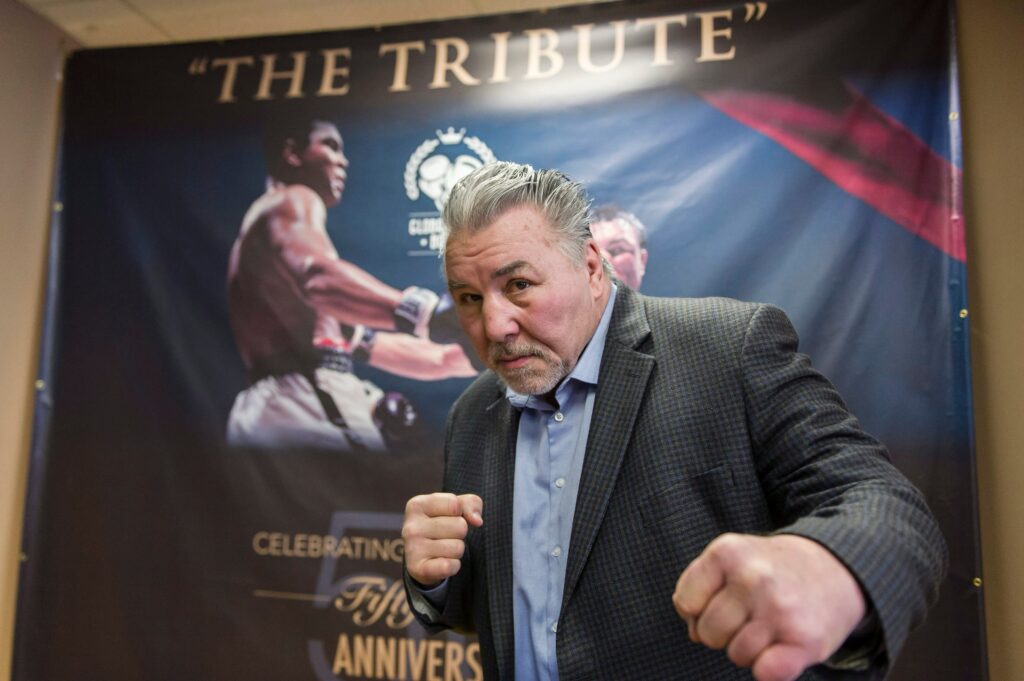
Boxer George Chuvalo was a gladiator of the ring, an unrelenting fighter with one of the toughest chins in the sport. With few interruptions, he held the Canadian heavyweight title for nearly two decades, going head-to-head with some of the biggest names of the 1960s and ’70s: Muhammad Ali, Joe Frazier, George Foreman, Floyd Patterson.
A world title eluded him. But Mr. Chuvalo was the rare boxer who could say that across his 93 professional bouts, he was never knocked down, remaining on his feet even while battered and bloodied.
“He’s the toughest guy I ever fought,” Ali said in 1966, after defeating Mr. Chuvalo in their first match, a marathon but lopsided 15-round bout in Toronto. Another fighter, Canada’s Bill Drover, told Sport magazine: “There’s no way to stop him. He just keeps coming and coming. The only way you can stop him is with a stick of dynamite.”
Going up against Frazier in 1967, Mr. Chuvalo took a bone-shattering left hook squarely to the face. “I thought my eye was going to come out,” he said. Getting hit by “Big George” Foreman, he recalled, was “like getting hit by a big Mack truck at 50 mph.”
Yet Mr. Chuvalo’s greatest challenges came later, outside the ring. In the span of 11 years, he lost his wife and three of his sons to drugs and suicide, in a cycle of grief and addiction that nearly destroyed him. He found a new calling as a public speaker, traveling across Canada to visit drug rehab programs and to warn high-schoolers about the dangers of substance abuse.
“The best thing I have going for myself is my attitude,” he once said. “I have a hard time quitting on something. I have a hard time walking away from something. I’ll be the last guy to quit on somebody.”
Mr. Chuvalo, who was awarded the Order of Canada for his boxing success as well as his antidrug advocacy, died Sept. 12, on his 89th birthday. His death was confirmed by the World Boxing Council, which praised his “unrelenting courage and legendary iron chin.”
A Notable Life
This article is part of A Notable Life, an obituary feature telling the stories of remarkable people every Saturday. Read more from the series here:
Photographing Miles Davis and ordinary New Yorkers, ‘he saw things nobody else did’
Her work was key to a landmark experiment. She was credited in a footnote.
By the time he won his last professional match, in 1978, Mr. Chuvalo had compiled a career record of 73-18-2, with 64 of his wins coming by knockout. He was especially proud of knocking out Manuel Ramos, Mexico’s heavyweight champion, in five rounds in 1968.
“I think he was ranked No. 4 in the world,” Mr. Chuvalo later told the Canadian magazine Maclean’s. “I knocked out all the No. 4s.”
The trouble came, he said, “with the ones, twos and threes.”
Mr. Chuvalo had 17 days to prepare for his first match against the world’s undisputed No. 1 fighter, Ali, who had sparked backlash with his opposition to the Vietnam War and the draft. Ali’s scheduled fight against Ernie Terrell, in Chicago, was scrapped, and the boxer traveled to Canada to face Mr. Chuvalo, who came into the bout as a 7-to-1 underdog.
A New York Times headline summed up the consensus: Among gamblers, Mr. Chuvalo was considered “A Big Bum With a Lot of Heart.”
Ali won in a unanimous decision. But Mr. Chuvalo was roundly praised for his resilience, having finished with a beat-up face that Toronto Star columnist Milt Dunnell compared to “a bucket of balls at a golf driving range.” His rematch with Ali, in Vancouver in 1972, also ended in defeat.
By his own description, Mr. Chuvalo was a “rough and tough” fighter, a 6-foot brawler who trained himself to absorb punches, not just mete them out. His strengths were summed up neatly by Rocky Marciano, the former world champion, who reportedly quipped that “if all fights were a hundred rounds, George Chuvalo would be unbeaten in any era.”
In his memoir, Mr. Chuvalo credited his tough chin in part to “being born with a short neck.” He said it also helped that he chewed bubble gum (“to strengthen my jaw muscles”) and had known “real poverty,” which he considered fuel for anyone wanting to become a pro boxer.
Mr. Chuvalo went on to work in real estate and appear in movies, including an unlikely cameo in “The Fly,” in which his character gets a bone broken in an arm-wrestling match with Jeff Goldblum.
His personal life began to unravel in 1984, when his youngest son, Jesse, tore off his kneecap in a dirt-bike accident and tried heroin at a party, after someone suggested it might help ease the pain.
Jesse began shooting up. Two of his brothers, George Jr. (known as Georgie Lee) and Steven, were soon doing the same.
Less than a year later, in 1985, Jesse died by suicide at age 20. His brothers’ addictions deepened, and in 1987 they were sent to prison for robbing a drugstore.
Shortly after he was released, Georgie Lee died of a heroin overdose in 1993. Mr. Chuvalo’s wife, the former Lynne Sheppard, died by suicide two days after the funeral.
“It never stops,” Mr. Chuvalo said. “I must have been a bad guy in a previous life. I don’t know.”
Mr. Chuvalo found solace through his relationship with Joanne O’Hara, a nurse and former colleague of his wife’s, whom he credited with helping him carry on amid thoughts of suicide. They eloped in 1994. But his son Steven continued to struggle with a heroin addiction, and was sentenced to jail for another drugstore robbery.
In 1996, he died of an overdose at 35, less than two weeks after he was released.
Mr. Chuvalo partly blamed himself for what he called his “personal holocaust.” Often, when his sons were shooting up in the basement, he had been “walking around like I was deaf, dumb and blind,” he said. But he also spoke out about a lack of social services and institutional support, including grief counseling that his son George Jr. could have used in prison.
“They have psychiatrists for sex offenders, but not for what he needed,” Mr. Chuvalo told the Times. “It was like if I sparred with lightweights before I fought George Foreman. It just wasn’t the proper preparation.”
Mr. Chuvalo found an outlet for his grief through public speaking, connecting with young people who barely knew of his career as a boxer. But he also struggled to keep his sadness at bay, especially at night when he was alone with his thoughts.
“It’s the only time I feel sorry for myself,” he told Maclean’s in 1999. “I think, ‘How can you even live after that, how the hell did all that happen?’
“You don’t want to be me after midnight.”
Fighting at Macaroni Field
George Louis Chuvalo was born in Toronto on Sept. 12, 1937, to Croatian immigrants from what is now Bosnia. His father skinned cattle on the floor of a slaughterhouse, and his mother worked at a poultry plant, plucking chickens for 2½ cents a bird.
Mr. Chuvalo was about 9 when she got him his first set of boxing gloves. He had pleaded for gloves for two years, he said, ever since he spotted photos of muscle-clad fighters at a cigar store near their home.
“The power of knocking a guy out, of standing over him, of raising your arms in the air, that was what appealed to me about boxing,” he told Canada’s National Post in 2013. “A cave man can understand boxing. He might not understand cricket, but he can understand boxing.”
Mr. Chuvalo’s earliest fights took place at a parking lot known as Macaroni Field, which sat near a pasta factory. By 18, he had turned pro. He claimed Canada’s heavyweight title in 1958 and was still bench-pressing 400 pounds nearly four decades later, frequenting the gym well into retirement.
Late in life, with his cognitive health in decline, Mr. Chuvalo found himself at the center of a bitter feud pitting his second wife against his surviving children, Mitchell and Vanessa, who said they were carrying out their father’s wishes in pursuing a divorce case on his behalf. The Toronto Star reported in 2018 that as the case dragged on and his dementia progressed, friends and family pitched in to ensure he was looked after.
“When I talk to young people about drugs or staying off drugs, I always talk about love in your life,” Mr. Chuvalo had told a reporter years earlier. “And sometimes people say, ‘Oh, yeah, love, you’re not going to bore me with that stuff are you?’
“But what else is there in life? What else are we here for if we can’t love people?”
Grieving a loved one? Tell us what made them special.
The Post is publishing reader-submitted obituaries as part of a weekly feature, What We Remember.
The post Hailed as Muhammad Ali’s toughest opponent, his biggest fight was outside the ring appeared first on Washington Post.