As Iran seeks leverage against the United States and its Middle Eastern allies, Saudi Arabia is facing a moment of extraordinary pressure. Iran-backed proxies in Iraq and Yemen have carried out debilitating strikes on its most important oil pipeline, attacked its military bases and energy infrastructure and gained critical territory along the Red Sea in an offensive against the Saudi-led coalition in Yemen that could fully choke off oil exports.
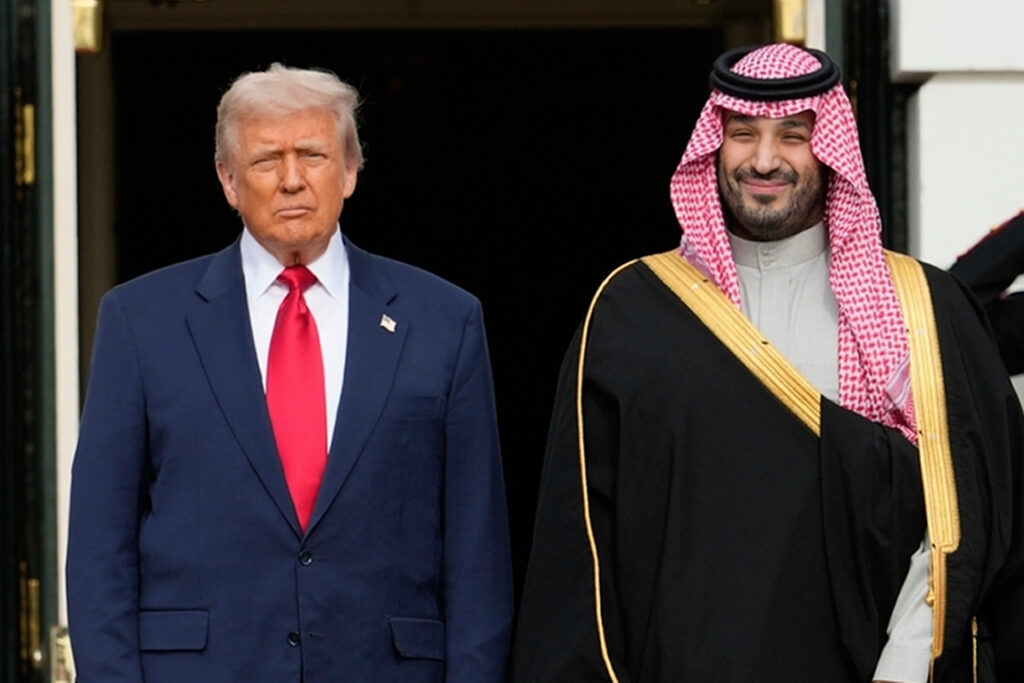
President Donald Trump, contending with soaring gas and diesel prices and a depleted munition stocks, has not offered a military intervention in response. Instead, the president — who since his first term has maintained close relations with Crown Prince Mohammed bin Salman, the de facto ruler of Saudi Arabia known as MBS — has been relatively blasé in remarks on the matter.
Last weekend, when asked about a call he had with MBS, Trump said that everything would be “fine and dandy.”
“The Houthis called us and they don’t want to fight with us … they don’t want us to go after them and would much prefer not having us involved and they’re letting most ships go through,” Trump said while visiting Ireland for a golf tournament. “It’s just one country they’re not too happy with. And we’ll get that straightened out.”
On Wednesday, Trump told reporters that “hopefully” the war would end soon. Without further explanation, he said that Iran wants to make a deal.
“We’ll see how that works out,” he added.
Two officials from Yemen, who are part of the Saudi-supported government and spoke on the condition of anonymity because of the sensitivity of the situation, said that requests made to Washington for assistance went unheeded.
“The government is indeed disappointed by the Trump administration’s lack of willingness to participate in the ongoing battles against the Houthis,” one of the officials said, adding that requests for help appeared to go “unheard and unnoticed” in Washington.
Michael Ratney, who served as the U.S. ambassador to Saudi Arabia from 2023 until January 2025, said the kingdom had “invested decades into its military partnership with the U.S. for just this kind of moment” of threat now confronting Riyadh.
“Now the moment has come, and the U.S. is not stepping up,” Ratney said, adding that the variety of threats facing Saudi Arabia in large part are the outcome of Trump’s decision with Israel to go to war with Iran.
A senior Trump administration official, speaking on the condition of anonymity under rules set by the White House, said the U.S. is focused on “protecting our core national security interests,” including freedom of navigation in the Red Sea, while “empowering our regional partners to take the lead in managing and resolving regional security challenges.”
“We are in continuous dialogue” with the Saudi government and the internationally recognized government in Yemen “regarding regional stability,” the official said. The official did not respond to questions about a Saudi appeal for assistance or Trump’s conversation with MBS.
The official said the U.S. expects the Houthis to abide by a May 2025 ceasefire negotiated after the Houthis attacked shipping in the Red Sea and the U.S. responded with air and naval strikes in Yemen. That episode showed that Trump “will take necessary action to protect freedom of navigation and U.S. commercial shipping,” the official said.
Saudi Arabia did not respond to requests for comment.
For his first international trip as president in 2017, Donald Trump chose Saudi Arabia. In Riyadh, the capital, he participated in a traditional sword dance; signed more than $110 billion in American arms sales; and gave a speech touting the strong partnership between the two countries.
Close ties between the countries persisted even after the killing of Washington Post columnist Jamal Khashoggi in 2018, which the CIA concluded that the crown prince approved.
Last year, Trump and MBS inked a strategic defense agreement, which included arms deals but not a mutual defense obligation.
Nearly seven months later, the war with Iran shows no signs of winding down — and, in many ways, the situation appears to be worsening, especially for nations in the Persian Gulf.
Saudi Arabia’s East-West pipeline, which became a vital bypass to export oil following Iran’s pressure on the Strait of Hormuz, remains largely shut after an attack last week that Saudi Arabia blamed on Iranian-backed militias in Iraq.
Iranian-backed Houthi rebels have seized control over the eastern shore Bab al-Mandab Strait — through which about 25 percent of the world’s container traffic and 10 percent of its oil flowed before the war.
And in recent days the Houthis have launched attacks on Saudi military bases and oil infrastructure across the country — including, according to Saudi Arabia, a drone intercepted before it could reach the holy city of Mecca, which the Houthis have denied targeting.
The battlefield advances have thrown global energy markets into further chaos, sending prices up at gasoline pumps in the U.S. and around the world and darkening the outlook.
Analysts who had been projecting oil flows would soon return to prewar levels are now warning the conflict has now entered a new, more damaging phase.
The East-West pipeline remains vulnerable to further attacks, and the cost of shipping oil through the Strait of Hormuz has skyrocketed, as Iran targets vessels trying to sail through sections of the waterway under the protection of the U.S. Navy.
The average cost of a gallon of regular gasoline in Michigan, $4.93, is 62 cents higher than it was just a week ago.
Diesel, which has a big impact on trucking and retail prices, continues to hit record highs, with the national average at $6.49 on Saturday, according to AAA — nearly $1 higher than a month ago.
Trump’s reluctance to get more involved comes as Republicans are at risk of losing their congressional majorities in midterm elections now less than two months away.
Lawmakers, primarily Democrats but also some Republicans, have questioned a Trump administration initiative to sign a civil nuclear agreement with Saudi Arabia and sell Riyadh four dozen F-35s, the world’s most sophisticated fighter jet.
On Wednesday, 15 senators — 13 Democrats and two Republicans — asked the administration to declassify and release all information about the proposed nuclear deal, including any annexes or side letters, as it has for similar agreements with other countries.
On Thursday, as a group of Democrats introduced a joint resolution to block the nuclear agreement, the administration notified Congress of its intent to sell the 48 F-35s, an agreement long-sought by the Saudis.
Congress has 30 days to register any disapproval, but will be out of session for much of the remaining time before the midterms.
Among other misgivings, lawmakers have expressed concern that the nuclear or F-35 deals could threaten Israeli military superiority in the region, and that the deals don’t include requirements for Saudi Arabia to normalize relations with Israel.
Even if the aircraft sale is approved, delivery will take years and have no effect on the current conflict in the region.
Andrew Leber, a Middle East scholar at the Carnegie Endowment for International Peace, said he believed that Trump wants to avoid getting involved and instead claim that the issue is one strictly between Saudi Arabia and the Houthis.
“At least in his mind, he can claim that this is not related to the war with Iran, even though that is obviously not true,” Leber said.
Saudi Arabia, he said, appeared to make the mistake of assuming that the U.S. would again strike the Houthis militarily, which it did in late 2024 and early 2025 as part of a campaign that ended with Trump declaring the group defeated.
Getting more involved militarily now might be unpopular in the U.S. — where fewer than a third of the population views the Iran war as worth fighting, according to polls. But analysts and officials said that there also could be costs to not intervening.
“The importance of Yemen is its geography,” said the second Yemeni official. “Iran understands that. The United States and Europe do not.”
The official said that Russia and China also see the strategic benefit of Yemen, and that adversaries of the U.S. were investing in the Houthis to help Iran gain more leverage over the United States.
“We feel that we are being attacked by our enemies and not supported by our friends,” the Yemeni official said.
Saudi Arabia and the U.S. for decades have maintained a strategic partnership based on the idea of “oil for security,” meaning that the U.S. helps ensure Saudi Arabia’s security as long as the kingdom, which before the war was the top oil producer, provides a steady flow of oil to the market.
Saudi Arabia in recent years has only doubled down on its investments in its relationship with the U.S., with MBS — who Trump called a “very good friend” — announcing during an Oval Office meeting last year that Saudi investments in the U.S. were close to $1 trillion.
Separately, and controversially, Saudi’s sovereign wealth fund invested $2 billion in 2024 in Trump’s son-in-law Jared Kushner’s private equity firm, Affinity Partners.
Those investments, however, have not translated into military action.
One problem for the Saudis “is that the U.S. is not in the mood to attack the Houthis, and the Houthis do not want to bring the U.S. into the scene … there is a mutual interest,” said Ahmed Nagi, a senior Yemen analyst for the International Crisis Group, a Brussels-based research organization.
In the past a combination of military pressure by Saudi Arabia and regional diplomacy brought the Houthis to the table. Without both, he said of the Houthis: “They are not un-defeatable, but they are really hard to beat.”
Nagi said that Saudi Arabia needs “to bring more countries on board” — including the U.S. and European Union nations — because the issue is not just between the Houthis and Saudi but a “broader security issue, especially now that the Houthis control [Yemen’s] western coast and Bab al-Mandab.”
In recent days, the Saudi Arabia-led coalition has launched airstrikes to “contain” the Houthis in western Yemen, one of the Yemeni officials said, but that strategy is expensive and unsustainable.
Pro-Houthi commentator Hussain al-Bukhaiti, whose brother is a senior political officer in the group, said that Saudi Arabia has launched more than 500 airstrikes against the Houthis in recent days, which prompted the Houthis to step up their attacks on Saudi’s oil infrastructure.
The Houthi rebels and Yemen’s military, backed by Saudi Arabia, were at war from 2015 until 2022. That war ended in a fragile ceasefire.
But the Houthis have in recent years grown increasingly frustrated by what they say is a blockade on their country by Saudi Arabia, which backs the internationally recognized government in the south.
Bukhaiti said that attacks by the Houthis would continue — and likely expand — until the Saudi aggression in Yemen ceases.
“Of course, this might damage the international economy,” he said, adding that the conflict is also hurting Yemen. “But we have nothing else we can do.”
Cat Zakrzewski contributed to this report.
The post As attacks choke off Saudi oil, kingdom confronts limits of Trump’s friendship appeared first on Washington Post.