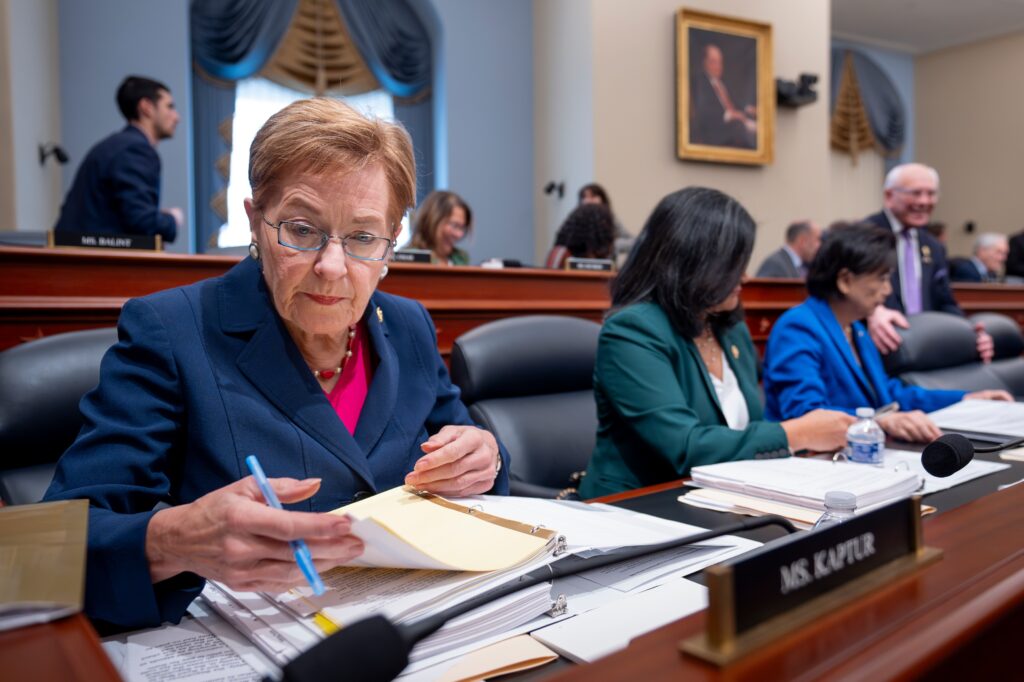
TOLEDO, Ohio — In an election cycle that has devolved into a state-by-state gerrymandering war, Rep. Marcy Kaptur (D-Ohio) stands as probably the most battle-hardened veteran.
At age 80, Kaptur is the longest-serving woman in Congress’s history, a milestone she passed three years ago.
In this year’s antiestablishment political environment, however, it is unclear whether her Washington experience will prove an asset or a liability. She’s also dealing with the physical toll of an early August hit-and-run car accident that put her in the hospital for a week, and a rehabilitation center for three weeks after that.
Then again, Kaptur has a record few can match when it comes to overcoming obstacles that come her way. Since 2011, the lines of her northwestern Ohio district have been redrawn no fewer than four times as Republicans have tried to find ways to defeat her.
The contortions have been extreme. For a decade, the 9th District included a 130-mile stretch of shoreline Lake Erie barely a mile wide in places. It took Kaptur three hours to drive from one end to the other of what became known as “the snake on the lake.”
As she seeks a 23rd term, Kaptur is in freshly reengineered territory in which Republicans upped their advantage by adding three rural counties, shifting the district further rightward by four percentage points.
“I know of no one who could hold that district as drawn, except Marcy,” said former Ohio governor Ted Strickland, a Democrat.
Kaptur is in a rematch with former state representative Derek Merrin, who came within three-quarters of a point of beating her in 2024. In that same election, Donald Trump carried the district by nearly seven points, making it one of only 13 across the country that voted for him while electing a Democrat to the House.
Merrin, who declined to be interviewed for this article, is using Kaptur’s age and tenure as a chief line of attack. In a campaign video, he said voters are “fed up with the political establishment, Democrats and Republicans, especially someone who has been in Congress for 43 years. Is 43 years not enough? I think so.”
On a recent Saturday morning, Kaptur tucked into a heaping plate of eggs, bacon and pancakes (and ordered a slice of apple pie to go) at her favorite diner, Schmucker’s. It is in a working-class Toledo neighborhood, around the corner from the bungalow her father, a grocer, bought in the 1940s and where Kaptur still lives and tends her large vegetable garden.
She has sounded unfazed, even fatalistic, about what could be her toughest contest since Republicans created the snake on the lake and gerrymandered her into a primary battle against a fellow Democrat, Cleveland-area Rep. Dennis Kucinich, in 2012.
“All we can do is show them our record of service — that in every community we go into, we try to help,” Kaptur said of her new voters.
She ticked off things she helped deliver in recent years: In Williams County, $5 million to upgrade the Amtrak station; in rural Defiance County, where fire rescue teams do double duty as medical emergency responders, a new fire engine; tens of millions of dollars for the Ohio Air National Guard’s 180th Fighter Wing; a better emergency management center in Sandusky County; nearly $40 million to enhance safety training for nuclear power plant workers, which is no small concern in a state with two active reactors; and funds for water and sewer facilities across the district.
“I had to fight for this region. Cleveland always had a lot more power because of the wealth that’s there. Our part of Ohio needed a strong voice,” she said.
As for the criticism she has stayed too long in Washington, she said: “I think you need a blend of ages in the Congress. The average seniority now is about six years, and they leave. You can’t do anything in six years.”
Kaptur is also counting on the deep connections she has been building with voters since the Reagan era. When then-Sen. JD Vance, now Trump’s vice president, showed up in 2023 at a United Auto Workers picket line in Toledo, Kaptur greeted him: “Good to see you. First time here?”
“First time here, yeah,” Vance answered, in an awkward moment that went viral.
Normally, congressional redistricting takes place once every 10 years, after a census. Ahead of the 2026 midterms, however, the process has been weaponized mid-decade in ways it hasn’t before.
Political leaders instigated the fights in Texas, California and several other states. Ohio’s new configuration, however, came as a result of a constitutional amendment stipulating that if its maps do not receive bipartisan support from the state’s redistricting commission, they must be redrawn after two election cycles.
This year’s was the result of a deal cut by the redistricting commission — which currently consists of five GOP and two Democratic appointees — that Democrats say avoided something worse for them.
Had the commission failed to reach agreement, the mapmaking would have been done by the state’s Republican-controlled General Assembly. Legislators probably would have drawn it so that Ohio’s congressional delegation, probably split between 10 Republicans and five Democrats, would have come up 13-2 in the GOP’s favor.
But the commission-approved version put both Kaptur’s district and that of Democratic Rep. Greg Landsman at greater risk.
Kaptur insisted she finds it “exciting” to meet people in the newer, more conservative areas that have been added to the district. She has made the rounds of agricultural expos, county fairs, hospitals and biofuel operations. “When I go out to some of these counties, they never met a Democrat, so they don’t know what to expect, and so there’s a lot of hands-on,” she said.
But her ability to do that was drastically curtailed when a hit-and-run driver smashed into the car that was carrying Kaptur and her campaign manager, Kegan Zimmerman, to a church service. Both were injured, with the congresswoman suffering what she said was damage to her ligaments. A warrant remains out for the arrest of the alleged driver, 23-year-old Jahiem Wright, who was charged with two counts of aggravated vehicular assault.
Kaptur is back on her feet but getting around slowly with the help of an ankle brace. “This accident that we had — not our fault — caused a little chaos, but we’re coming back, and we’re working very hard,” she said. “I’ve been working by Zoom. I’ve been going out where I can. We have a wonderful campaign team.”
The town of Napoleon is part of her new district. Local Democratic Party Chairman Rich Vargo said in an interview: “Generally, we’re up against a red wall here,” with Republicans getting more than three-quarters of the vote.
While he has no illusions that Kaptur can win Henry County, Vargo said he has seen signs of Democratic energy. He has been unable to keep up with the demand for yard signs, and the party’s booth at the county fair was mobbed. In the annual Tomato Festival Parade, which took place in August, “usually we get people yelling at us, but we were handing out literature and the feedback was incredible,” he said.
Perhaps most significant, Vargo added, close to 80 percent of Henry County’s registered Democrats voted in the May 5 primary.
And yes, Kaptur’s age bothers some. “I’m really fed up with government. We need younger people,” said Julie Schwiebert, a retired nurse and former Republican who attended an organizing meeting that Kaptur’s campaign held in Napoleon. But she added that, given the alternative, “right now, if you’re blue, you’re in.”
Why does Kaptur keep going? “What inspires me to run is the progress we’ve made, though it’s been too slow,” she said, getting a little choked up.
Yes, she acknowledged, there will be a time to hang it up: “Inter-generationally, we pass the torch, and I’m trying to do that with younger members. And hopefully, the work will continue.”
But the longest-serving woman in the history of Congress is not ready to see that day come just yet. In November, she will learn whether voters agree.
The post She’s survived four gerrymanders and a car crash. Can her luck hold? appeared first on Washington Post.