COUNCIL BLUFFS, Iowa — The strength of a potential JD Vance presidential campaign launch will be determined, in part, by how well the White House can mitigate Republican losses in November’s midterm elections.
On Friday, the vice president went for a twofer: He visited a deep-red district in a swing state, trying to mobilize Republican partisans whom the GOP desperately needs to turn out. It’s also the state that happens to be the first to get a say in who will be the 2028 Republican nominee.
Iowa Democrats have lost significant ground over the past decade, and President Donald Trump won the state by 13 percentage points two years ago. But Democrats are poised to potentially win several competitive seats this year. Races for the U.S. Senate, the governorship and two of the state’s four congressional seats are all highly competitive.
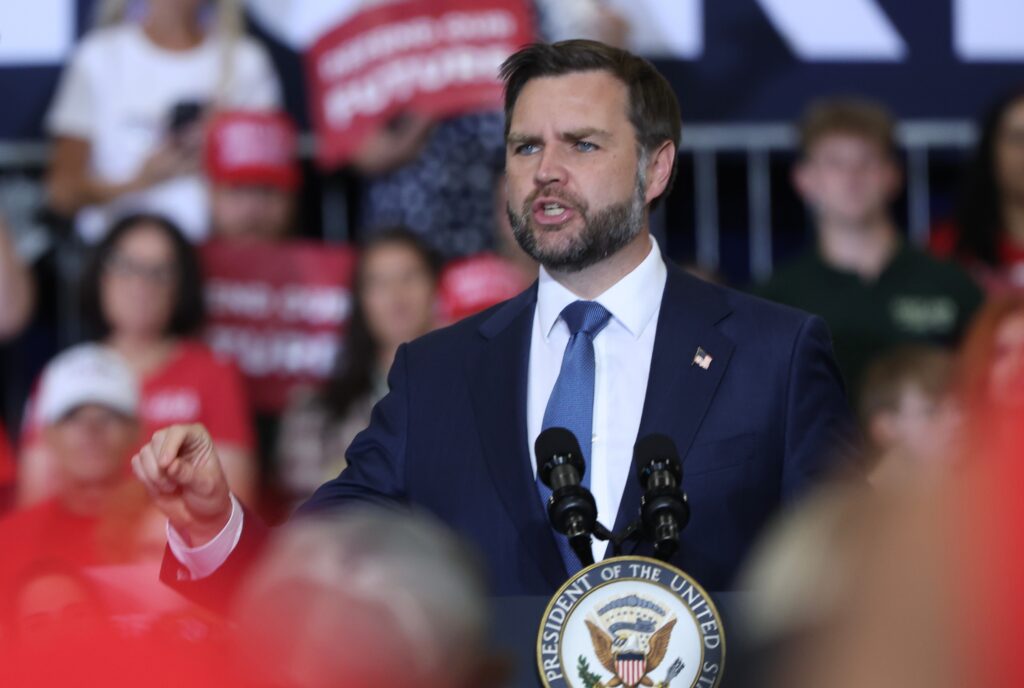
“I always tell you, ladies and gentlemen, whenever you hear me talk during this midterm campaign, I’ll say Rome was not built in a day because we know there’s a lot of work to do,” Vance said, urging the Republicans in the crowd to remember Trump’s accomplishments over the past year and a half and to trust the administration to continue delivering on campaign promises.
Democrats are “not the party that my grandparents grew up talking about,” he said, referring to his working-class Midwestern family that supported Democrats.
Vance was joined here by Zach Lahn, the Republican nominee for governor, who has consistently trailed his Democratic rival.
Absent from the rally was the state’s Republican Senate nominee, Rep. Ashley Hinson. In a sign of the poor environment for Republicans, Hinson this week started running an ad touting her commitment to “reaching across the aisle” and embracing bipartisanship, emphasizing that she has “worked with Democrats” on veterans’ issues, in addition to supporting Trump’s policies.
Instead of exclusively hammering Hinson’s Democratic opponent, state representative Josh Turek, Vance focused on Democratic Senate nominees in Michigan, Texas and Kansas. He said Iowa’s Democratic gubernatorial nominee, Rob Sand, was “cut from the same cloth” as the Democratic Senate nominees in those states.
Vance’s 30-minute speech also provided some lessons in the planning of a presidential run. The rally was beset by awkward pauses in the preshow soundtrack and poor acoustics inside the convention center here, which made it difficult to decipher the vice president’s remarks.
But the crowd gave Vance a warm welcome nonetheless, breaking out in a chant of “JD,” much as an arena of Republicans did last week when he addressed the party’s midterm convention in Dallas. The visit was his second to Iowa since May, when he made his debut here as vice president to stump for a swing-district House member in the Des Moines area.
Vance spoke directly to Trump’s base here in the reddest part of the state, where Republicans have their largest lead in voter registration.
Trump advisers told The Washington Post that the decision to travel there was aimed at encouraging Trump supporters to turn out this fall — a strategy the White House is deploying in swing states across the country as Democrats are running ahead in polls and GOP enthusiasm remains dampened.
Last week, Vance visited nearby Kansas, where the incumbent GOP senator is also facing a surprisingly close reelection fight. Trump won that state in 2024 by 16 points.
The location of Vance’s stop was just over the border from Omaha, Nebraska, a state Trump won by more than 20 points in 2024. There, too, the Senate race is proving to be a thorn for Republicans. They are spending nearly $25 million in advertising to defend the GOP seat — five times what backers of Dan Osborn, an independent running with tacit support from Democrats, has spent, according to the tracking firm AdImpact.
In Iowa, Nebraska and Kansas, farmers are under mounting strain from the war in Iran and Trump’s tariff policies, which have both raised the cost of fuel and materials.
Vance spoke directly to farmers, asking them to consider actions the administration has taken to open new markets for them, and to “strengthen the farm safety net,” citing $40 billion in farm aid.
He bragged that under Trump, the U.S. is “growing American food on American farms.” He did not mention Trump’s recent decision to temporarily import beef from other countries to lower costs amid shortages, a decision that has gone over poorly with many farmers and ranchers. In Kansas, the head of the Farm Bureau, who has supported Trump, recently condemned his beef policy.
Iowa Democrats on Thursday held a news conference in Council Bluffs to highlight Hinson’s support of Trump’s policies and the impact on farmers.
“This year we have spent as much on diesel at this point as we did all of last year, and we haven’t even started harvest yet,” Daniel Rosmann, a farmer from Shelby County, said at the Democrats’ event.
Hinson this week voted to allow the conflict with Iran to continue without congressional approval. Two of her Republican House colleagues from Iowa — swing-district Reps. Zach Nunn and Mariannette Miller-Meeks — flipped from their past votes and broke with the president on the war.
Nunn and Miller-Meeks, both veterans, voted to require Trump to seek congressional approval to continue the war, issuing statements saying that they did not want to see the conflict to continue open-ended and noting the deaths of Iowan service members.
Vance has yet to announce plans to run for president and has said he will make a final decision after the midterm elections. He received an exceptionally warm welcome from Trump supporters when he gave a keynote speech at the party’s midterm convention in Dallas last week, where Trump also praised his performance.
But Trump has declined to publicly endorse him for the job, saying it’s too early to do so, despite privately indicating he wants to help Vance get elected.
The post Vance campaigns in deep-red territory, highlighting risks for GOP appeared first on Washington Post.