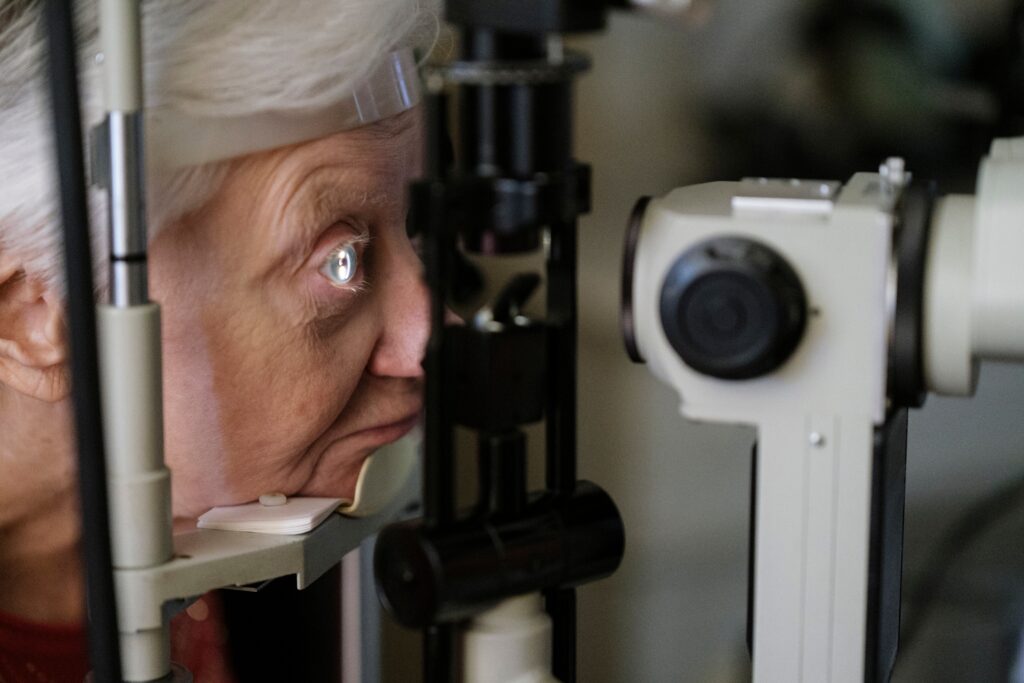
The first time Varda Yoran, 97, saw a phantom landscape, she was in a hospital wheelchair, waiting to be taken back to her room.
“Suddenly, I saw myself physically moved,” Yoran, a Brooklyn-based sculptor, recalled. “Nobody is pushing me. I’m not pushing myself, but I’m being moved out of the hospital, outside into the street, turning right, going to the corner.”
She saw trees and flowers, a yellow house, buses, and people walking. “I knew none of this was real. I knew it couldn’t have been real,” she says. Her reaction was understandable: “I thought I was going crazy.”
Yoran, who is legally blind, has Charles Bonnet syndrome (CBS), a condition in which people with significant sight loss experience visual hallucinations. It most commonly occurs with age-related macular degeneration (AMD), which damages the part of the retina responsible for sharp, central vision.
According to the American Academy of Ophthalmology, it is the leading cause of vision loss in people 50 years or older.
Studies suggest Charles Bonnet syndrome affects roughly one in six people with retinal disease or significant vision loss, with higher rates among those most severely affected.
“Sometimes, I see a person sitting here. A middle-aged man in a blue shirt and a little girl of about seven, standing there next to him,” says Yoran, who lives at home with on-site assistance and a steady stream of visitors to whom she speaks in multiple languages. “For sure, they’re not there. They’re sitting there in my living room. I know they’re not here, but I could see them so clearly that I could paint them.”
“When she told me about it, she told me she had been experiencing it for a long time but didn’t tell anyone because she thought she was losing her mind,” says Yoran’s daughter, Dafna Yoran. “But it was so intense in the hospital when they took her to the scan that she couldn’t keep it in any more.”
Ultimately, her daughter searched online for an explanation and came across Charles Bonnet syndrome. They later consulted a neuroscientist friend, and spoke to Yoran’s primary care provider who looked it up and agreed that it sounded like CBS.
It’s a familiar scenario for Surendar S. Purohit, a retina specialist at Specialty Eye Institute in Jackson, Michigan.
“Oftentimes the family will say, you know, ‘Grandma is saying weird stuff. She’s seeing things that we’re not seeing,” he says. His patients have reported seeing people, patterns and geometric shapes.
Why does a brain deprived of normal visual input generate such specific imagery?
Dominic H. ffytche, professor of visual psychiatry at King’s College London, has used brain imaging to study CBS hallucinations. He found that different kinds of hallucinations are associated with activity in specialized areas of the brain’s visual system.
For instance, the collateral sulcus, a groove in a part of the brain involved in visual processing, has “lit up” in fMRI scans, showing increased activity associated with hallucinated patterns and textures. Other areas are involved in processing more complex images, including landscape scenes.
“When the signals that normally come from the eye no longer come in, the cortex that’s deprived of its input becomes more excitable,” he says. “The brain cells there start firing at rest when they shouldn’t be, or they increase firing.”
CBS can happen with a range of eye diseases causing vision loss, and can occur in people who become blind. Macular degeneration is the most common culprit. What’s not clear is why some people experience hallucinations with sight loss and others don’t.
“There’s some rewiring that goes on, and for some people that leads to this overexcitability and hallucinations, and for other people it doesn’t cause that,” says ffytche.
And despite its prevalence, awareness of the condition remains limited.
“I think a lot of people are not familiar with it, even within the medical community. I don’t recall being taught this in medical school,” says Purohit. ” … But as a retina specialist, I see it all the time.
Too often, older people hide symptoms from families because of the stigma, ffytche says, worried they might have dementia or a serious mental illness.
“All those worries can be totally swept away just by having the conversation before the hallucination starts,” says ffytche, who co-authored Royal College of Ophthalmologists guidance on managing CBS.
Clinicians should also consider other causes or coexisting conditions. The good news: CBS is a normal response to vision loss, with “a very good likelihood” that intensity and frequency diminish over time, even if they don’t go away entirely.
For Varda, knowing in advance would have made a significant difference.
“It would have saved me a lot of nervous tension of thinking that I’m going crazy,” she says. “We have the right to know what to expect.”
The post How this common age-related eye disease leads to hallucinations appeared first on Washington Post.