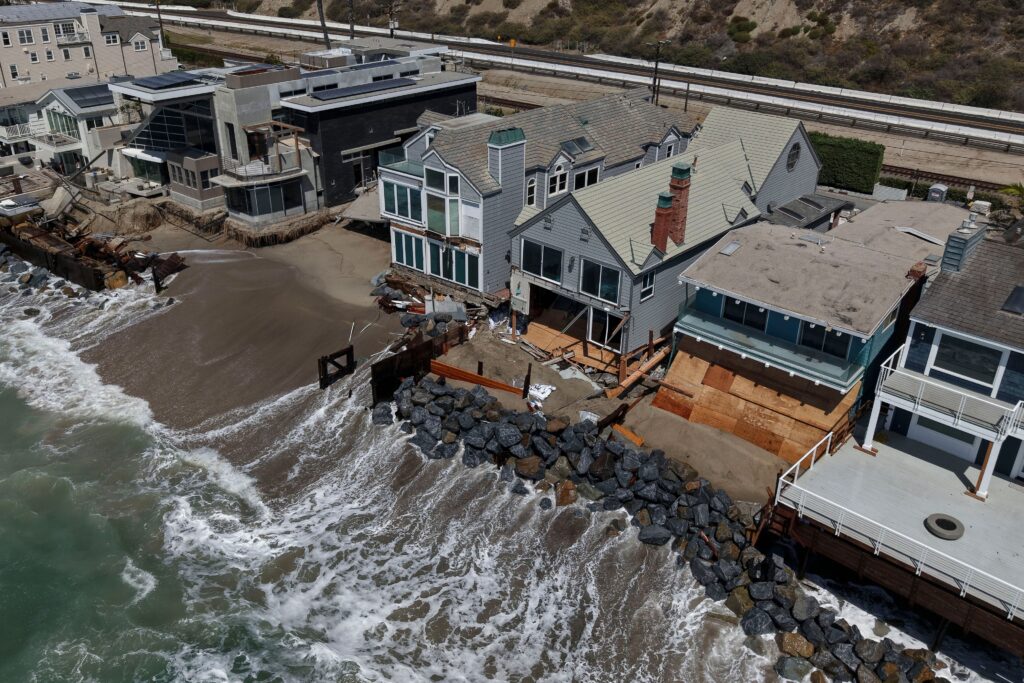
DANA POINT, California – Natalie Driessen drove down Beach Road on a mission, past neighbors whose houses fell into the sea and others now scrambling to prevent their property from collapsing next.
She had a video from March that she wanted everyone to see. When she spotted an Orange County supervisor outside what was left of one mangled kitchen and living room, Driessen pulled out her phone to play the clip of the California Coastal Commission — the powerful state agency tasked with preserving beaches — discussing a home in her gated community.
California beaches are considered public beyond a certain high tide line, the commissioners warned, and that waterline was rising. “I wonder,” one of the commissioners said, “how many years before I’m allowed to just pull up a chair — sit in their, you know, front deck porch and watch TV because it’s public land. … I don’t think we’re that far away from this, right?”
Storms and high tides — fueled by a near record-breaking El Niño — have battered the California coast in recent weeks, destroying homes and eroding beaches. The fallout has supercharged years-long tensions between the owners of coveted oceanfront property and the authorities they say aren’t doing enough to protect them.
The damage has intensified a bigger debate playing out around the coast: What can or should be done to save private property in the most vulnerable communities?
Driessen was furious about the March clip — convinced the authorities wanted her and other beachfront homeowners to give up and leave in the face of sea damage.
“We’re paying taxes!” the 51-year-old plastic surgeon told the county supervisor indignantly.
On Beach Road in Dana Point — which has been home and second-home to actors, famous athletes and members of the Disney family — the destruction has residents fuming and banding together. They’re organizing in a group chat and paying more than $50,000 per household, they say, to build a rock wall along the shore, desperate and rushing to stave off further damage with another El Niño-driven surge expected in a couple weeks.
Residents want to make the rock wall permanent, but “coastal armoring” is so controversial that the California Coastal Commission generally bans it in new developments.
“It’s important to note that while seawalls can provide temporary relief for homes, they can also increase erosion and destroy the public beaches that help protect those same structures,” Joshua Smith, a spokesperson for the Coastal Commission, said in a statement.
Smith said the commission has “for years repeatedly engaged the community and the city on medium- to longer-term strategies for preventing flood damage in this area,” adding that the agency has suggested installing a cobblestone berm, elevating homes or adding sand to beaches.
The commission approved emergency permits for the Beach Road rock barrier, which it says will cover 17 properties. But many residents are refusing to sign the papers — outraged that they may have to tear the wall down after 120 days if they do not get permanent approval.
Everyone agrees the community, and others like it, need a long-term plan to deal with the eroding beach. But they disagree over what that should look like, and who is to blame for the erupting crisis.
“When we have these emergencies like what happened last week, the responses are ad hoc … and generally they may not lead to better, good long term outcomes,” said Charles Lester, a former Coastal Commission director who now directs an ocean policy center at UC Santa Barbara. “Once the rock goes on the beach it’s very hard to bring it back up.”
One long-term option for vulnerable communities, Lester said, may be retreat.
“At what point do we start to recognize that maybe it’s not a good idea to have the development there?” Lester said. “If we get to that point, the question is not, ‘Okay, leave,’ it’s more like — ‘Okay, how do we facilitate a community transition?’”
Replacing the beach sand is another possible solution — but those efforts are expensive and could take years.
“If California is good at anything in this world, it’s bureaucracy,” Dana Point Mayor John Gabbard lamented in an interview.
The residents of Beach Road know that not everyone sympathizes with wealthy families losing their second homes with ocean views. Driessen sees comments on social media that suggest they deserve the misfortune. Some say they should have seen it coming in the risky business of beachfront real estate.
Driessen says she worked hard for her dream beach house, purchased two years ago. She took out loans and put herself through school.
Now her backyard is destroyed; her home is still standing but at risk whenever the next storm hits.
Driessen’s problems started last year, she said, with a sinkhole. By this summer, the holes had multiplied and she called local officials in a panic, saying she worried she would lose the house.
She estimates that she and a neighbor collectively spent more than $400,000 trying to avert disaster, reinforcing a seawall and putting up sandbags.
They raised alarms, she said, but got little help.
She said she tried to rally people into collective action at a neighborhood party in August. “Guys, are we going to wait for someone to get red-tagged?” she remembers asking, using the term for a home marked uninhabitable.
It didn’t go anywhere, she said. Then Hurricane Marie hit Southern California this month.
The storm reshaped iconic spots along the coast. In Laguna Beach, officials declared an emergency. In Malibu, dozens of homes were evacuated after a giant sinkhole opened up outside the home of actor Nicolas Cage. In Santa Monica, beach erosion was so bad that officials canceled a music festival scheduled for the end of September.
The storm hit especially hard in Dana Point, a little more than an hour south of Los Angeles.
Away in Hawaii for a wedding, doctor Shalesh Gupta checked video footage from his Beach Road home and realized that his patio collapsed into the ocean. The waves had destroyed his seawall. The bedroom and living room fell next.
Like other homeowners in the area, he said, he only has $250,000 in flood insurance — not enough to cover the loss. His lot is empty. His daughter has urged him to give up on his second home there. “I’m telling you — water is rising, you need to sell the property,” he recalled her saying.
Experts say that California could see its highest sea levels ever this winter because of El Niño.
But Gupta and other residents are adamant: They can rebuild with the right protections.
“This problem that we now have was preventable,” argued Katrina Foley, the Orange County supervisor who visited Beach Road.
Experts recommended depositing sand decades ago to counter erosion, she said, but local officials didn’t do it. Now they are trying to “make up for 50 years of inaction,” she said.
The county is working to replenish sand in a few key areas, and officials say those efforts could help other shores such as Beach Road’s. Orange County and the city of Dana Point have both declared emergencies, and local officials say they are working with state and federal representatives to get resources.
For now, the Beach Road homeowners are banking on their own temporary solution: the rock wall.
“All of the effort that’s happening right now is 100 percent the residents … everything from manpower to dollars and cents,” said Chris Rogers, whose home was largely wrecked.
Driessen and neighbor Steve Watts, 68, stopped outside Gupta’s empty lot to chat with one of the men they hired to build their wall. Driessen brought up the video of the Coastal Commission meeting again as waves crashed over their barrier-in-progress.
In her kitchen later, she vented to Watts and another neighbor. “My house was built in 1956, before the Coastal Commission even became a thing,” she said. “So I can protect my home.”
“Constitutionally, we can all protect our home,” Watts said.
“Right,” the third neighbor said.
Plenty of people disagree with their push to fortify the beach, however.
“The real threat to California’s beaches isn’t the waves — it’s the concrete we pour after they hit,” argues a recent op-ed in the San Francisco Chronicle co-written by Lester, the former Coastal Commission director.
California requires local governments to create adaptation plans for sea level rise by 2034. The Coastal Commission has been giving grants for long-term planning , said Kelsey Ducklow, the commission’s statewide coastal resilience coordinator.
“What we hope to avoid for all communities is the sort of reactive responses that we’re having to see now,” Ducklow said.
The post Fight intensifies over the fate of homes falling into the sea appeared first on Washington Post.