Russia is just one day into three-day elections that will determine the makeup of the lower house of the country’s parliament, the State Duma. But the outcome of the vote has been all but guaranteed since before the first ballots were cast.
The elections, the first parliamentary vote the country has held since its invasion of Ukraine in 2022, are widely expected to result in the Kremlin-aligned United Russia party maintaining its overwhelming dominance in the Duma.
The party currently holds 310 of the 450 seats in the chamber, giving it a supermajority and the power to make major legislative decisions without the input of other parties. It needs to keep at least 300 seats to retain that supermajority.
Four other political parties are also expected to be represented in the Duma following the election, all of which generally vote in line with United Russia and support the war in Ukraine. They are the Communist Party of the Russian Federation, the Liberal Democratic Party of Russia, the A Just Russia party, and the New People party.
Democracy watchdogs and foreign governments have denounced Russia’s elections as being neither free nor fair. Russian officials have rejected such claims in the past, saying that the country carries out its voting process in line with the law.
But experts tell TIME that the Russian government exerts its influence in ways that all but predetermine the results of elections and ensure that President Vladimir Putin and United Russia maintain control.
And this year’s vote, says David Szakonyi, an expert on Russia and election fraud who is professor at George Washington University, is “occurring in the most repressive political environment in Russia’s post-Soviet history.”
Here’s what experts have to say about how the Kremlin ensures elections result in its desired outcome—and why it continues to hold them.
Restricting opposition
The Kremlin uses multiple levers to influence elections on the government level, at the polls, and in daily civilian life, according to Szakonyi.
“Without a doubt, the most powerful tool” in the Kremlin’s arsenal, Szakonyi says, is limiting which candidates appear on the ballot in the first place.
In the case of the ongoing parliamentary vote, the one anti-war party that was registered by the Central Election Commission, the Yabloko party, was prohibited from participating in the election by Russia’s Supreme Court. The high court ordered that the party be removed from the ballot last month in response to a lawsuit from the pro-Kremlin Rodina party that accused the Yabloko party, which has garnered support from young Russians and those opposed to the war in Ukraine, of copyright infringement, receiving foreign funding, and extremism.
Szakoni says that the Kremlin has the ability to “harness the judicial system to pass rulings” such as the Supreme Court’s decision against the Yabloko party, which it uses as a “legal veneer” that shields the influence of Putin’s government over the ballot.
This screening of anti-war and other opposition parties, he says, comes months in advance of elections, creating a list of candidates that includes little or no meaningful opposition at all.
The Kremlin has also labeled opposition figures who oppose the war as “foreign agents,” a designation that prevents them from holding public office. In other instances, opposition leaders and activists such as Alexei Navalny have been prosecuted and imprisoned. Still others have fled the country.
The vote count
Experts tell TIME that the Russian government has also exercised its influence more directly on vote counts to achieve its desired election results.
“Historically,” Szakonyi says, Russian electoral officials have “intervened regularly to deliver votes to the ruling party and take them away from competitors.”
In the past, this was done via “crude ballot box stuffing,” he says; now, he asserts it is also performed by altering the results of online votes.
Online voting is used in more than a third of Russia’s regions, which Szakonyi asserts puts more power in the government’s hands since it eliminates the physical tally represented by paper ballots.
“The way that the electronic votes are being counted is almost completely a black box for the rest of society,” he says.
Regina Smyth, an expert on Russia and authoritarian regimes who is a professor at Indiana University, says that “falsification,” or the practice of altering the number of votes that are counted, occurs at precinct election commissions, of which there are over 90,000, all across Russia, that she says are “mostly staffed by loyalists, and they will simply report false numbers.”
There is also fraud, Smyth alleges, in “mobile voting,” when officials deliver and pick up ballots from people in their homes who are, for example, disabled or ill and unable to vote otherwise.
‘Implicit threat’
On a deeper level, an “implicit threat” stemming from the Russian government sways countless votes each election cycle, Szakonyi contends.
“Many Russian voters do not have the autonomy to cast an independent vote. They work for the state,” he says. He argues that many university students, healthcare workers, and teachers, whose livelihoods depend on state-run organizations, belong to a “block of captive, vulnerable voters” who fear prosecution by the Kremlin more than they value the influence of their ballot.
Voting is also taking place this year in Russian-controlled areas of Ukraine: in Crimea, which Russia annexed in 2014, and in the Luhansk, Donetsk, Kherson, and Zaporizhzhia regions.
“In the occupied territories of Ukraine, where the elections are being held in these illegally occupied territories, soldiers, heavily armed soldiers, travel from house to house coercing people to vote,” Smyth tells TIME.
A lack of independent election oversight
On top of the various methods the Kremlin allegedly uses to achieve the voting results it wants, there are slim to no oversight mechanisms in place to document election interference in the country.
Golos, which was the only independent election watchdog within Russia, shuttered in 2025 following years of governmental pressure after its chairman was found guilty of working with an “undesirable organization” and imprisoned in a penal colony.
Szakonyi describes Golos’ loss as the “biggest blow toward any type of accountability” for the Kremlin, saying it was “the biggest tool that civil society had to identify, uncover, and publicize the fraud that was basically happening in every single electoral cycle.”
Russia has also refused to invite international election monitors from the Organization for Security and Co-operation in Europe (OSCE), the world’s largest regional security organization, to observe this year’s elections.
Maria Telalian, director of the OSCE’s election-monitoring office, the Office for Democratic Institutions and Human Rights, said in a statement last month that the decision not to invite any OSCE monitors was “deeply regrettable, particularly as it continues a pattern of not implementing the commitments that every OSCE participating State has undertaken towards its own citizens and the international community.”
The ongoing vote marks the third nationwide election in Russia to take place without OSCE observation. Russia previously imposed severe limits on OSCE election observation in 2021 that the organization said made monitoring that year’s parliamentary elections in the country impossible. It did not invite the group’s monitors to the 2024 presidential election at all.
So why is Russia holding elections at all?
Despite the results of the parliamentary elections being all but determined, they carry a symbolic weight crucial to Putin’s legitimacy in the public eye and his desire to continue the war against Ukraine, experts tell TIME.
“There’s lots of reasons to have elections. First and foremost, the Russian population expects elections,” Szakonyi says. “Putin’s legitimacy depends on his ability to win election votes to the presidency and have his ruling party win on a regular interval, and demonstrate that they’re popular and that their policies are in demand from the citizenry.”
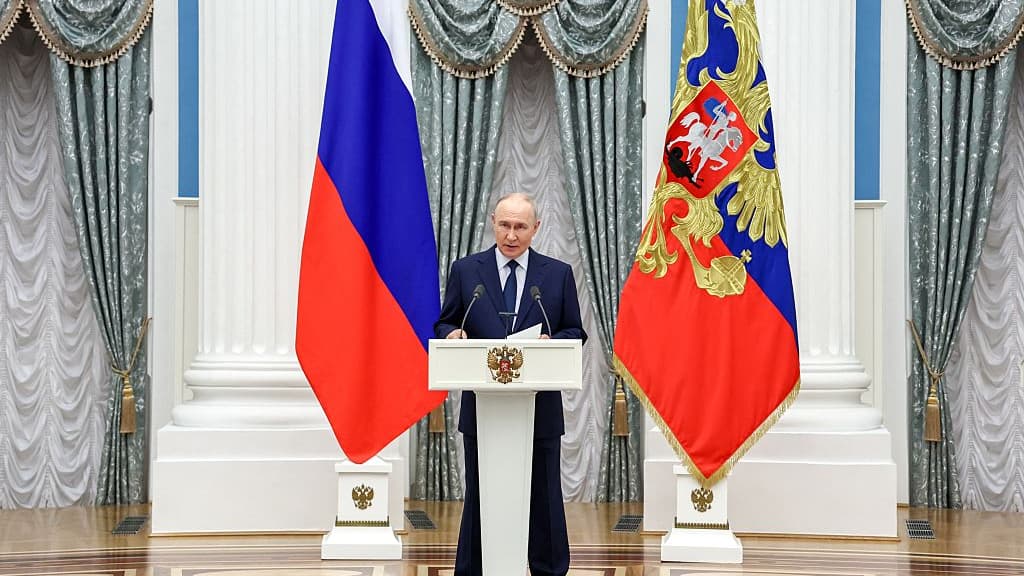
During an address in which Putin urged Russians to vote days before the elections began, the leader said that “your choice and resolve will show once again that millions of people stand behind our fighters” and that “participating in the elections is our shared contribution to Russia’s victory.”
“This is a way for him to theoretically show that the Russian population is united behind his war and wants to continue fighting, and that Russia has had this referendum and will continue to push harder,” Szakonyi says.
The post Why the Outcome of Russia’s First Parliamentary Elections in Years Is All But Assured appeared first on TIME.