The House lawmakers on Wednesday passed legislation paving the way for tough new sanctions on Russia that will target financial institutions and the energy industry, which has largely financed the assault on Ukraine.
The legislation, which now sits with President Donald Trump for signing, has been hailed for its harsher measures on Russia, with Ukrainian President Volodymyr Zelensky calling it “an extremely powerful tool.” However, Democratic leaders have expressed grave concern over the broader tariff authority it affords to Trump.
The legislation allows Trump to impose tariffs of up to 100% on countries that make “new purchases of crude oil or natural gas” originating from Russia, or any country among the top five importers of Russian oil or gas over the last 12 months.
According to the Center for Research on Energy and Clean Air (CREA), the top three purchasers of Russian oil and gas in August were China, India, and Turkey.
Deborah Elms, head of trade policy at the Hinrich Foundation, says Trump’s previous ambition to introduce tariffs using any available avenue has ignited the concern among Democrats.
“The reason why people are so nervous about this is that the authority is extremely wide, and has been handed to an Administration that has already shown great latitude to follow the spirit of the law,” Elms tells TIME. “Tariffs could be set at 100%. It’s really at the discretion of the Executive Branch.”
Democratic leaders sound the alarm on “terribly flawed” bill
The bipartisan effort, named in honor of the late Republican Sen. Lindsey Graham of South Carolina, who spent the final year of his life building support for the measure, passed with 262 votes to 159. Some 58 Democrats voted with the majority of Republicans in favor of the bill, despite objections from party leadership.
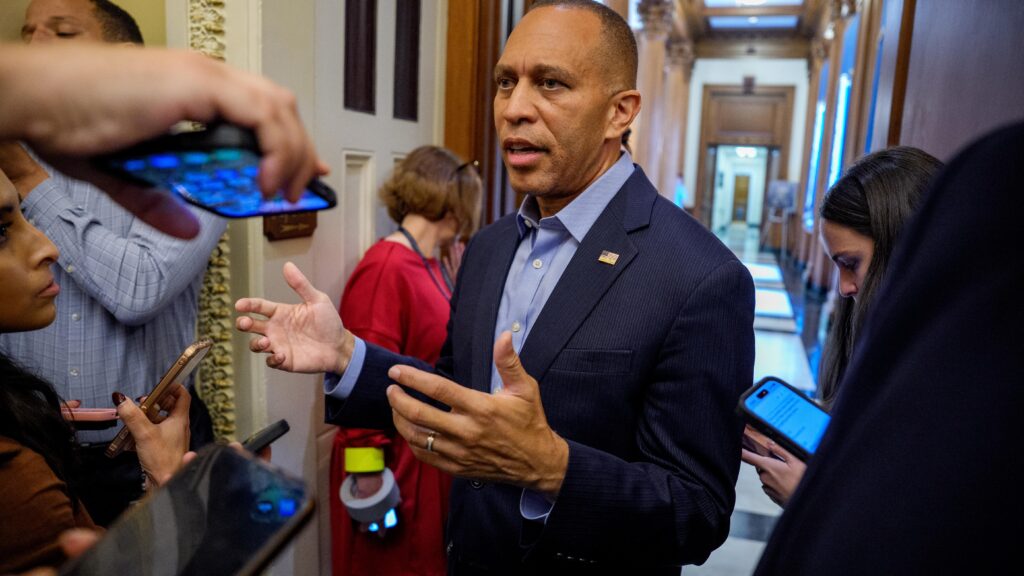
House Minority Leader Hakeem Jeffries has led the Democratic opposition to the bill, raising concerns over giving Trump new tariff powers.
“Why in the world would this Congress or the People’s House give this President unfettered authority to visit more tariffs on the world that will have an adverse economic impact on the American people?” the New York Representative questioned ahead of the vote.
After the bill passed, Jeffries told TIME that Trump “cannot be entrusted with new powers to impose tariffs that will further raise costs for American families.”
TIME has reached out to the White House for comment.
Shortly after his return to office, Trump implemented global tariffs as part of what he called a “Liberation Day.” Although the majority of those were shut down by a Supreme Court ruling in February that deemed them illegal, his general use—and threatened use—of tariffs has continued to fuel international tensions.
Tariffs introduced since Trump’s return have already made their mark on American households, experts say. The Yale Budget Lab in late August estimated that household costs due to tariffs “total about $1,100 annually under current law.”
The U.S.-Canada has raised fresh concerns over the financial impact on American consumers.
Many Americans are already struggling with the cost of living crisis. The Urban Institute in April found that “49% of people in American families don’t have the resources to cover essential expenses to live securely in their community.”
Rep. Gregory Meeks of New York, the top Democrat on the Foreign Affairs Committee, has also raised the alarm about the potential impact on American families.
In the weeks leading up to the Russia sanctions bill, he urged lawmakers to find a “compromise that properly punishes Russia for its illegal war of aggression against the Ukrainian people, while protecting the American people from reckless inflationary tariffs.”
In a statement to TIME after the vote, Meeks said he found it “regrettable” that lawmakers chose not to “place more guardrails” on the bill’s tariff authorities.
Similar concerns were raised by Rep. Don Beyer of Virginia, who described the bill as “well intentioned, but terribly flawed” in its efforts to hinder Russia’s war effort against Ukraine. “Trump has abused every tariff authority Congress has delegated to the President,” Beyer told TIME, accusing his colleagues of choosing to “ignore our warnings that he is highly likely to continue that pattern with this bill.”
Beyer had delivered a stark warning on the floor ahead of the vote, insisting the bill “would do more harm than good for America and for Ukraine.”
“Trump has abused every presidential tariff authority—every single one—that Congress has given, often to target our allies. This bill has a loophole that would allow him to define basically any country as a facilitator of evading Russian sanctions,” he argued. “He could then hit them with tariffs of up to 100%, with no guardrails or oversight, and no expiration. It’s a much stronger tariff power than those he has already abused, and it would be much harder to challenge in court. Giving him this power when he has shown us over and over again what he will do with it would be an incredible mistake.”
Why other Democratic lawmakers supported the legislation
The legislation’s capacity to economically isolate Russia earned it the bipartisan support needed to get the bill to Trump’s desk.
The bill allows for the further introduction of sanctions on persons and financial institutions affiliated with the Russian government, the prohibiting of energy exports and investment into Russia, and blocks the transfer of funds to the Kremlin.
The bill also includes the potential to expand sanctions on Iran, and comes amid growing concerns from the U.S. over the relationship between Moscow and Tehran. The U.S. Treasury on Monday announced the latest sanctions targeting the Russian bank VTB over allegations it is involved “in Iranian sanctions evasion.”
Democratic Rep. Marcy Kaptur of Ohio, who co-chairs and co-founded the Congressional Ukraine Caucus, is in firm favor of the legislation. ”We’re going to pay close attention to the Administration and to see what they’re going to do with these new powers that have been given,” she told TIME after the vote.
Kaptur previously said that both the sanctions and tariff measures were “the best chance we have to get bipartisan legislation signed into law to hold Russia accountable and achieve peace.”
Rep. Steny Hoyer of Maryland also praised the legislation, championing it as an additional way to showcase support for Kyiv. “Today we took a step to redeem our pledge to Ukraine, to support their sovereignty and their democracy,” said Hoyer outside the Capitol. “We will sanction, actively and effectively, Russian criminal behavior.”
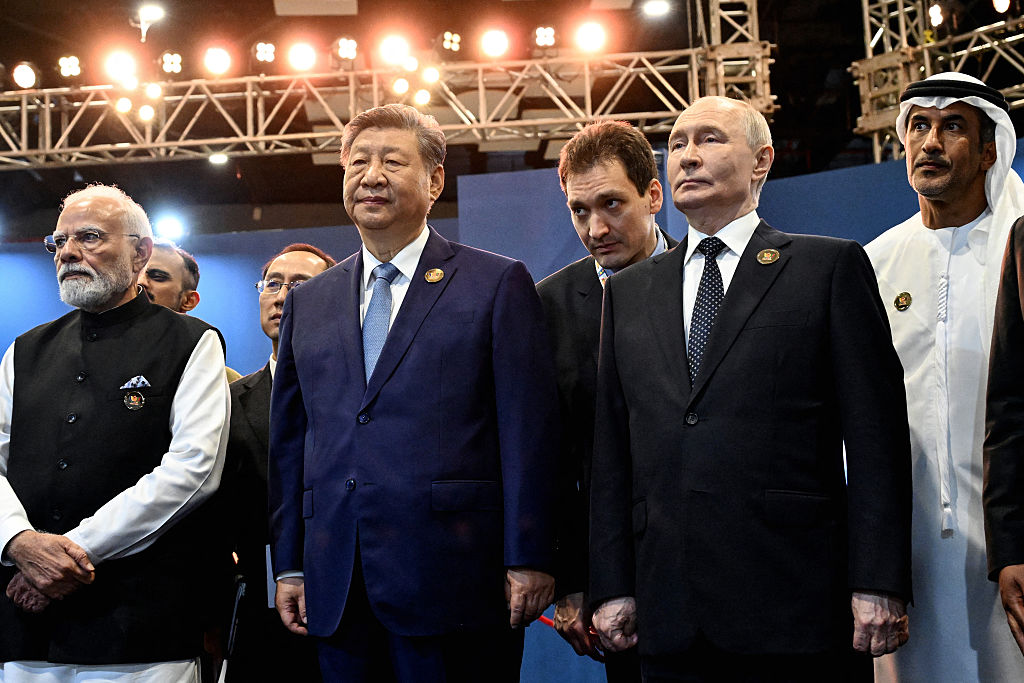
How China and India could be impacted by the Russia sanctions bill
The legislation extends Trump the authority to impose tariffs on new and prominent importers of Russian oil and gas.
The legislation could prompt a new wave of tariffs handed out by the President, experts warn. “The tariffs can be introduced across the board,” says Elms. “This is what makes it so alarming.”
China and India are two major importers of Russian oil and gas and therefore stand to be the most affected. In August, China was importing roughly 1.25 million barrels of Russian Crude oil daily, according to commodity analysts Kpler via Reuters. India imported record-highs of 2.5 million barrels daily of Russian Crude in June, per Kpler’s analysis.
According to The European External Action Service (EEAS), Russia’s shadow fleet—largely unregulated oil tankers transiting sanctioned oil—includes between 600 to 1,400 vessels. Exports are crucial for China and India, the leading importers of seaborne oil from Russia.
U.S. sanctions have already targeted Russian oil tankers and Moscow’s energy industry in response to the full-scale invasion of Ukraine. Still, China and India have remained steady buyers, but the threat of tariffs could change the attitude of both countries, experts predict.
“I think they will be quite concerned on this one,” says Elms. “Presumably because of this [bill], we will see some diversification away from Russian energy by India and China.”
While the Supreme Court ruling barring most of Trump’s prior tariffs cited Congressional power to impose tariffs, this argument won’t be applicable if lawmakers attempt to restrict the President’s ability. “In this case, Congress has quite clearly given that authority to the President,” says Elms.
Beijing has hit back firmly against the tariff measures included in the bill. “China opposes long-arm jurisdiction and unilateral sanctions that have no basis in international law,” said Foreign Ministry spokesperson Guo Jiakun.
The legislation comes at a crucial time for U.S.-China relations, just a week ahead of President Xi Jinping’s visit to Washington. U.S. Treasury Secretary Scott Bessent is also set to meet with his Chinese counterpart, Vice Premier He Lifeng, this weekend.
The U.S. already has a number of tariffs in place on Chinese goods, including a tariff of up to 12.5% on goods allegedly made with forced labor. The U.S. Trade Representative’s last year launched a tariff investigation into China’s “apparent failure” to comply with the “Phase One” trade deal signed with Trump in 2020.
Meanwhile, India’s Foreign Ministry responded to the new sanctions bill by saying it was “monitoring further developments.” The statement said India “remains firmly committed to ensuring energy security for its 1.4 billion people” and “will continue to do so through diversified sourcing.”
The statement said imports of Russian energy had been discussed with U.S. officials in recent months, and that “implications for not just the bilateral relationship, but also the international energy market have been very clearly articulated by the Indian side.”
Trump threatened tariffs on Indian goods last August in response to Delhi’s continued purchasing of Russian oil. “They don’t care how many people in Ukraine are being killed by the Russian war machine,” claimed Trump, days ahead of his meeting with President Vladimir Putin that yielded no concrete results.
Similar to China, India also currently faces a tariff on alleged forced labor goods, with the levy landing at 10%.
After agreeing on a framework for a bilateral trade agreement in February, Delhi and Washington have continued negotiations since.
“India and the U.S. have been supposedly a ‘moment away’ from a bilateral agreement,” says Elms. “I think it is highly unlikely now that India will actually sign that agreement because they are now potentially subject to new tariffs at any time.”
The post Democratic Leaders Fear the New Russian Sanctions Bill Could ‘Harm’ Americans. Here’s Why appeared first on TIME.