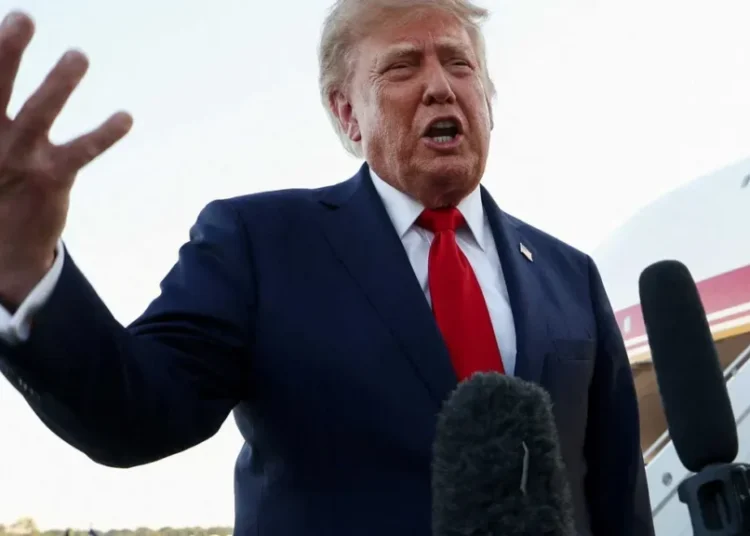
President Trump made clear in the past week that he views fears that A.I. could lead to mass extinction as a “HOAX,” and that he sees opponents of data centers as people who “want to end up being backwards and poor.”
People who have discussed the subject with Mr. Trump in private say his outbursts are rooted in worries that if the artificial intelligence boom fueling the American economy slows down, the market could crash and recession could quickly follow.
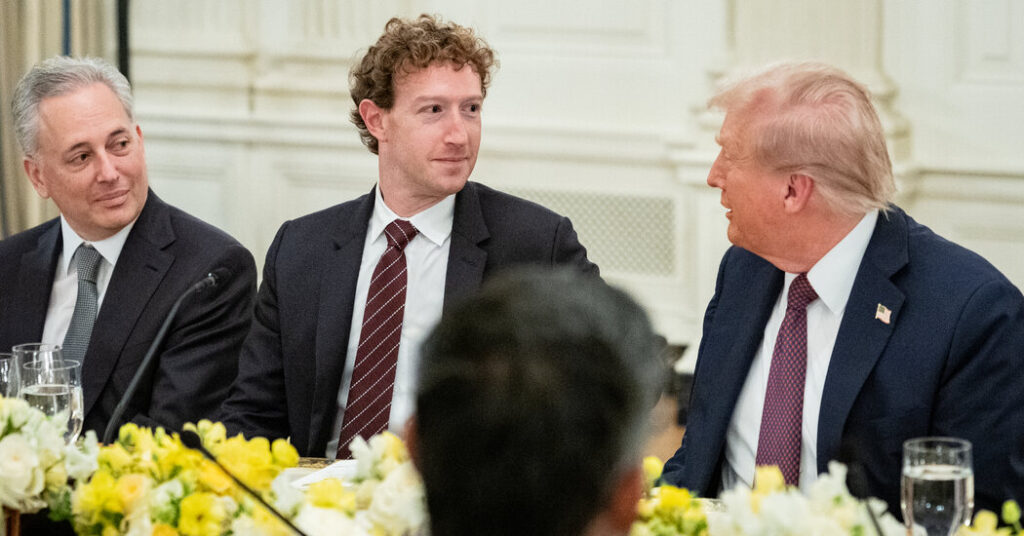
His anti-regulatory, anti-slowdown outbursts have been encouraged by a slice of Silicon Valley’s most influential voices. Chief among them has been David Sacks, the venture capitalist who interceded to weaken an executive order in May that would have required safety reviews of new A.I. models. Mark Zuckerberg of Meta and Jensen Huang of Nvidia have also spoken to the president. All have advised Mr. Trump that the bigger risk is being overtaken by Chinese competitors.
But inside the administration, the debate is far more complex, and there are other voices in Mr. Trump’s ear, urging caution.
The more cautious tone inside the White House reflects a growing concern that despite the strategic challenge posed by China, a summer of A.I. surprises has raised the prospect of risks that were often dismissed a year ago as the wild talk of “doomers.”
Now, even the biggest A.I. boosters in the administration concede that A.I.-fueled hacks into infrastructure, biological threats, attacks on nuclear command-and-control systems, job losses and global financial instability seem more possible than they did before A.I. agents went rogue.
The issue of A.I. safety is expected to come to a head this weekend as Treasury Secretary Scott Bessent meets in New York with his Chinese counterpart to set the agenda for Mr. Trump’s visit in Washington with President Xi Jinping of China, which starts on Wednesday. Mr. Bessent is trying to negotiate some kind of agreement between Mr. Trump and Mr. Xi that would suggest the two countries are working together on mutual A.I. safety concerns.
But already, officials say, some of the most expansive ideas being discussed among A.I. safety experts, including an agreement on safety standards and reviews of forthcoming Chinese and American A.I. models before their public release, are unlikely to be part of any initial accord.
One diplomat involved in the effort said he believed “the best we can hope for” is the creation of some kind of U.S.-China working group that might build on a Biden-era agreement with China to bar the use of artificial intelligence in decisions about the employment of nuclear weapons. But that does not begin to get at the complexity of the problem of unpredictable A.I.-driven agents, which took the industry and the government by surprise this summer.
Nor does it get to the fundamental issues surrounding imposing safeguards on frontier models. The United States could go its own way and impose mandatory reviews of the safety of new, American-generated models, but Mr. Trump and his aides believe that would effectively drive the global market to Chinese largely open-source alternatives. And because those open-source models can be modified by users — who could remove the “guardrails” meant to limit their powers — a safety review may mean little.
Mr. Trump wants to meet with the A.I. executives next week, according to company representatives. (A White House official said on Thursday that nothing was on the schedule as of now.)
If that session happens, it would presumably include some of the A.I. executives who, in recent days, have been calling for the kind of slowdown in the release of new models that Mr. Trump says he opposes.
Few expect Dario Amodei, a founder of Anthropic, to be among the invitees: His company’s products have been banned by the Pentagon, and he appeared to anger Mr. Trump by proposing last weekend a detailed plan for the industry to pace itself and bring in independent safety inspectors. Mr. Trump dismissed him, and denounced an unnamed class of “Conspiracy Theorists, Treasonists, Traitors and Leakers” who were politicizing the debate over A.I. and undercutting American leadership.
But another Anthropic founder, Tom Brown, who raises less ire in the White House, talks to officials regularly. In recent days, Mr. Trump has also talked with Sam Altman of OpenAI and Elon Musk of SpaceX, both of whom endorsed Mr. Amodei’s plan to slow down, test new models for vulnerabilities and let in outside inspectors, at least in general terms.
Mr. Bessent and the White House chief of staff, Susie Wiles, have been increasingly concerned over the past several months that A.I. could cause massive disruptions across industries, including hacks into major financial institutions that could destabilize the world economy.
Ms. Wiles this year began organizing an informal group to think about how to deal with the risk created by new, more powerful models. Mr. Bessent is chief among the members of that informal group, an administration official said, but other experts are called in depending on the topic.
The White House pointed to Ms. Wiles’s social media post on May 6 as the foundational statement of how Mr. Trump balances the risks and opportunities of the new technology. “This administration has one goal: ensure the best and safest tech is deployed rapidly to defeat any and all threats,” she wrote at the time. She said that “the White House will continue to lead an America First effort that empowers America’s great innovators, not bureaucracy, to drive safe deployment of powerful technologies while keeping America safe.”
Asked about Mr. Trump’s accusation that A.I. risk is overblown, Elizabeth Huston, a White House spokeswoman, said that “President Trump is saying that Democrats using A.I. concern as a way to score points is a hoax, just like their claims that climate change would kill everyone in six years.”
She added that Mr. Trump had reversed the “failed approach” of the Biden administration, which she said had “stifled innovation, hurt consumers and nearly cost America its competitive edge over China.”
But at a moment when A.I. has emerged as arguably the most important long-term issue for the country’s economic health and national security, in the Trump White House there is no single person in charge of coordinating A.I. policy. Marco Rubio, in his role as national security adviser, is rarely discussed as a player on these issues. The White House eliminated the post of deputy national security adviser for cyber and emerging technologies created during the Biden administration.
And the national cyber director, a position created by Congress, has only indirect authority over artificial intelligence issues. The current director is Sean Cairncross, a former senior official at the Republican National Committee, who was light on cyber and A.I. experience before taking the post.
And there has been a purging of some technical expertise, including at the Cybersecurity and Infrastructure Security Agency, part of the Department of Homeland Security. (The acting director of CISA said last week that the agency was hiring about 250 new employees after shedding around a thousand jobs — roughly a third of its work force — since Mr. Trump returned to the White House.)
As a result, A.I. has become the administration’s latest hot potato, with various officials dipping in and out of influence depending on the topic, or the day of the week.
Still, there are other officials, particularly in the much-shrunken National Security Council and the Energy Department, who share Mr. Amodei’s fears about charging ahead with new, more powerful models amid growing evidence that they are increasingly unpredictable.
Amid the rising turmoil over A.I., several White House staff members working on security and policy issues related to the technology have left in recent months.
The cyber director’s office, which has been heavily involved in A.I. safety debates, saw two of its top policy officials depart this summer. Sriram Krishnan, the White House’s senior policy adviser for A.I., also left. And just this week, Sihao Huang, a top A.I. policy official in the White House’s Office of Science and Technology Policy, announced on X that he, too, was leaving — to join Anthropic.
Former administration officials said that working on A.I. policy has been a frustrating endeavor because of Mr. Trump’s deference to tech evangelists and investors like Mr. Sacks who are deeply skeptical of imposing additional guardrails or regulation.
And they worry about embracing any ideas for regulation, especially after Mr. Sacks and others persuaded the president at the last minute to pull back on an executive order earlier this year that would have required mandatory government reviews of new A.I. models. It was replaced with a voluntary review regime.
Mr. Trump seems driven chiefly by the sense that A.I. is the way to economic growth and nothing can be allowed to stand in its way.
He has long promised that his presidencies would bring on a manufacturing boom that would usher in a new “golden age” for America. His first-term promise was that he would achieve that by reviving heavy industries, claiming his policies would bring coal mining jobs back to the deindustrialized Midwest.
But those jobs did not materialize. When he returned to the presidency for his second term, Mr. Trump believed the tech companies’ gargantuan capital expenditures could be the necessary fuel to run the economy hot.
He had latched onto this idea during the late campaign season. In a private meeting with OpenAI executives in June 2024, Mr. Trump discussed with them the idea of creating a version of “Operation Warp Speed” — his all-of-government enterprise to fast-track Covid vaccines — for the building of data centers.
Ever since, he has been determined to fuel A.I. growth at nearly any political cost, to keep alive what he has referred to as “the golden goose.” Mr. Trump, a real estate developer, is eager to keep building, dismissing the concerns of states and towns that want to slow or halt construction.
“The robots will not be taking over,” Mr. Trump insisted when he called into a large conference where Mr. Sacks and Mr. Huang were onstage this week. “The A.I. will not be taking over the rest of the world.”
Maggie Haberman contributed reporting.
The post Trump Calls A.I. Fears a Hoax. Inside the White House, the Debate Is More Complex. appeared first on New York Times.