Does history repeat itself, or merely rhyme? The historian Timothy W. Ryback has thought about this question a lot. Ryback, the director of the Institute for Historical Justice and Reconciliation at The Hague, has written extensively about Adolf Hitler’s Germany, including in books such as Hitler’s Private Library: The Books That Shaped His Life and Hitler’s First Victims: The Quest for Justice.
Ryback’s new book, 53 Days: How Hitler Dismantled a Democracy, which grew out of a series of articles he wrote for The Atlantic, is a straightforward narrative of the period from Monday, January 30, 1933, when Hitler was appointed chancellor, to Thursday, March 23, 1933, when the Reichstag legislative body passed the so-called Enabling Act, which effectively gave the chancellor the power to dissolve the democratic Weimar Republic and inaugurate the Third Reich. As Joseph Goebbels noted at the time, “The big joke on democracy is that it gives its mortal enemies the means of its own destruction.”
53 Days makes no reference to contemporary politics. And yet certain echoes of the 1930s resonate so loudly that it is impossible not to hear them. To cite just a few: Hitler was obsessed with tariffs. Hitler tried to fire his central banker. Hitler was preoccupiedwith seizing Greenland. Hitler was intent on adding an expensive new wing to the Reich chancellery, part of his grandiose architectural ambitions for the nation’s capital. He attacked and muzzled the press, attempted to purge the civil service of anyone disloyal to him, had a genius for inflaming the populist grievances of his base, and spurred angry young men to take paramilitary action against perceived enemies.
[Read: What the press got wrong about Hitler]
Reductio ad Hitlerum can have the baleful effect of trivializing the Holocaust, which thankfully has no parallel in the modern American context. Yet closely examining Hitler’s rise can yield useful insights into today’s autocratic moment—and help deepen our understanding of history’s unfolding.
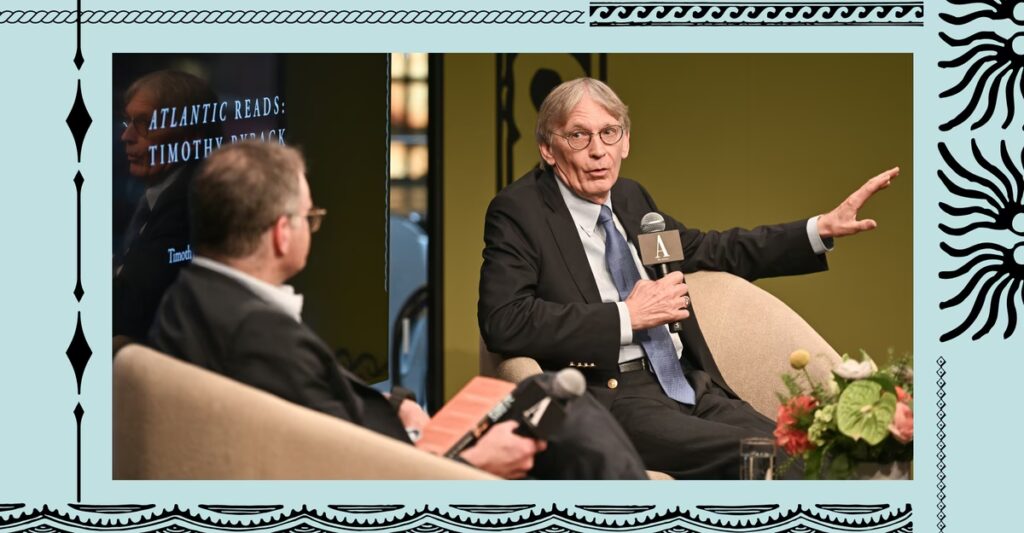
In a conversation I had with Ryback yesterday at The Atlantic Festival, the historian discussed the rhymes and contingencies of history, the uses and misuses of the past, the lessons of 1933, and what a reexamination of Hitler’s rise can teach us about human agency and fate. This interview has been edited and condensed for clarity.
Scott Stossel: Why this book now?
Timothy W. Ryback: Histories are written for the era. We read about the things that have meaning for us. Read all the great biographies of Adolf Hitler: You’re not going to find a mention of Hitler’s central banker or his tariff policy. But suddenly, these things matter. For me, the most striking are the resonances in the personality type, the positioning. Hitler’s key to success was to never admit defeat. Always double down. We’re used to seeing the newsreel footage of Hitler as the raving lunatic, frothing at the mouth. Well, he despised democracy, but he understood it as well as anyone. When Hitler got 37 percent of the vote in the July 1932 election, that was his high-water mark in terms of a completely open, free election. And he said he should be controlling the country. Listen to his logic: 37 percent is 75 percent of 51 percent, meaning the relative majority of the absolute majority. He used that to incredible effect in co-opting, coddling, or crushing his political allies on the far right before he ever turned to the left. And he was always preaching to his base. I mean, his political advisers would come and say, Whoa, cool it with the anti-Semitism. And Hitler would hear nothing of it. He used that formula, that understanding of democratic processes, to get where he got.
Stossel: It has been reported by Trump’s first wife that he kept Mein Kampf by the side of his bed. He denied that and then said No, it was a gift, and it was a collection of Hitler’s speeches. To what extent do you think that Trump is actually looking at Hitler and other fascist leaders of the past for a kind of guidebook for how to take power? And how much of it is just a kind of temperamental instinct for identifying grievances, inflaming them and saying, I will be your solution?
[Read: The Jews who voted for Hitler]
Ryback: This issue of grievance politics was the essence of Hitler’s political posture. And there were a lot of grievances out there. There was the Treaty of Versailles, which forced Germany to accept full responsibility for all the destruction of the First World War. There were massive reparation payments, which strained the economy. The other thing: He gridlocked the legislative processes time and again. He basically paralyzed the Reichstag, made it impossible for any laws to be passed, forcing the government to rule by executive decree, then turned around and said, Look, democracy doesn’t work as a system. Give me a chance. So I think the modalities were very similar. Keep in mind, the grievances that Hitler was playing off of, actually, a lot of it was legitimate.
Stossel: As it is today. You have a chapter in this book titled “Guardrails,” speaking to Hitler’s transgression of guardrails. How do you see, today, the pushing against and possible weakening of guardrails?
Ryback: Historians always look back, which lends these processes a sense of historical inevitability, rather than the reality, which is political contingency—what happens from one moment to the next. And I think in that regard, you begin to see Hitler in a very different context. His first day as chancellor, he wants to rewrite election laws. Turns out that’s too complicated. He then wants to ban the Communist Party. There’s pushback: Do we really have a right to do this? Could it cause social unrest? He said, Well, look, if there’s social unrest, we’ll just call in the army. To which the minister of defense, Werner von Blomberg, stands up and says, Mr. Chancellor, with all due respect, our military is trained to defend the German nation against foreign enemies; it is unthinkable that a German soldier could be ordered to shoot on German citizens in German streets. And this puts Hitler in his place. Hitler realized he’s banged up against about every constitutional guardrail there is. The next day, he issues this official memo to the members of the Nazi Party, and he declares war on his own government.
Stossel: I’m immediately put in mind of Jim Mattis and Mark Milley, and other folks who, in the first term, said, We are here to defend the Constitution, not to execute your will if it’s not in defense of the Constitution. You anticipated my next question, which was: When you look back at historical events, the natural inclination of both historians and lay people is to understand the narrative as kind of predetermined. But with Hitler’s rise to power, there are so many points along the way where a single action could have stopped him. President Hindenburg had already replaced three chancellors before Hitler came to power. He didn’t have to approve Hitler’s press for the Enabling Act. Do you think that Hitler’s rise and the Third Reich and the Holocaust were inevitable?
Ryback: Was the Holocaust inevitable? Big question. Simple answer: no. Look, we’ve got an election coming up in November. You watch Fox News, you get one version of what’s going to happen; watch CNN, The New York Times, you get another. We have no idea yet. One day after the election, you’re going to have every political pundit explaining how this outcome was inevitable. Hitler was going to rallies and saying, I don’t care what the outcome of the election is going to be. I am here to save the German nation. I will not leave the chancellorship. The newspapers at the time said, You know, Mr. Hitler should read the constitution because it’s not up to him to decide whether he stays in office. It’s the president. In some ways, I felt like the book should have been, “How Hitler almost failed to dismantle a democracy.” Forgotten heroes stood up to him: the journalists who were calling him out at every step; the Social Democrats, who were being threatened, and yet pursuing an attempt to save the republic.
[Read: Hitler used a bogus crisis of ‘public order’ to make himself dictator]
Stossel: One key moment in the rise of Hitler and his consolidation of power was obviously the Reichstag fire. Your book comes out before our next election, where we think about October surprises. What worries you, looking ahead to the midterms?
Ryback: This is where there are a lot of resonances with the electoral processes at that time. You had a monolithic right-wing movement. You had a fractured left-wing coalition that was continuing to fragment. You had a center group of undecided voters that was going to tip the election in one direction or another.
Stossel: When Hitler came to power, I think it’s fair to say that people did not expect that the National Socialists would have been able to win as many of the Reichstag seats as they did. In 2016, everyone thought Hillary was going to win. She did not. In 2024, again, it looked for a long time like Trump’s defeat was inevitable. It was not. Looking ahead to two months from now, polling suggests favorable signals for the Democrats. How do you think about November 2026?
Ryback: Hitler said a lot of horrific things. But to my mind, one of the most chilling was when Hitler finally got to power. He said, For the last 12 years, people have been mocking and ridiculing me. No one’s laughing anymore. Hitler did run against Hindenburg in the spring of 1932 for the presidency of Weimar. He lost by 6 million votes. Well, what did he do? He went to court to sue to have the election results overturned amid claims of voter fraud and irregularities by state officials. Where have we heard that before? The judge threw him out on his ear.
In March 1933, the German people went to the polls again. It was a referendum on the Hitler administration. No one knew what was going to happen. The Germans saw everything that Hitler had shown the German people, what he wanted the country to be. It was the largest electoral turnout in the history of parliamentary elections in Germany, going back to the 1870s. And they gave Hitler an overwhelming victory.
What I would say is: Don’t look at March 5, 1933. Look at April 2026, when the Hungarians had to go to the polls. Viktor Orbán had been in power for 15 years. Orbán had compromised the courts, he had suppressed the opposition press, he had driven the Central European University out of the country—and a lot of dissidents left. And yet, two-thirds of Hungarians voted to get him out of office, and did. Had the German people voted in March 1933 the way the Hungarians voted last spring, there would not have been a Third Reich. There would not have been a Holocaust. And Hitler would have been out of office within weeks.
The post Hitler’s Rise Was Not Inevitable appeared first on The Atlantic.