When I saw a video of a run club called Barrio Athletics promising that it would be “taking over” Leimert Park on Sept. 6, I thought:
Here we go again.
An online flame war soon erupted over one of the most explosive allegations in L.A.: Latinos are trying to drive out Black people.
It came in an election year that will bring the city down to just two Black councilmembers for the first time since the early 1960s, with two Latino candidates facing off for a South L.A. seat. It came four years after secretly recorded audio emerged that captured some of the city’s most powerful leaders, all of whom happened to be Latino, scheming about how to dilute Black political power.
South L.A., long the epicenter of Black life in the Southland, has been majority Latino for decades. The 2020 census places Black Angelenos at just 8% of the city’s population, the fifth census in a row where the community’s share has shrunk. In a sign of gentrification, Realtors regularly cold-call longtime Leimert Park residents with cash offers for their homes.
“When you see folks post up in your space and say, ‘Get ready for a takeover,’ you see it and think, ‘OK!’ ” said Karen A. Clark, treasurer of the Leimert Park Merchants Assn., which represents business owners in the economic and cultural heart of Black Los Angeles.
We stood inside the Barbara Morrison Performing Arts Center, which Clark co-owns and where she serves as creative director.
Her group reached out to Barrio Athletics founder Henry Gallardo soon after the video emerged, to let him know that he had to pull permits to hold a public event, just like everyone else.
“But before they could respond,” Clark said, “it just took on a life of its own.”
Gallardo, 25, the son of Guatemalan immigrants who grew up in South L.A., moved his event to Elysian Park — after delivering apologies on podcasts and radio shows that Clark deemed “lovely” but have drawn more online scorn.
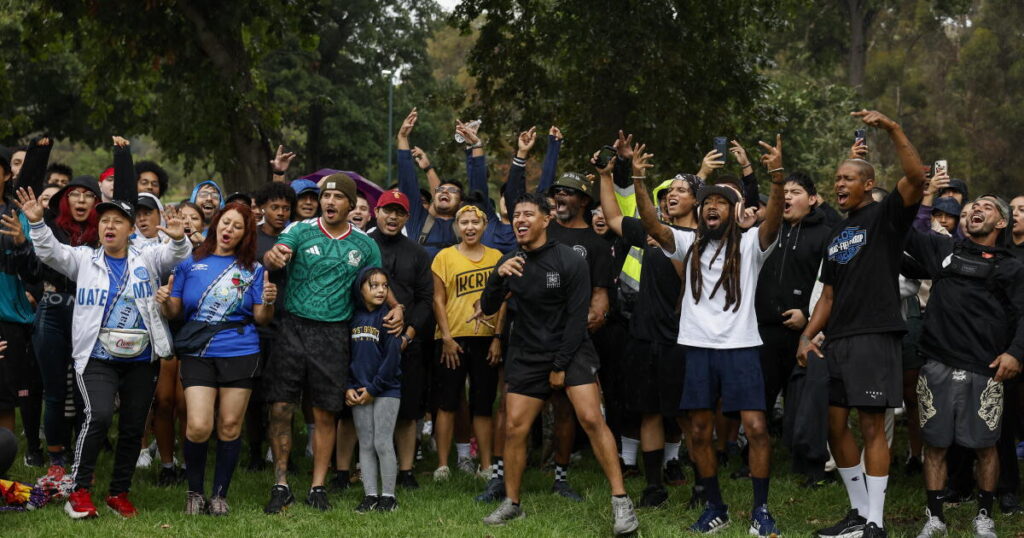
My colleague Corinne Purtill went to the relocated meet-up for Barrio Athletics, which is based in South L.A. and attracts a multiethnic group of runners. About 150 people showed up for a 5K run Sept. 6 on a rainy morning.
A 38-year-old South L.A. native who gave his name as D-Ranks told Corinne that he had to deal with online haters because he spoke in support of Barrio Athletics as a Black man.
“Kill that noise right now. Like we don’t deal with the same things?” he said of Black and Latino people.
Jocelyn Juarez, 24, participated in her first run that day. The South L.A. native recently moved back home after living in Kansas, where she told Corinne that strangers seemed far more at ease living with each other.
“Here in L.A.,” Juarez said, “we have our guard up.”
This is a city where neighborhood displacement — whether by gentrification, government or natural disaster — is as commonplace and messy as the bloom of jacarandas. Few communities have weathered those forces more than Black L.A.
After their jog, Gallardo told Barrio Athletics runners that he had no ill intent when he chose Leimert Park.
“People try to paint it as violent,” he said via megaphone. “Look around. Is this violent? No. This is love. We’re just running.”
I believe him. But he shouldn’t be let off so easy, because he committed another sin that too many Angelenos are guilty of:
Ignorance about the city we profess to love.
Gallardo admitted on the “Scottie & Frnds” podcast that he didn’t know about Leimert Park’s significance to the Black community, admitting he “should’ve done more research” before deciding to take Barrio Athletics there.
I had never visited Leimert Park’s Sunday open-air market, either, so I asked Clark to give me a tour last weekend. That’s what you do when you go somewhere new: Ask someone who knows.
I immediately saw the issue when I arrived at Leimert Park’s quaint business district, known locally as the Village —and it wasn’t that I was one of the few non-Black faces.
Barrio Athletics had planned to start and end their run in tiny Leimert Plaza Park while also setting up a DJ and smoothie stand there.
On Sunday, just outside the fenced-off green space, street vendors were selling everything from African fabrics to soap. Delicious food — Jamaican patties, raspberry tarts, Nigerian-style goat, salmon tamales — scented the streets. Young people took turns on the ramps outside Neighbors Skate Shop.
A bunch of runners, no matter their race, would have thrown off the vibe and made themselves the center of attention. In what world is that cool?
“If you wanna pay my rent, you can be any color,” Benedict Bernardez said with a laugh from his food stall. “But know where you’re visiting.”
The 50-year-old Belizean immigrant remembered getting raised eyebrows when he first set up here 17 years ago, because “they heard I had an accent and my last name.”
But Bernardez eventually earned acceptance by establishing himself as someone who was committed to the neighborhood, not an interloper.
“It’s all about respect,” he said.
That was the same sentiment offered by Merchants Assn. President Aminah Muhammad, who owns Sisters Marketplace.
“It would’ve been wonderful to let us know in advance,” she said of Barrio Athletics. “But then I’d ask, ‘Are you gonna patronize us, or just run through?’ ”
Milan Dwimfo runs a jewelry and gift store named after its founder, Sika, who was her late father and a Leimert Park pioneer. A nearby alley is dedicated to him. Milan, 41, grew up seeing the “highs and lows, ebbs and flows” of the neighborhood and said she’s “so exhausted” of the press and digital warriors trying to fan Black-brown fires in the city at any chance.
“People love a war, people love the drama of it all,” she said. “But that’s not who we are.”
When Clark and I walked into Nappily Naturals, Umaar Askia said he had just attended to a group of Latino regulars who asked about the Barrio Athletics controversy.
“They didn’t even know about it until they heard it from their nephews,” said Askia, 58, who owns the apothecary with his wife. “And [the Latino regulars] were like, ‘I don’t feel uncomfortable in Leimert. I’m here all the time.’ ”
Not a single vendor I spoke to expressed any enmity toward Latinos, or even Gallardo. But damned if they were going to let a group of randos storm into Leimert Park and expect a hero’s welcome.
Genelle Brooks-Petty is an interior designer and fourth-generation neighborhood resident who opened the hip-hop-themed All Chill ice cream shop five years ago. She wanted to open something that “feels like what [Leimert Park] looks like right now but also welcomes” the thousands of people expected to move into new developments along the Crenshaw Boulevard corridor on Leimert Park’s western edge.
The 49-year-old knew that Barrio Athletics’ “takeover” language wasn’t meant to be taken literally.
“But some people are sensitive about how you talk about their sacred space,” Brooks-Petty added. “And we do need safe emotional spaces for Black people, no more than other people need their own sacred spaces.
“It was big issues,” she concluded, “that were brought up in an inopportune time.”
I ended my Leimert Park Village tour at a weekly drum circle in front of Sisters Marketplace that’s open to all. A group of about 20 — mostly Black people but also some middle-aged white women and young Latino men — pounded away with hands or sticks to a unified beat.
Looking on was Osvaldo Barraquín, a 38-year-old Salvadoran immigrant who lives in South L.A. He comes to the Sunday market “whenever I have a chance,” because he likes the food and music.
Barraquín saw Barrio Athletics’ Instagram video and thought it “sad.”
“You don’t just show up to someone’s party and say, ‘Hey, I’m going to hold my own party, too,’” he said in Spanish. “And the thing is, the [Black merchants] would have probably said, ‘Let’s all party together sometime.’ But first, you need to ask.”
The post A failed run club ‘takeover’ of Leimert Park shows what’s at stake for Black L.A. appeared first on Los Angeles Times.