When President Trump’s envoys sat down with Vladimir V. Putin at the Kremlin this month, the Russian leader exuded confidence.
Within months, he said, Russian troops would finally capture Ukraine’s entire Donbas region. And Russia was poised to pummel Ukraine’s electricity grid, setting the stage for a miserable winter.
Then one of the envoys, Jared Kushner, tried to push back. With all due respect, you told us exactly that a year ago, Mr. Kushner said to the Russian president. What are the chances we come back here in another year and you are again saying the same thing? Maybe we don’t lose a year?
The exchange, described by a person familiar with the talks and by a U.S. official, captured the quandary of Mr. Trump’s more than 18 months of efforts to end the war in Ukraine.
Congress this week passed a landmark sanctions bill taking aim at Russia’s energy sector, a new attempt to make Russia “suffer” for its invasion and to pressure Mr. Putin to make compromises.
But even as that bill makes its way to Mr. Trump’s desk, the Trump administration is doubling down on a different approach: offering benefits for Russia that officials hope will get Mr. Putin to consider ending his war.
Among the new inducements: the White House is now considering signing business deals with Russia before it stops fighting in Ukraine, according to two people close to the talks. The U.S. official, speaking on condition of anonymity to be candid about the negotiations, said that deals with Russia before the end of the war were possible because they would show that the United States is serious about a reset relationship with Russia.
The approach represents a shift from Mr. Trump’s pledge last year that business deals with Russia would not come “until we get the war settled.” It indicates that Mr. Trump’s envoys for ending the war, Steve Witkoff and Mr. Kushner, are groping for new ways to entice Russia to stop fighting, now that it has become clear that Ukraine will not withdraw from the swath of its own territory that Mr. Putin insists he must control before the war ends.
And it contrasts with the approach advocated by both Republicans and Democrats in Congress — not to mention Kyiv’s European allies and Ukraine itself — that only heightened economic and military pressure on Mr. Putin can compel him to compromise.
“This bill will cripple Russia’s war machine and finally bring Putin to the negotiating table,” Representative Michael McCaul, Republican of Texas and one of the sanctions bill’s leading proponents, said on Wednesday after a bipartisan majority passed the legislation, 262 to 159.
Mr. Trump has indicated he will sign the bill, which was championed by Senator Lindsey Graham, Republican of South Carolina, until his death in July. It would allow the president to levy tariffs of as much as 100 percent on countries buying the most Russian oil or gas and would impose sanctions on Russian officials, businesspeople and financial institutions. Senator Darline Graham, Mr. Graham’s sister who replaced him in his seat, said it would “increase the president’s negotiating leverage.”
But insofar as the Trump administration is pursuing a carrot-and-stick approach with Mr. Putin, carrots seem the focus. The U.S. official said that the administration wanted to create more incentives for members of the Russian elite to push for peace. Executing some business deals before the end of the war could help convince anti-American hawks around Mr. Putin that Mr. Trump really does want to create a new relationship with Russia, the official added.
Balazs Jarabik, a former European Union diplomat in Kyiv who now works at R. Politik, a political analysis firm, said signs pointed to the United States “considering bigger concessions toward Russia.”
Washington “is now signaling that some deals could move forward if Moscow first demonstrates concrete restraint,” said Mr. Jarabik, who has been tracking the talks closely. “Washington had previously resisted signing such agreements before a cease-fire.”
It was not clear what deals in particular are on the table. The Kremlin’s foreign policy adviser, Yuri Ushakov, said after Mr. Putin’s meeting with Mr. Witkoff and Mr. Kushner on Sept. 5 that “economic issues and potential major mutually beneficial Russian-American projects were discussed in some detail.”
The Kremlin has been promoting business opportunities to the White House ever since Mr. Trump returned to office last year. Russian officials have floated deals for rare earths and aluminum, joint ventures in the Arctic and even getting U.S. companies involved in selling Russian natural gas to Europe.
Mr. Trump has hailed Russia’s economic potential as “tremendous,” but he has previously held out business deals as a reward for a Russia that makes peace.
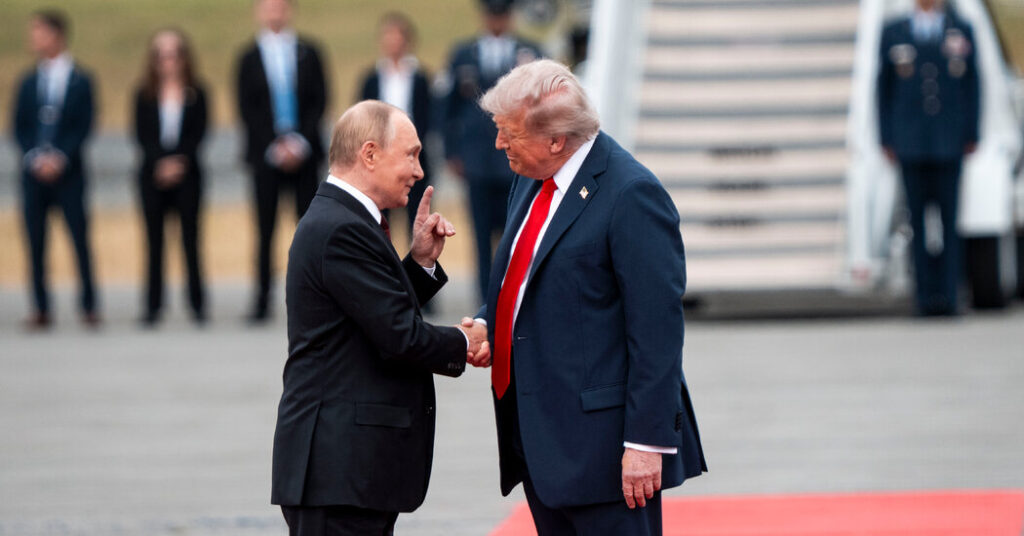
“They want to do business,” Mr. Trump said ahead of his Alaska summit with Mr. Putin last year. “But they’re not doing business until we get the war settled.”
The quiet shift appears to reflect the administration’s pursuit of new ideas to end the war after talks surrounding a possible Ukrainian withdrawal from the rest of the Donbas region ran aground. Earlier this year, Ukrainian officials proposed calling that area “Donnyland” in an effort to appeal to Mr. Trump to push back harder against Russia’s territorial demands.
Mr. Kushner referred to the impasse in an appearance by video link at a gathering of international supporters of Ukraine in Kyiv last weekend, the YES Annual Meeting.
“President Putin’s laid out his line of what he wants to achieve,” Mr. Kushner said. “If Ukraine, you know, wanted to withdraw to that line, then obviously, we have the rest of the deal set up and put together. Ukraine right now does not want to do that.”
Mr. Kushner went on that the Trump administration’s job “as the mediators” was to “come up with a creative solution” that “allows both parties to move forward.” He said Mr. Trump and President Volodymyr Zelensky of Ukraine were very committed to the talks, and “what we heard is President Putin’s very committed to this as well.”
At that point, part of the audience in Kyiv burst out in laughter, a sign of the deep skepticism among Ukraine’s allies of the administration’s evenhanded portrayal of the talks. Two days later, a jet-powered Russian drone struck a train at a border crossing through which dignitaries, including David Petraeus, the former C.I.A. director, were traveling.
The negotiations to end Russia’s war, which has now lasted more than four and a half years and claimed hundreds of thousands of lives, largely ground to a halt earlier this year as Mr. Witkoff and Mr. Kushner focused on the war with Iran.
This month’s trip to Moscow and then to Kyiv by Mr. Witkoff and Mr. Kushner appeared to be an effort to restart the negotiations. Ukrainian officials said that trilateral peace talks between the United States, Ukraine and Russia could resume in October. The possibility of a limited cease-fire — ending strikes on shipping in the Black Sea or on energy infrastructure — is expected to be discussed in those talks.
Robert Jimison contributed reporting from Washington.
The post Trump Wants Putin to End the War. He May Offer Russia Business Deals First. appeared first on New York Times.