It’s not just Nepal.
Glaciers are melting across much of the Himalayas. Long-frozen ground, known as permafrost, is thawing. And a raft of disasters is menacing tens of millions of people who live in the countries that span the world’s highest mountains: landslides, bursting lakes, swollen rivers so forceful they wash away entire communities.
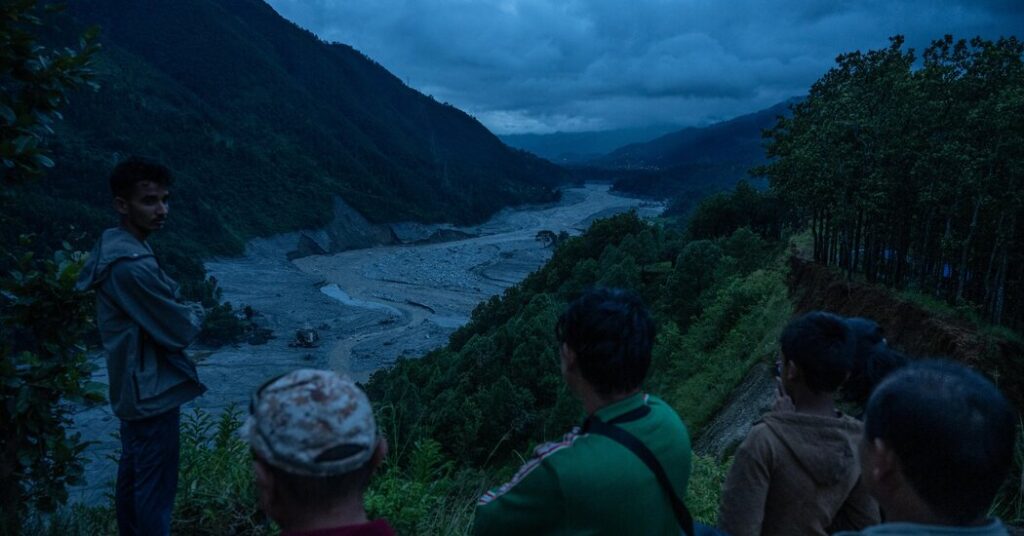
Now, three weeks after a glacier collapsed, unleashing flash floods that left more than 8,000 dead or missing in Nepal and China, experts are urging national and local leaders across the region to prepare better for the next catastrophe. That includes more robust monitoring of their shared mountains and rivers, exchanging data with each other, and putting in place early warning systems and evacuation plans.
“We need a lot more data-sharing and communications across these national borders,” said Miriam Jackson, who studies Earth’s frozen parts, or the cryosphere, as a research scientist for the Norwegian government.
“We are going to see more and more of these events,” she added. “The cryosphere is changing very quickly. We have more and more people living quite close to these hazards. And we need more knowledge.”
Her call was echoed by a report published this week by an environmental consultancy called Systemiq. It found that of 40,000 glaciers in the Hindu Kush Himalayan range, only 21 are being actively monitored. The range spans Afghanistan, Bangladesh, Bhutan, China, India, Myanmar, Nepal and Pakistan.
That is all the more worrisome, scientists say, because the Himalayas, a source of water for two billion people downstream, are being pummeled by climate change. A report issued by scientists this week concluded that fossil fuel emissions played a “very strong” role in the Aug. 26 disaster in Nepal and Tibet, as rising temperatures likely destabilized permafrost and ice under the mountain slopes, leading to the catastrophic flood.
A 2023 report that Dr. Jackson coauthored while she was at the International Centre for Integrated Mountain Development found that glaciers melted 65 percent faster from 2010 to 2019 than in the decade before. An earlier report from the same institute found that even if the global average temperature increase compared to preindustrial levels is capped at 1.5 degrees Celsius — the target limit set as part of the 2015 Paris climate agreement — one-third of the glaciers of the Hindu Kush Himalayas would be gone by the end of this century. In early September, scientists said the world breached that 1.5 degree threshold.
In India alone, nearly 200 glacial lakes are considered to be at high risk of bursting their banks and 56 at very high risk, according to the Systemiq report. The Indian state of Uttarakhand suffered a similar but smaller-scale rock avalanche struck in 2021, and a glacial lake burst in the Indian state of Sikkim in 2023. Arushi Chopra, one of the authors of the Systemiq report, said there will be others. “It’s not a question of if, but when,” she said.
Several scientists cautioned that while it is unrealistic and even unnecessary to monitor every Himalayan glacier, it’s important to keep an eye on the most at-risk areas, including the glaciers that sit above hydropower dams or large towns and villages, for which a small disturbance in the mountains can have catastrophic consequences.
To focus monitoring efforts on those hot spots would be more viable, said Walter Immerzeel, a mountain hydrologist at Utrecht University in the Netherlands. That would require satellite data keeping an eye on the glacier as a whole, sensors in the ground to measure rock movement and a remote sensing technique called radar interferometry that can provide some early warning for instability in the mountains, avalanches and glacial lake outbursts.
“You cannot monitor every glacier and rock wall in the Himalayas,” he said at an online briefing for journalists Wednesday.
The terrain makes it difficult to install measuring instruments. It’s also exceedingly expensive, especially for countries like Nepal, with limited resources.
Madhab Uprety, a technical adviser at the Red Cross Red Crescent Climate Center, based in Kathmandu, said he hoped this disaster would “open some opportunities” for cross-border monitoring. Because even in a country like Nepal, which has dealt with many floods and landslides in its history, the events of Aug. 26 were unprecedented. “There was no existing monitoring or any warning arrangements to detect it or communicate it at that scale,” Mr. Uprety said.
Cross-border data sharing is further complicated by geopolitical tensions in the region, with several countries in the region having fought wars and disputed borders.
“There’s an urgent need for having greater cooperation among all these Himalayan states,” said Devendra Kumar Sharma, who managed several hydropower dams on Himalayan rivers and who is now president of the International Commission on Large Dams. “Climate change is happening. It doesn’t recognize boundaries.”
Dr. Jackson, the researcher, was in a meeting with other cryosphere scientists when the Nepal flooding unfolded. They all realized early on how awful it would be; they had been warning of something like this for years.
“You know there’s a good chance of this happening,” Dr. Jackson said. “You don’t know when.”
The post Warnings Across the Himalayas After Nepal Floods appeared first on New York Times.