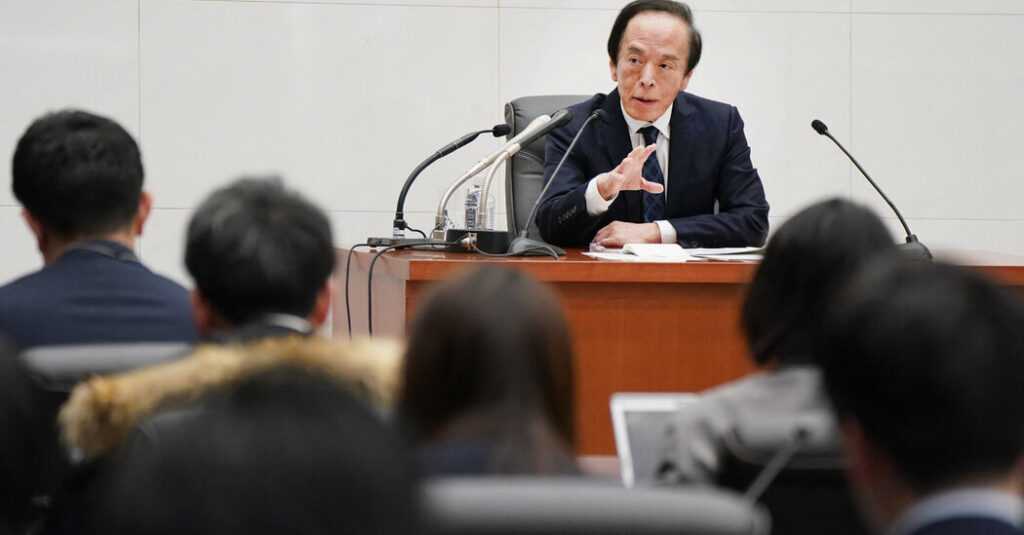
The Bank of Japan raised interest rates on Friday in a closely watched move that followed unusual scrutiny by the Trump administration.
Japan’s central bank moved its policy rate from 1 percent to 1.25 percent, the highest level in 31 years in a country that has long combated stagnant prices with near-zero interest rates.
Markets had widely expected the bank to raise rates at its September meeting, as prices in Japan have climbed steadily in recent years. It followed rate hikes from the Federal Reserve on Wednesday and the European Central Bank last week, as countries grapple with rising energy prices from the war in the Middle East.
U.S. Treasury Secretary Scott Bessent publicly pressured Tokyo to tighten policy. Speaking at an event in Texas last week, Mr. Bessent even suggested that he had inside knowledge of the bank’s plans to raise rates.
The Bank of Japan “already had very good reason to raise interest rates,” said Izumi Devalier, Bank of America’s chief Japan economist. But recent rhetoric from the United States creates the impression that Japan’s central bank, which is independent by law, “was co-opted into policy,” she said. “It’s not good for monetary policy.”
At the same time, the Japanese government has pushed in the opposite direction. Prime Minister Sanae Takaichi has leaned on the Bank of Japan to keep interest rates low as she seeks to fund higher government spending without alarming investors about Japan’s ability to pay its debts.
That has put the Takaichi administration at odds with Mr. Bessent. He has relayed frustrations to Japan’s finance minister about low interest rates weighing on the yen. The Japanese currency fell to a multi-decade low against the dollar, as higher interest rates in the United States drew capital out of Japan.
In July, the United States and Japan jointly intervened in the foreign exchange market to prop up the Japanese currency. Mr. Bessent followed the intervention by saying in an interview that he was sure the Bank of Japan would “do the right thing” at its upcoming meeting.
Mr. Bessent escalated that rhetoric in recent weeks, daring traders to bet against the yen. “When we intervene with the Japanese yen, I have pretty good insight into what the Japanese, what the Bank of Japan is going to do,” he said at an event at Southern Methodist University. “I am the house now,” he said.
Japan’s finance minister, Satsuki Katayama, said that Mr. Bessent’s remarks sounded “a bit scary” when translated into Japanese.
For months, Bank of Japan Governor Kazuo Ueda has signaled that so-called underlying inflation — the long-term rate of price changes after excluding temporary shocks — is nearing the central bank’s 2 percent target.
“Now that underlying inflation is at 2 percent, you actually want to be much more vigilant about upside inflation risks,” said Ms. Devalier. That is because “now you have to contend with the risk that inflation doesn’t stop at 2 percent; it just continues to head higher and overshoots the target,” she said.
The main inflation risks now are a weaker yen, which makes imports more expensive, and higher prices stemming from turmoil in the energy markets. Japan has historically purchased virtually all its oil from the Middle East, but this year has been forced to turn to more expensive supplies from the United States and elsewhere.
Oil prices have soared to over $100 a barrel in recent days over fears that a drone attack on a critical pipeline in Saudi Arabia could further disrupt Persian Gulf energy supplies.
The Bank of Japan’s move was so widely expected that the yen had already climbed in anticipation, gaining over the previous two weeks. Yields on 10-year Japanese government bonds rose to a three-decade high this month.
Takahide Kiuchi, executive economist at Nomura Research Institute, said competing pressures from Washington and Tokyo could ultimately give the central bank greater freedom to act.
“Treasury Secretary Bessent’s remarks might function less as direct pressure on the B.O.J. and more as a check on the Takaichi administration, which has been quietly restraining B.O.J. rate hikes behind the scenes,” Mr. Kiuchi said. As a result, the Bank of Japan “is effectively gaining a free hand to execute rate hikes or accelerate their pace.”
The post Japan Raises Interest Rates in a Decision Muddied by U.S. Pressure appeared first on New York Times.