Ancient Greek stories have captured people’s attention all summer.
Director Christopher Nolan’s expansive retelling of “The Odyssey” has racked up more than $1.6 billion at the box office and the resurrected courtroom comedy “Coyote vs. Acme” portrays Wile E. Coyote as a modern-day Sisyphus.
As summer turns to fall, the Getty and the Latino Theater Company — a nonprofit organization dedicated to portraying the Latino experience onstage — are riding that wave with their reinterpretation of Sophocles’ “Antigone” at the Getty Villa’s Outdoor Theater through Oct. 3.
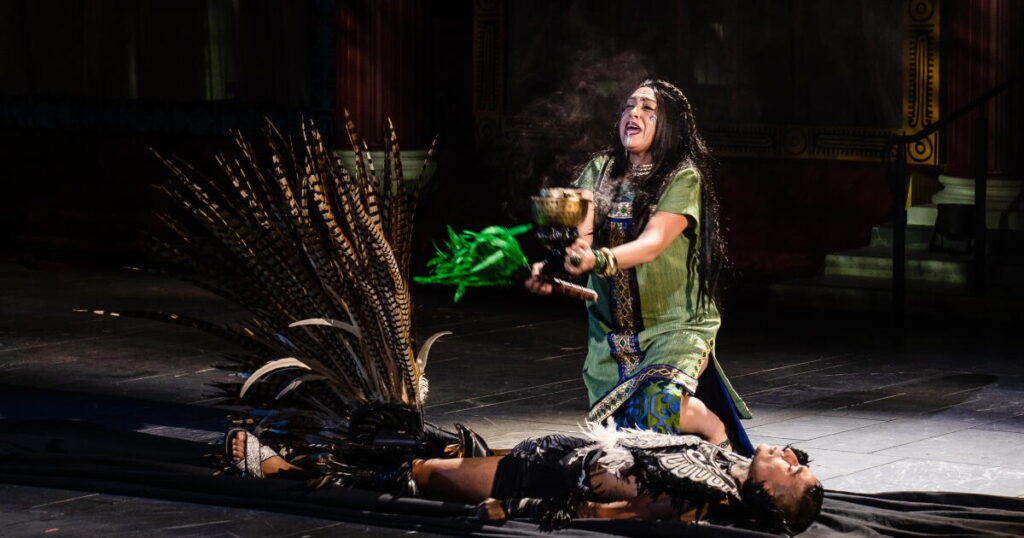
Instead of placing the drama in a Hellenic setting, “Antigone: In the Language of Kings” moves the action to pre-conquest Mexico, specifically the Mexica capital of Tenochtitlan.
Playwright Evelina Fernández hoped that situating “Antigone,” which lyrically investigates the themes of tyranny, hubris and respect for basic human dignity, in Tenochtitlan would help audiences see the Mexica (also known as the Aztecs) through a new lens.
“People always talk about the violence of the Aztecs,” Fernández told The Times. “But there was also a heartfelt tranquility that belonged to the culture. The Mexica’s words of how you should live upon the earth are really beautiful and relevant to today.”
She noticed that oftentimes when Mexica are portrayed on television and film, emphasis is put on human sacrifice rituals and the “pulling out of a beating heart,” but after much research she found a poetic heartbeat pulsing through the misrepresented society.
As in the Greek story, the play follows Antíkona (Antigone) as she faces off against her uncle and newly crowned ruler Tlahtoani Klion (known in the original as King Creon) after he declares her recently slain brother an enemy of the state and thereby ineligible for a traditional burial. The headstrong lead disobeys the edict and finds herself subject to the oppressive hand of the state. In Fernández’s version, Antíkona’s insubordination inspires a peoples’ rebellion and brings an end to Klion’s rule due to his inability to treat citizens with common decency.
The production’s director, José Luis Valenzuela, said imbuing the ancient play with the political tones of current times helped highlight the eternal primacy of the values present in the text without explicitly talking about Latino communities.
In Fernández’s adaptation, Klion is a stand-in for the current leadership in the U.S. and its penchant for imposing unpopular tyrannical edicts.
“It would be easier to show people being arrested, dying in the detention centers, dying in the desert and you’re not allowed to give them aid. That is part of my existence as a Chicano in the U.S.,” Valenzuela said. “There is no respect for basic human rights and I think it’s all underneath this play without saying, ‘Hey, I’m an immigrant.’ ”
Situating the work during the peak of the Mexica empire — which rose to prominence in the mid-1300s — helped bridge the gap between ancient Greece (“Antigone” was first performed in 441 BC.) and present day in terms of historical time lines. But creating the grounded nature of that world was no small task.
To write her script, Fernández consulted the works of Mexican historian of pre-Hispanic cultures Miguel León-Portilla and American writer Earl Shorris. León-Portilla wrote extensively about the conquest of Mexico from the Mexica viewpoint, documented the philosophy of Aztec intellectuals and analyzed poems in Nahuatl — the language of the Mexica empire.
Together Shorris and León-Portilla penned the 2002 book “In the Language of Kings: An Anthology of Mesoamerican Literature, Pre-Columbian to the Present” — from which the “Antigone” adaptation takes its name.
To do honor to the name of the production, Fernández included dialogue and musical numbers in Nahuatl— the work is mostly in English with some lines in Spanish.
Guiding the playwright’s implementation of the Indigenous language was Cal State Northridge professor Fermín Herrera — one of the few experts in the continent on classical Nahuatl. Fernandez would select a passage from the 2,500-year-old play that she wanted to incorporate and Herrera translated it.
He also taught the stage actors how to deliver their Nahuatl lines and recorded pronunciations for them to have as reference.
Learning to speak a few sentences in Nahuatl was no small task for the company of actors.
“Connecting all the sounds of the language was hard for me to remember,” Antíkona actor Esperanza América said. “I would go to the beach, put on some music and run the sounds. Once I had all the sounds down, I had to really connect the acting and try to unite Antíkona’s tenacity with the beauty of the language. That took some time.”
For Valenzuela, the seeming barrier actually had a freeing effect on the director.
“When I directed in Europe, I directed actors in languages that I didn’t speak at all and I love it because the actors cannot lie to you,” he said. “[Evaluating an actor on just their sound and emotion], makes it a lot easier, in a way, to find the meaning of a performance.”
Further helping bring to life the Mexica sensibilities were the elaborate outfits crafted by costume designer Maria Catarina Copelli. The veteran artisan consulted Mexica codices, along with the attire of other pre-conquest cultures within Mexico, to inform the patterns, colors and materials used for the costumes. This research helped in staying away from stylistic stereotypes and anachronisms often placed on so-called “Aztec” garbs.
“Nowadays there is a misunderstanding about what Aztec style, if you’re gonna go to a store and buy something labeled ‘Aztec’ style, you’ll find a lot of patterns that are in fact U.S. Native American,” Copelli said. “The Mexica had very strict laws for dressing. So we kept that in mind, and [aimed for] something more accurate with reality, not a stereotype.”
Colors like turquoise and jade were reserved for royalty and nobles wore their tilmàtli (cloaks) longer than commoners. However, Copelli took some liberties with the costuming as the outfits had to be breathable given the outdoor environment and allow for the free flowing movement of dancers.
Fernández hoped that seeing the extravagance of a pre-conquest world and hearing the poetic nature of the Nahuatl language helps to empower Latinos to feel pride in and learn more about their culture.
“As Mexican Americans in the U.S. we’re not taught that [pre-colonial] part of our culture, we often have to discover this by ourselves,” the playwright said. “It’s empowering to know where we come from. And as the [Mexica] words say, ‘Do not forget that you come from someone, that you’re born by the grace of someone and that you come from your ancestors.’ ”
The post In ‘Antigone: In the Language of Kings,’ a 2,500-year-old tale set in Tenochtitlán is as timely as ever appeared first on Los Angeles Times.