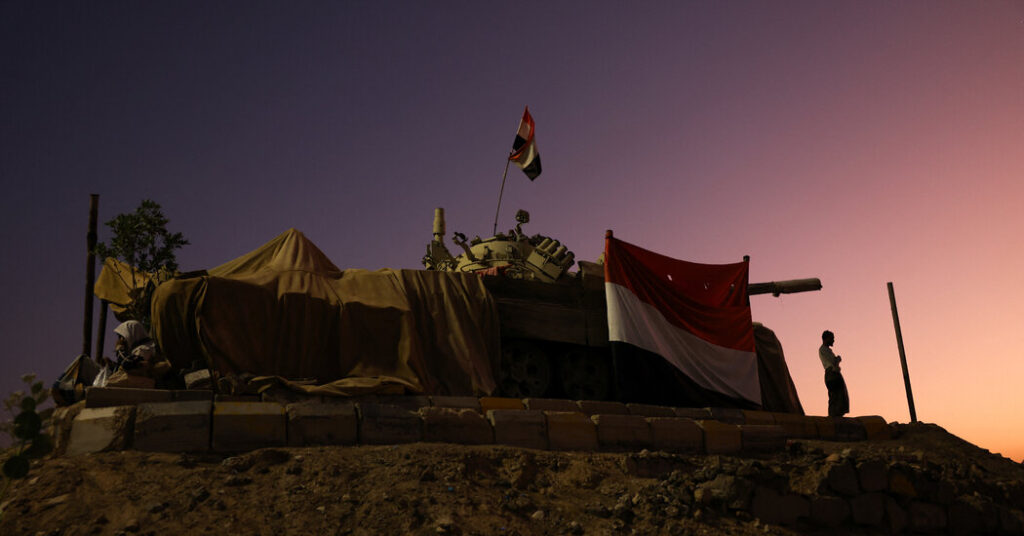
Fighting has intensified near two strategic provinces in Yemen, a sign that Iranian-backed Houthi militants are expanding their offensive after seizing the country’s Red Sea coastline, analysts say.
A sustained Houthi push into Yemen’s resource-rich eastern regions, including Marib Province, would threaten the economic lifeline of the internationally recognized government and risk triggering a fresh humanitarian crisis among millions of Yemenis.
While the Houthis have succeeded in taking much of northwestern Yemen since capturing the capital, Sanaa, in 2014, Marib has so far eluded them.
“It is the bastion and stronghold in the north for those who resisted the militia’s coup more than a decade ago,” said Mohammed al-Basha, a Washington-based risk analyst focused on Yemen. “If they capture it, it would be such a symbolic and strategic win for them.”
Marib, about 75 miles east of Sanaa, and the southern city of Taiz have emerged as the Houthis’ most likely targets after they captured territory near the Bab al-Mandab Strait, a vital waterway for global trade. That advance has allowed the militia to increase its pressure on shipping in the Red Sea.
Pro-government forces have struck Houthi positions in both provinces with fighter jets and drones over the past month and say they have repelled the militia’s advances. The Houthis have countered by firing missiles at government-held areas.
The Yemeni government has been backed for more than a decade by Saudi Arabia, which has led a military coalition aiming to roll back the militia. The coalition carried out a devastating bombing campaign, but it ultimately failed to oust the Houthis from power.
Since then, Yemen has effectively been divided into two states, with the Houthis in control of large swaths of the country’s north and the government in the south, based in the temporary capital, Aden.
Marib is home to some of Yemen’s largest oil and gas fields. Its loss would deal a severe blow to the government’s finances as well as its claim to legitimacy. Marib’s fall would also open a route for the Houthis toward the eastern province of Hadramout, Yemen’s largest, which shares a long border with Saudi Arabia.
“If Marib falls to the Houthis, it would mean the militia would be in reaching distance to the Saudi-Yemeni borders,” said Ahmed Nagi, a senior analyst for Yemen at the International Crisis Group. “That would be unacceptable to Saudi Arabia and threatens their national security.”
A Houthi political official, Mohammed al-Bukhaiti, said that tribal elders in Marib had called on the group to “liberate” the province. “Sanaa assures everyone that it is committed to liberating every inch of Yemeni territory,” he said in a phone interview. He said Saudi-backed forces had rejected de-escalation efforts.
Yemeni government officials and analysts describe the recent clashes as among the most intense since 2021, when the Houthis last mounted a major assault on Marib but were pushed back. The Yemeni government and Saudi Arabia both appear to be stepping up airstrikes to blunt Houthi advances, said April Alley, a senior fellow at The Washington Institute, where her research focuses on Yemen and the Gulf.
But she said: “The Houthis have the wind at their back for the moment. Government forces are deeply fragmented, and morale took a huge hit after the west coast losses.”
The Houthis said on Wednesday they had shot down a Saudi F-15 fighter jet over Marib with a locally made missile. The wreckage of the downed jet seems to be consistent with that of the F-15 jets in the Royal Saudi Air Force, a review of the images by The New York Times found. However, the exact location of the wreckage could not be confirmed.
In recent weeks, the battlefront has also extended to Taiz, which connects the Houthi-controlled north with the southern coast controlled by the government.
“What the Houthis are doing is trying to besiege the city of Taiz and choke off the last highway connecting Taiz with Aden,” Mr. Nagi said. “Who controls the city would matter strategically for both sides.”
The Houthi-run Saba news agency reported Saudi airstrikes on Thursday in the city of Abs in Yemen’s Hajjah Province that left one person dead and another wounded. The agency said that Saudi aircraft also targeted three telecommunications towers in Taiz Province. A Houthi military spokesperson, Yahya Saree, said that the Saudis had carried out 37 airstrikes using F-15 jets targeting Taiz and Hajjah over the past 24 hours.
Saudi Arabia’s Civil Defense on Thursday said a Yemeni resident had been killed in the Saudi province of Taif, east of Islam’s holiest site, Mecca. They were hit by shrapnel from an intercepted Houthi drone, the Saudis said.
It was the first announced death in the kingdom since the Houthis intensified their cross-border strikes this month. A Pakistani man was injured and in critical condition, the authorities said.
Shuaib Almosawa Almosawa reported from Sanaa, Yemen.
The post Fighting Intensifies in Yemen as Militia Advances on Key Provinces appeared first on New York Times.