The weather on May 22, 2011, was bright and cloudless in Joplin, Mo., ideal for a high school graduation. C.J. Huff, the superintendent of schools, had gotten to his office at 5:30 in the morning to put the finishing touches on his speech. That afternoon, the ceremony proceeded on a disciplined schedule, the way Huff liked it. He recalls walking out into the sunlight afterward, feeling relieved that graduation had gone smoothly.
In the parking lot, he heard a storm siren wailing. As he drove home, a meteorologist on the radio mentioned severe weather. But the sun was still above him. When he turned into his subdivision, though, he noticed something out of the ordinary, even physics-defying: A tree in the right of his field of view snapped in half, and the top part lifted away from the lower trunk and began to float in the air, like a leaf. He suddenly realized that a violent wind was rocking his car from the left. Just as he did, he felt the wind shift in the opposite direction. His windshield filled with grass and dirt.
A tornado was entering Joplin, a city of 50,000 people. Most of us imagine tornadoes as ominous but narrow funnels. This is not what the most dangerous ones look like. The Joplin tornado was a rain-wrapped wedge that expanded to a mile wide, making it hard to identify until it was nearly on you.
One resident, Callum Eldred, who had then just finished 10th grade, described it as the blackest thing he had ever seen — like a wall looming over his city, with what looked like “twigs coming out of the top of it.” The “twigs” were things like telephone poles, trees and bits of houses. “You don’t know what you’re looking at because you’ve never seen it before,” Eldred, now 32, told me recently, “like in a movie, when the Indians first see ships.”
The tornado touched down just southwest of Joplin, gathered steam, then carved a six-mile line straight through the city, its winds cresting above 200 miles an hour. It obliterated a hospital, crumpling steel beams like paper. It gobbled up nursing homes, churches, 500 businesses and nearly 7,500 houses, more than a third of the city’s housing stock. And it ultimately killed 161 people, making it the deadliest tornado in America in over half a century.
The intensity of a 200-mile-an-hour wind is not double what you would encounter if you stuck your head out the window of a vehicle traveling 100 miles per hour. When speed doubles, the force of wind quadruples, so that kind of tornado is not something humans or infrastructure experience in any other circumstance; nothing can really be built to withstand it.
At a bank, only the steel-and-concrete safe deposit vault was left upright. The rest of the building was blown clean away. Cars, manhole covers, even the hospital’s medevac helicopter turned to missiles; chairs embedded themselves in walls. The tornado scoured into the earth, tearing up asphalt. It dragged people out of their homes and ripped off their clothes, even their skin. About 30 minutes after it set down, it lifted. Thirty minutes after that, the sky was blue again.
Huff’s immediate instinct, once the storm passed, was to drive into town and take stock of the school buildings. Joplin High School’s principal, Kerry Sachetta, had that impulse, too. “The gym was exploded,” Sachetta recalled. “The performing arts center was exploded.” On the sports field, “it looked like God and the angels shot down splintered two-by-fours, like you see arrows coming down in movies set in medieval times.” Trees were sawed off. Tangled power lines were sparking all over. “It was like Armageddon,” Sachetta said. The sharp pine scent of cracked timber filled the air, along with the smell of natural gas.
The tornado had destroyed six schools in Joplin: the regular and technical high schools, two middle schools and two elementary schools, facilities that taught more than half the district’s 7,911 students. Three more elementary schools and an administrative building had obvious damage. The storm also killed seven Joplin students, including one who was handed a diploma by Huff hours beforehand. More than 100 students had been injured. Many had lost family members or homes.
A week later, Huff held a news conference in front of the ruins of the high school. School, he declared, would start on time in August. The idea had stunned Joplin’s school board, but it gave him temporary emergency powers to make decisions without its input. He salvaged a countdown clock from the practice field and set it to 87 days. Reopening on time would prove that the city still had a future.
Huff ultimately led a remarkable turnaround. The district barely lost enrollment, and over the next few years, it actually improved educational outcomes. Huff’s part in this set him on a new career path, designed to fill a void in federal support for school administrators: In 2017, he was hired to help the Department of Health and Human Services with its disaster-relief efforts, advising school leaders on how to rebuild their districts after devastating storms, wildfires and floods.
This work has become increasingly urgent in our disaster-plagued age. Though there is inconclusive scientific evidence that climate change causes or worsens tornadoes like the one that hit Joplin, the warming planet has led to more intense hurricanes, longer wildfire seasons and other severe weather phenomena across the globe. Forthcoming research from Brown University estimates that 25 percent of all American public schools are now in areas with “very high risk” of at least one kind of climate-related disaster. In the aftermath of these crises, superintendents trained in the minutiae of curriculum implementation are suddenly thrust into an entirely new role. This is where Huff comes in: His job is to deploy to other ruined districts and try to export the lessons he learned restoring Joplin’s schools.
The idea that schools should be central to a region’s post-disaster recovery emerged three decades ago after a brutal hurricane. Schooling had long been considered a priority below shelter. School buildings, with their vast gyms and industrial kitchens, were often converted into refuges for the displaced. Then, in 1992, Hurricane Andrew ravaged Florida, and leaders in the hardest-hit county, Dade, decided to find focus amid the chaos by throwing themselves at reopening schools as fast as they could. “We were the ones that brought this community back together by opening up the schools,” the Dade County superintendent, Octavio J. Visiedo, later told education researchers — thus undergirding the reboot of a whole society.
If you got children back into school, it freed up parents to return to work. It reassured families that a community would remain viable, making them less likely to move elsewhere. And restoring routine for children could safeguard the psychological health of a future generation. Other officials began to follow suit, racing to reopen schools in Grand Forks, N.D., after a major 1997 flood and across Florida during a ruinous 2004 hurricane season.
In 2005, Hurricane Katrina underscored this principle and expanded it. The extended tail of misery it wrought on New Orleans put a spotlight on the longer-term suffering that disasters inflicted, particularly on children. In 2010, nine months before Joplin’s tornado, the social and behavioral scientist David Abramson released an influential study called “Children as Bellwethers of Recovery.” Citing post-Katrina data, Abramson argued that young people’s mental health reflects the performance of all the systems around them — government, civic institutions, health care, schools. When children regain stability, that is evidence that a community is functioning again; if they don’t, that’s a “lagging indicator.” That means leaders should “prioritize kids” after natural disasters, Abramson told me recently; their flourishing can help the adults along.
In the years since, this has played out so often that it has become a national rite of passage: A school district is crushed by a storm or a wildfire, and overnight, a superintendent becomes a short-term crisis-response coordinator, first charged with overseeing wrecked infrastructure and traumatized children and then presiding over a district’s resurrection. Indeed, superintendents can end up determining whether an entire community rebounds or withers.
Even as more and more superintendents find themselves in this position, the help and training for educators has not kept up. In the United States, there is no centralized guidance for school administrators. For example, FEMA’s recovery framework involves encouraging communities to ask themselves questions in the vein of: Is your old transportation network actually the one you want to rebuild? What’s your big vision for the next 20 years? How can federal money help get you there? There has been no explicit federal guidance, meanwhile, for questions like: How quickly should children return to school? How should we rebuild damaged school buildings? This was true in 2011, when the tornado hit Joplin. It’s still largely true 15 years later.
Katrina also crystallized an emerging belief that the devastation wrought by extreme weather might present a chance to correct broader social problems. In 2006 testimony before Congress, Robin Jarvis, an acting school superintendent in New Orleans, called Katrina a “once-in-a-lifetime opportunity” to redesign a public school system that had already been teetering on the edge of insolvency and make it “world class.” State officials redesigned New Orleans’s public education system around charter schools.
Back in 2011, Huff was new to all of this thinking; he had received no training on post-disaster school operations. He felt, he said, as if he was “flying blind.” But he would come to seem, to many, like the ideal implementer of the principles that Abramson and other researchers had laid out.
On a late-June day, I drove with Huff from where he now lives in Springfield, Mo., to Joplin, to look at the path the tornado took and what had been created in its place. The foothills of the lush Ozarks emptied into dusty plains dotted with water towers. The region is patchworked with farms, but it has never had very good soil. Originally a hardscrabble frontier, Joplin became a boomtown at the turn of the 20th century after the discovery of lead and zinc. Its school football teams dominated state competitions.
Within a few decades, the best ore had been used up. The region started running on fumes. Today neglected cemeteries are bellied up to the Interstate. Slightly desperate signs beckon cross-country tourists, promoting attractions like a museum dedicated to an electric shovel or the Uranus Fudge Factory: “The Best Fudge Comes From Uranus!” When we got into Joplin, though, it looked much fresher — both appealing and a little eerie. The town center devastated by the tornado has front yards so treeless and identical houses so immaculately painted that it resembles the video game Animal Crossing.
When Huff decided that Joplin’s schools would reopen on time, other educators were reeling. “We looked for our kids for a whole week,” Sachetta, the former high school principal, who is now Joplin’s superintendent, recalled. “If a kid was on Facebook and they were posting, we marked them off the list. We used every method possible. Call their parents, call a friend. ‘Have you seen Joe? Are you sure?’” Then there was the question of how to hold summer school, replace torn-up textbooks and prevent students from going to the ruined school buildings.
The students were drawn there. When Randy Steele, then a school board member, drove by the high school at night, he would see lights faintly bobbing in the dark: flashlights wielded by teenagers who might be sneaking back to look for their cheerleading uniforms or just wander the wreckage. The site was more dangerous than they knew. In the first few days after the tornado, Steele and some district employees dug through what was left of the buildings, trying to salvage sheet music, instruments, desks, anything that still looked usable. But Huff heard from his facilities director, as he put it, “Asbestos is probably everywhere.”
Tests confirmed it was. “It’s not like the government or FEMA had a SEAL-team-type, education-focused, insertion team saying, ‘Here’s what to expect,’” he said. Instead of concrete advice, he mostly received warnings, the most dire from a FEMA official who said to expect the loss of at least a third of Joplin’s school-going population as families were displaced. A Department of Education administrator said there could be up to 150 student suicides. “It scared the heck out of me,” Huff said.
He worked to set up temporary facilities all around town: The wrestling team met in a fireworks store, emptied after the Fourth of July. The heavily damaged East Middle School was relocated to an industrial building on the far edge of Joplin, with no windows and a gravel floor. It was next to a dog-food plant, “and when the wind was out of the right direction, it just did not smell good,” Huff remembered. For the temporary high school, he negotiated to use a shuttered big-box store inside a shopping mall.
In 2011, Huff, at 41, was sandy-haired and baby-faced; he peppered his speech with “awesome!” As his national profile rose, he made a useful mascot for a city bent on an inspiring turnaround. His rousing TV interviews led to more coverage, more donations. Barry Manilow donated more than $300,000 worth of instruments to Joplin’s school music programs. The United Arab Emirates gave a million dollars to buy a laptop for every child, to replace the ruined textbooks. Huff hired nine new trauma counselors, who set up “weather school,” in which meteorologists gave presentations to assuage students’ anxieties.
When it came to the longer-term rebuild, Huff perceived a rare opportunity. With an influx of federal money and an infrastructural blank slate, he could change Joplin’s education system significantly. “We will rebuild better than before,” he promised the community in an open letter.
Joplin’s schools had been struggling already. About 65 percent of students qualified for free or reduced-price lunch; when Huff became superintendent three years earlier, the district had among the lowest high-school graduation rates in Missouri. The dropout rate had been aggravated by a class divide. Some children who lived in the wealthier pockets referred to working-class children as “the dirties,” Huff told me. So he wondered: Why not remake the schools in a way that might even out educational outcomes?
He dispatched more than 50 Joplin administrators and teachers to fly around the nation to visit institutions whose design and philosophies might be an inspiration, from vanguard charter schools to Apple’s campus in Cupertino, Calif. The idea of making public high schools “career academies” was sweeping education-policy circles, and, Huff said, “we wanted to have new 21st-century learning spaces. Just real, real new and fresh.”
Joplin High would be his most ambitious project. It had already needed expansion, and now he envisioned rolling the high school and technical college into one, offering a group of simulated workplaces like a restaurant kitchen and a nurse’s bay to train in. Ninth graders could enter one of five “freshman academies” focused on the arts, business, health, service and technology. Instead of long, “double-barreled” hallways lined with classrooms, the interior of the new school would feel like a miniature town, with dispersed cafes and little plazas. Storm shelters would be built into the design, with multipurpose rooms that could be used as gyms and performance spaces.
At first, the whole town came together. Residents stayed up all night to clear one another’s debris. FEMA employees “kept comparing us positively to New Orleans,” Tracy Clements, a former school counselor, told me — a fact that made Joplinites feel proud. The tornado had ripped the letters J, L, I and N off the JOPLIN HIGH SCHOOL sign, leaving O and P. One night, somebody added an H and an E in duct tape, so the sign spelled HOPE. Huff kept a roll of duct tape in his car, to repair the letters if they peeled off.
Over the course of that first year, school enrollment dropped only 6.5 percent, and the district did not lose a single student to suicide. Huff traveled the country telling the story of Joplin’s reborn schools. People magazine made him one of its six 2011 “Heroes Among Us”; in 2013, Missouri named Huff its superintendent of the year. But as Huff’s fame grew, backlash was brewing in Joplin. In the chaotic months after the tornado, residents had been excited about a major upgrade to the city. Now harder-to-fix frustrations were mounting: the slow rebuilding, the long toll of injuries. Grief fed a desire to put back what was lost, just as it had been. Callum Eldred, the former student, told me that it was initially “cool” to go to high school at a shopping mall — but over time, he started to feel like a guinea pig in somebody else’s experiment.
Some residents began to object to an underlying idea that Huff’s rebuilding plan seemed to convey: that the old Joplin, whose residents bravely survived disaster, was actually a backward, failing place. Tina Carl, Eldred’s mother, told me that in her view, the recovery started to “look like a class separation.” She thought Huff was capitalizing on the destruction to make Joplin and its schools more “bougie.” “I felt like, I don’t think they’re thinking the way poor folks are thinking,” she said. “They’re thinking like rich people.”
The complaints were not baseless. The temporary and new buildings were funded through insurance, government grants and donations, but Huff also had to ask Joplin residents to approve a $62 million local bond and was forced to borrow money while awaiting FEMA reimbursements. After a Missouri state audit criticized the district’s dwindling reserves and procedural opacity, residents began confronting him in supermarkets, accusing him of stealing Joplin’s money. Frustrated and hurt, Huff fought back in public, clashing with new school-board members. His office started a blog called “Real or Rumor”: “I am happy to report that there is NO $150,000 elephant tusk Italian chandelier in the new high school,” one post read. To his critics, the jaunty tone seemed condescending. An online petition demanded his removal; hundreds of signers called him “arrogant,” a “crook” and a “bully.”
Huff stopped sleeping. He gained 40 pounds. On drives, he found himself wondering what would happen if he flicked his wrist and sent his car into a tree. “Most days, my state of mind was that I wasn’t afraid of dying,” he told me. “In fact, I welcomed it.” Three weeks before Joplin won a 2015 award as a “future-ready school district” from the Department of Education, Huff resigned. “I was destroyed physically, mentally, spiritually,” he said.
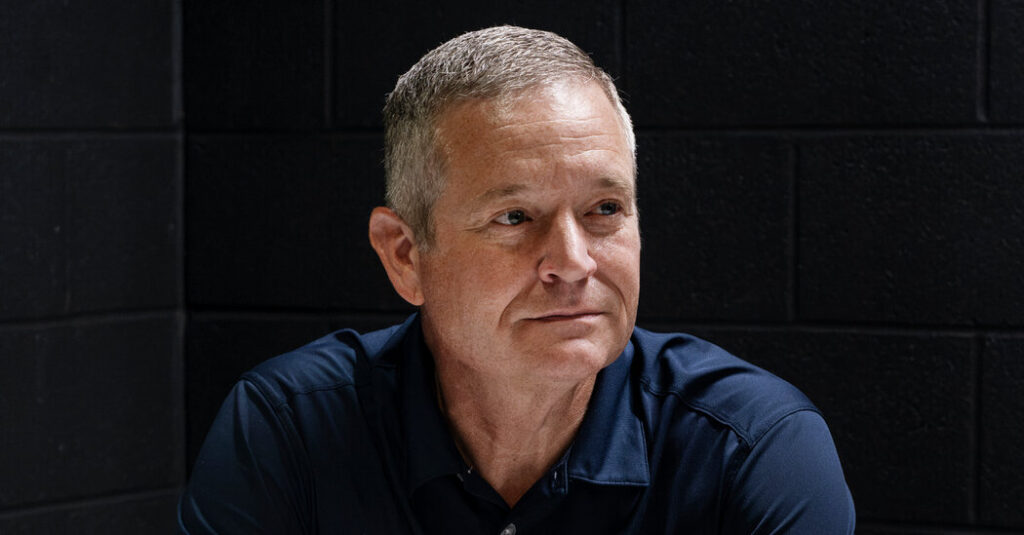
One afternoon in Joplin, Huff and I stopped for lunch at a cafe. Huff is now 56, with salt-and-pepper hair and a more subdued vibe than he had a decade ago. As we ordered, a man Huff thought he knew walked past our table. Huff said hello, and for a second, the passerby didn’t recognize him.
“C.J.,” Huff prompted.
“Ah,” the man said. “The infamous C.J. Huff.”
After two years piecing together educational consulting work, Huff got a call: The Department of Health and Human Services was looking for someone to lead education-related disaster relief. It was 2017, and his basic brief was to do “landscape assessments” of shattered school districts: to figure out exactly what educators needed in order to reopen their schools. When he accepted the job, Hurricane Harvey had just made landfall, and he was deployed to Texas.
There, he was given a cubicle in a response hub that FEMA and state officials had set up in a golf-club-manufacturing plant. It held 1,200 disaster experts from dozens of federal, state and local agencies — “huge teams of people,” he told me, “to support health care, for instance.” But Huff was among only a handful of people assigned to support educators. Vast areas of the state’s coast had been underwater, and Huff realized how complicated and wide-ranging flood damage was compared with the more circumscribed havoc wreaked by a tornado.
The scale of flood damage set limits on how fast schools could reopen: In the worst-hit places like Port Aransas, a city on an island off the coast of Corpus Christi, even temporary buildings could not open their doors for nearly two months. But speaking to Sharon McKinney, the district superintendent, Huff felt overwhelmed by a sense of recognition. The grief, the exhaustion he saw in her: “I remembered that look on my face.”
Dozens of federal and state officials had visited McKinney and left her their business cards. She had become responsible overnight for building design and decoding government regulations, things she had little training for. But no one took the time to walk her through what she should actually do, she told me. She and Huff sat together in her office and talked.
Traveling to other districts, Huff learned that resource-poor parts of America struggled to implement even some of the most basic principles of school recovery. In Puerto Rico, school buildings were used as shelters months after Hurricane Maria hit; when Huff arrived eight months later, some were still missing roofs. When he got to Florida after 2018’s Hurricane Michael — which came on the back of a particularly destructive 2017 hurricane season — he realized that the local, state and FEMA leadership bench was “only staffed so deep,” especially when “large-scale disasters happen back to back like that.”
He has now been doing this work for nearly a decade, but new disaster zones still jolt him. Huff recalled looking out the window of his Uber from the Maui airport into Lahaina, Hawaii, a month after the 2023 fire, thinking about how the stripped toothpick trees reminded him of Joplin. The general emptiness of the landscape, though, was a shock; fire doesn’t produce debris in the way storms do. All four school campuses remained unusable, and many students had enrolled elsewhere. The blaze had done a different kind of damage, melting car batteries and timber treated with arsenic to resist termites. Even intact buildings were coated in toxic ash.
All these years after the tornado, he is struck by how little has changed procedurally. There are still no clear federal guidelines for restoring schools after a disaster. In my own conversations with superintendents whose districts were devastated by hurricanes, floods and wildfires over the past decade, I heard about how they felt left alone to manage crises that had damaged their own homes, put them at the front line of comprehensively caring for thousands of their most vulnerable neighbors — the children — and rendered them responsible for decisions that would determine whether their communities’ tax bases survived, whether their towns lived or died.
Josh Barnes, who ran the broader division within the Department of Health and Human Services that contracted Huff, left H.H.S. in 2019. But he told me that he still sees an acute need for better organized federal help. School leaders, Barnes said, are not “adequately able to benefit from the collective experience that we have as a country.” In his view, every time a new district becomes a disaster zone, “we are discovering the same lessons for the first time, for, like, 20th time. And it’s agonizing to watch, frankly.”
As Huff visited other school districts, he discovered another common thread: The backlash he experienced was not specific to Joplin. Devastated communities often fell into infighting following disasters. After a catastrophe defined by helplessness, finding a shared enemy gave people something they could control.
In Maui, for example, Huff was surprised by the intensity of the community’s anger, even the children’s. At one meeting of fifth graders he convened, a child was incensed that leaders hadn’t sounded a warning siren. Huff was also struck by the residents’ desire to retain the island’s “identity,” to put things back the way they were — what he called the “‘heart piece’ of recovery.” Lahaina’s jade-green elementary school had stood in the same spot since before Hawaii joined America. That location was in the island’s tsunami zone. Contemplating the site, Huff knew it was impractical to rebuild there. But some Lahainans fought to preserve the site nonetheless.
Seeing all of this helped Huff process his own experience. “Joplin’s cycle of recovery is very, very real,” he told me. Jarvis, the acting New Orleans superintendent, resigned less than two years after Katrina. After flooding in 2016 in Nicholas County, W.Va., local officials proposed to use the recovery money for an ambitious school-consolidation plan. Residents mutinied, and the debate over how to rebuild and how much to spend dragged on for years, eventually leading to resignations.
When superintendents didn’t face resentment, it was often because the whole community — local leaders and residents alike — had assigned blame to federal officials. When everyone felt abandoned by the same institutions, that failure could be strangely protective. In Port Aransas after Harvey, the demon was outside: Frustration was directed outward, at contractors and FEMA. “We were all in the same boat,” McKinney told me. For years she kept an email she had printed out on her desk, a FEMA reimbursement denial for hardware, to remind her of what victimized her town. (FEMA did not reply to a request for comment.)
One night in Texas, Googling disaster recovery theory in his hotel room, Huff came across a graphic. It depicted a line tracking people’s psychological response after a disaster: The line soared upward as survivors experience a “heroic” surge of optimism, the “honeymoon phase.” Then the line plummeted into the “disillusionment phase,” in which fatigue, blame and rage send a community far lower emotionally than it was before the catastrophe. Only long afterward would the real “recovery and reconstruction” begin.
When Huff first saw it, he thought: “Oh, my gosh, this is exactly what I went through. This is normal.” He sent it to other leaders from the time of the tornado, several of whom mentioned or showed it to me, too. It became cherished, like a talisman. When Huff described this graphic to me recently, he began to cry.
The central tension in disaster recovery — between rebuilding what was lost and creating something new — will always be hard for communities to reconcile. And complicating the research around school recovery is how time can change the picture. Two decades after Hurricane Katrina, the remaking of New Orleans’s school system is seen as a contentious case study: It prompted real and comprehensive academic gains, yet it also deepened some inequities in the schools. In Joplin, certain educational metrics, especially graduation rates, improved after the tornado; though those rates fluctuated over the longer term, they have shot up recently.
But several former Joplin students told me that their feelings about Huff’s rebuilding plan had evolved as they got further out from their high school years. Mariah Vazquez, whose home was destroyed in the tornado, entered the new Joplin High when it opened in 2014 and told me that she initially felt lost in the “extravagant” building. But, she said, “I would not be where I am today” — a professional photographer — without the career academy project. For a long time, Eldred, who stayed in the Joplin area and works at McDonald’s, felt as if he were still “living in the shadow of the tornado.” But now, he said, he can appreciate the citywide recovery that Huff’s flashy school renovation plan helped jump-start. He mentioned the modern library, the cutting-edge hospital, “things we probably wouldn’t have gotten if we stuck to the old-style Joplin.”
Today Huff works out of a co-working space in a former chicken-processing plant in downtown Springfield. When the plant was converted, the developers got rid of the equipment but didn’t change the architecture, so the floors slant in odd ways, a relic from when the builders wanted the blood of slaughtered chickens to run into easy-to-clean pools.
After the pandemic began to discourage in-person deployments, his government work became too intermittent. So he and his wife founded their own company in 2024 as “a turnkey solution” for shattered superintendents awash in problems after disasters, he said. “FEMA technical assistance. Grant writing. Grant management. Anything and everything that school leaders have to deal with.” When we spoke on the phone a few weeks ago, he was about to travel to central Pennsylvania to meet with a superintendent whose school was hit by a tornado in August. In theory, Huff is better positioned than anyone to do this kind of work. “It’s mystifying,” said Abramson, the social and behavioral scientist, that public officials don’t do more to “help affected communities quickly climb the learning curve” by imitating Joplin’s fast, ambitious school reopening plan. But over time, Huff himself has begun to think that his logistical advice goes only so far. After all, every school district is facing its own specific, regional obstacles. Now he tries to offer something more like solidarity. For two superintendents I spoke with who worked with Huff, that empathy was just as crucial as any recovery template.
Huff told me that in retrospect, he thinks all the TV interviews he did about Joplin, the crusading, visionary attitude, might have been a way to distract himself from feeling or processing his own grief. “Maybe part of the reason I kept the hero cape on was so I didn’t have to face those memories,” he said. “It was easier for me to just focus in on the work.”
Now he tells educators: “‘I’m not your knight in shining armor. I’m here to be your backup.’ I try to be a Swiss Army knife.” He encourages school leaders to spend more time listening than talking and to “take the hero cape off.” “I always kind of frame it as, ‘Do as I say, not as I did,’” he said.
One day in Joplin, Huff took me to the high school he once reimagined. For 20 minutes, we wandered all around the school’s imposing facade, from the triple-height entryway doors to the outdoor amphitheater, searching for a way in. Pressing his face against the tinted windows to try to spot someone within, Huff looked like a child locked out of his family home. Finally he spied a custodian and pounded the glass until she opened a door.
Inside, the windows filled the high-ceilinged space with a beautiful, gentle light, bringing the outdoors in. We visited the restaurant, the state-of-the-art black-box theater, the auto-body-work training area, the “think tanks” — small, soundproof rooms — that supported the development of clubs and organizations, “just to make sure kids felt like they’re part of something.”
As we wandered the school, Huff began speaking in the present tense. “We’ve got a great culinary arts program here,” he said, showing me a full restaurant where students can serve guests. “Kids have a lot of chances to just explore their passions.” We paused in the hall, where alcoves displayed striking wood sculptures that artists had carved out of tree trunks torn up by the tornado. He touched a wall. “I’m wandering around here, and I’m like, ‘That spot needs painting.’” Finally, we had seen everything we could. Huff pushed an emergency-exit door and walked out into the sun. It was easier to leave than to get in. In two months, the school would be full of students again, and he would be on to the next place.
The post He Rebuilt His City’s Devastated Schools. Then Came the Backlash. appeared first on New York Times.