Since returning to office, President Trump has often gone to risky, extraordinary lengths to pressure the Federal Reserve into lowering interest rates. So it was all the more remarkable when he affirmed in May that he wanted his new, handpicked Fed chairman to call the shots.
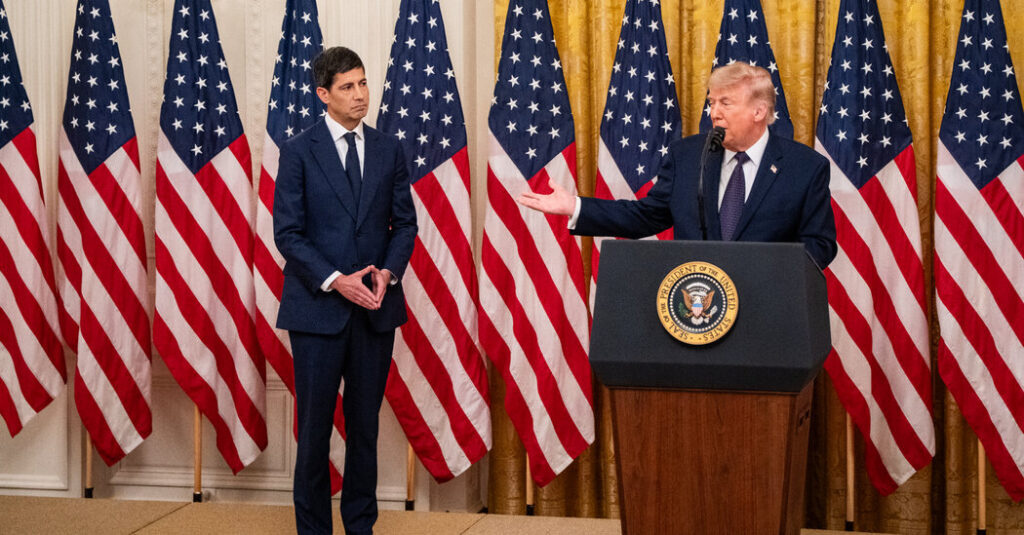
“I want him to be independent and just do a great job,” the president said, as he stood alongside Kevin M. Warsh on the day he was sworn into office. Mr. Trump soon added: “Just do your own thing and do a great job.”
On Wednesday, Mr. Warsh did his own thing, so to speak, when he joined his colleagues in voting unanimously to raise borrowing costs for the first time in three years. The outcome was exactly the opposite of what Mr. Trump wanted, and the president responded in anger. But unlike his previous Fed-related outbursts, he trained his ire on everyone except the man he had installed atop the nation’s central bank.
The shifting approach underscored the evolving stakes for both Mr. Trump and Mr. Warsh as they seek to tame years of persistent inflation at a precarious moment for the U.S. economy. While the president has hardly abandoned his aggressive pursuit of lower borrowing costs, he has still afforded Mr. Warsh more leeway than his predecessor, Jerome H. Powell, a recognition of the blowback that might arise from interfering with the new Fed leader.
The dynamic was on full display in a conversation between the two men that Mr. Trump revealed to reporters late Wednesday. At some unspecified time before the vote, the president said that he told Mr. Warsh that “you might as well vote with the board because it’s just not going to matter,” adding that other Fed members were “hostile” and “political” toward him.
The Fed’s policy-making committee is composed of the seven members of the Board of Governors, the president of the Federal Reserve Bank of New York and a rotating group of four presidents from the remaining 11 regional banks. Three Fed governors were previously nominated by Mr. Trump, including Mr. Warsh.
“They’re raising the rates to make Trump do as bad as he can possibly do,” the president said of the full board, shortly after describing Mr. Warsh as a “good man.”
The comments marked a notable departure from the withering criticism that Mr. Trump had frequently levied against Mr. Powell, who kept his distance from the president.
But the change in tone did not mean that Mr. Trump was willing to drop his pressure campaign entirely. The president still issued an unrelated ultimatum that he would cut off a swath of U.S. trade unless the central bank slashed rates to 1 percent or lower.
The threat risked significant repercussions for American families and businesses, and it left experts unsure how long Mr. Warsh’s honeymoon would last given that the Fed is unlikely to stop at just one interest rate increase. On Wednesday, most policymakers projected raising rates at least once more this year, with additional increases under consideration in 2027.
“There is really no escaping this perception that Trump is still trying to put a thumb on the scale of how the Fed acts, even if he’s absolving Warsh of blame,” said Sarah Binder, a political science professor at George Washington University. “Trump is still in the story, and there are still doubts and people wondering as I am, ‘What exactly does the relationship look like?’”
“That is one of the political costs and the dangers of having a president who feels compelled and entitled to tell the Fed what to do,” she said.
For Mr. Trump, the shift reflected more than a year of hard-learned lessons about the consequences of meddling with the Fed.
The president’s past interventions to try to force down rates — using punitive investigations and withering attacks on Fed members — sparked disruptions on Wall Street and in the bond market. His attempts to fire one of the Fed’s governors drew a rebuke from the Supreme Court, though Mr. Trump has not given up.
And the president’s repeated efforts to investigate and penalize Mr. Powell, in particular, angered even some Republicans in Congress. The resulting outrage threatened to derail the confirmation of Mr. Warsh, who was dogged by questions in the Senate this spring about his ability to resist a president who has repeatedly tried to interfere in the Fed’s work.
Mr. Warsh, for his part, has frequently declined to discuss politics or his interactions with Mr. Trump, a pattern he continued on Wednesday. But the Fed chairman historically has emphasized the importance of an independent Fed, insisting at one point during his confirmation that Mr. Trump had never “asked” him to commit to a rate decision — “nor would I ever agree to do so.”
The pressure may only grow with the midterm election approaching, as Mr. Trump struggles to convince a restive public that his policies have not made inflation worse. The president believes a growing economy should not elicit rate increases, even though his preference for staggering rate cuts could worsen the problem.
“Because every time you have good news, they raise interest rates,” Mr. Trump claimed at a rally in North Carolina late Wednesday. “Every time you have good news, you’re supposed to lower interest rates because we become a better credit.”
But, with the Warsh-led Fed, White House officials have adopted a delicate hand. They have repeatedly praised Mr. Warsh’s economic bona fides while maintaining they are well within their right to criticize the central bank.
In a recent appearance on CNBC, Kevin Hassett, the director of the White House National Economic Council, insisted that Mr. Trump would “respect” Mr. Warsh’s decision on rates, whatever that turned out to be.
But, Mr. Hassett added, “we also don’t think that in a democracy that one is not allowed to talk about policy and economics.”
For many experts, the question remains: How long will it last?
“I don’t think Trump’s patience is going to be unlimited, but it seems like a better relationship for now compared with how Powell dealt with it, which was to say, ‘I’m not talking to Trump at all,’ which seemed to cause more tension in some ways,” said Derek Tang, an economist at the research group LHMeyer.
The post Fed Chairman Escapes Trump’s Public Ire Over Interest Rate Increase appeared first on New York Times.