El Niño is coming for us.
It’s out there over the Pacific Ocean, waiting. Muscling up for the move.
It’s come this way before, and it overstayed its welcome. At intervals of 20 years and sometimes more often, it has lashed and splashed us, turned our living rooms into muddy aquariums, swept away our cars and houses, and sometimes hundreds of Angelenos.
So, when Sepulveda Boulevard becomes the Sepulveda River in a few months, and the TV news reporters pull on those yellow rain slickers for “Stormwatch ‘26,” remember that L.A. has starred in this movie before.
El Niño’s nastiest modern visit was on March 2, 1938, when a pair of storms hit the city of L.A. with 5.88 inches of rain in 24 hours. It rampaged for several days, and flooded the basin so devastatingly that the Oscars, scheduled for March 3, had to be postponed for a week because so many stars and filmmakers were marooned up in the canyons and on their ranches in the San Fernando Valley. More on death and destruction later.
We live in a perfect geological machine for flooding. The thousands of square miles of mountain watershed around us, the San Gabriels and the San Bernardinos, are as steep as roller coasters, and the rain funnels off them in tumults. The one-day rainfall record in California, and the fourth highest ever in the nation, landed in the San Gabriels on Jan. 22, 1943, a couple of miles southeast of Mt. Wilson: 25.83 inches in 24 hours — 2 feet in one day.
Devastating as that was, the monumental storms of 1862 flooded a lot of the West, from Arizona to Oregon, and into Mexico and Canada. Along parts of the coast, relentless rain and early snowmelt made the sea barely distinguishable from the land. In Sacramento, the new governor, Leland Stanford, had to be taken to his inauguration by rowboat.
Cattle and sheep died by the hundreds of thousands. Vineyards and groves went churning into the sea. In L.A., “numbers have been rendered homeless and destitute,” a Marysville newspaper reported, “and in many cases barely escaped with their lives.”
California floods are proportionately deadlier than earthquakes. In 1862 there was no accurate tallying, but in a state of 400,000 people, as many as 4,000 may have died. For years afterward, Angelenos collected firewood from the mangled forest of broken tree branches the waters left behind.
The 1862 mega-floods were not from an El Niño but a piling-up of atmospheric rivers. Each El Niño of yore that put this broad basin underwater had a different character because each cut loose on an evolving L.A., a place altered in part by floods and changed because of them.
The writer John McPhee, who chronicled the alarmingly kinetic San Gabriels in his book “The Control of Nature,” marveled at the human stubbornness that keeps us here. He wrote that a thousand years ago and more, when early native Californians were confronted with the same tradeoffs, they decided that “the climate was so congenial that when people discovered it they were willing to struggle to live in it.”
So we do. And here’s what we’ve been through and what we have done about it.
In November 1913, Los Angeles rejoiced to welcome a lavish, steady [and more or less purloined] flow of water. The L.A. aqueduct, an astonishing feat of engineering, brought hundreds of millions of gallons a day down more than 200 miles from the Owens Valley into the San Fernando Valley. Three months later, stupendous rain damaged the pipeline as it passed through the Antelope Valley, but it was swiftly fixed.
Not so those February floods in Los Angeles itself. The Los Angeles River was still pretty much what it had been for eons: a wandering river of the West, often nothing more than damp wetlands in summer, but quickening into rushwaters in winter. As early as 1815, the flooded young pueblo had to hoist its skirts and move up to higher ground.
Rain watered crops, and soaked in to recharge the groundwater that hydrated the city — something that can’t happen now, when something like 40% of the city is covered over, impermeable to rain.
But too much rain destroyed crops, and L.A. ran on agriculture. Like the groves and gardens, houses built foolhardily near the dry summertime river risked being pulled off their foundations and washed away by the winter torrents.
That happened in the 1914 storms, to the bridges criss-crossed by streetcars and railroads, and to the famous pigeon farm that stood at the Y where the Arroyo Seco joined the L.A. River (what is today called Lincoln Heights), where myriad “squab” were raised for fancy dinner tables.
The flood drowned them by the tens of thousands. Survivors wheeled and circled above the wreckage for days, and injured birds straggling ashore were killed by Angelenos looking for a free meal.
The most important consequence of 1914 floods: the creation of a county flood control district. The aqueduct seemed to make the city’s founding river not just obsolete but dangerous, so construction began on catch basins, dams and reservoirs.
Soon they’d fill with water, and with what writer McPhee called “rock porridge,” a cold rolling lava of mud and debris and boulders the size of Volkswagens.
On New Year’s Eve 1933 into New Year’s Day 1934, a mud flow above La Crescenta and Montrose killed at least four dozen people, washed away or buried in mud and broken trees and smashed houses, a mix that churned and hissed down from mountains that had been burned bald by brush fires months before, then smacked with a year’s worth of rain in a day or two.
Dust Bowl troubadour Woody Guthrie, who’d be moving to California in a few years, wrote a lament to “Los Angeles New Year’s Flood.” Among Guthrie’s “dear ones” who “crossed that golden river” were 19-year-old twins, Winston and Weston Doty, USC yell leaders who had played twins in the 1924 film “Peter Pan.” They’d driven from their Venice home to a party in Montrose. Their bodies were found close together in the mud flow.
The next day, New Year’s Day, the Rose Bowl game was played as usual; Stanford lost to Columbia. Before that, as “rock porridge” still slid downhill, and the rain still fell, the annual parade had come off as scheduled, if not as planned.
The parade theme was “Tales of the Seven Seas,” and in the downpour, 30 flowered nymphs were washed off one float. South Gate’s rain-sodden float depicted a floral Titanic sinking alongside the killer iceberg.
Across the waterlogged basin, it rained almost 8 inches over New Year’s Eve and New Year’s Day. Venice and Culver City and the southeastern county towns and farmlands were inundated. Buildings and bridges crumpled like soggy soda crackers.
The year before, 1933, the Long Beach earthquake had changed the way California built buildings. Now the 1934 flood changed the way Southern California protected them. New dams and debris basins turned the vast natural waterways and springs and creeks of old L.A. into a chutes-and-ladders system to divert and hold back water and mud, before the next time.
And “next time” came on fast.
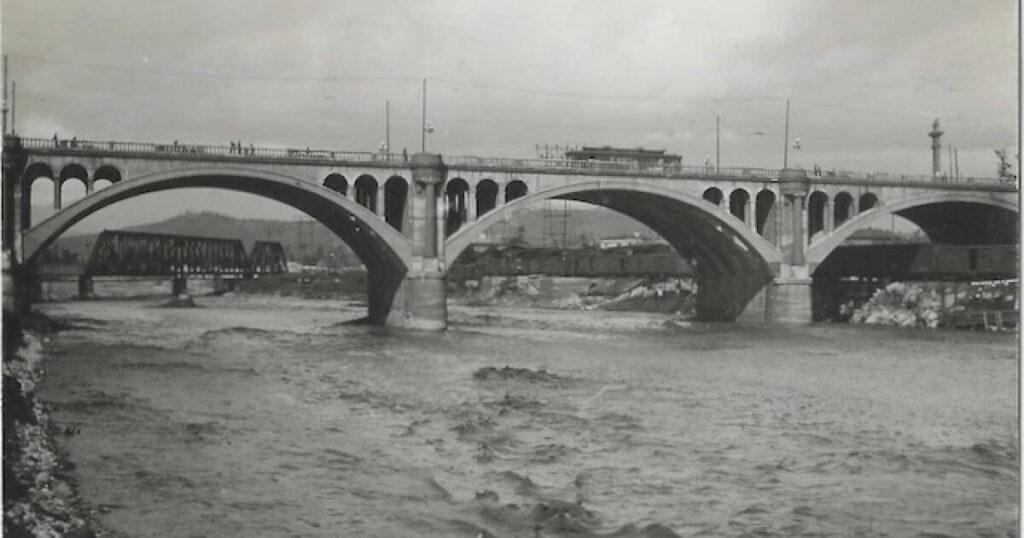
In early 1938, two monster one-two storms left L.A. as an inland sea and an isolated island. Railroad lines and roads and bridges were wrenched away. Compton and other towns were inaccessible and impassable. At Long Beach, 10 people died as they stood on a bridge over the L.A. River, gaping at the floodwater. Another five died when the same thing happened to the Lankershim Bridge in Universal City.
Thousands of homes were lost, and thousands more evacuated, not always in time. Ten tons of mud chuted down Beverly Glen, killing a woman and her baby. A million tons of sodden dirt avalanched down onto Riverside Drive from Elysian Park. Families climbed to their rooftops and hollered for rescuers. The mother of The Times’ art critic chose to evacuate with some silverware and a Spanish shawl, “in case we needed to sell something.”
Parts of Orange County, still a vast agricultural Eden, were drowned. The three principal rivers and their tributaries — the Los Angeles, the San Gabriel and Santa Ana — joined into an inland sea. The L.A. River broke out and redirected itself by a mile near Compton, wiping out neighborhoods. The rushing Santa Ana River killed at least 10, and electric power was lost to entire cities, like Riverside. Palm Springs too was inundated. As The Times wrote, “hundreds of motion picture celebrities and wealthy society and businessmen and women in Palm Springs appealed to Los Angeles for aid.”
Only shortwave radios worked, and the mayor of Los Angeles, Frank Shaw, spoke to the nation thanks to a relay via a wireless station way up in Point Reyes.
He sounded as chipper as a Chamber of Commerce ad. “This area has suffered within the last 24 hours from its most serious condition in years. … However, it has passed and the sun is shining …“
“Our friends throughout the United States can be assured that Los Angeles is still smiling and that Los Angeles is still facing forward.” A week after the floodwaters receded, Angelenos started circulating petitions that would recall the corrupt Shaw from office.
Movie people were stranded on Lookout Mountain, and in Malibu, where a highway patrolman managed to ferry milk to director Frank Capra’s children. Stars James Stewart and Shirley Temple bunked down in their studio dressing rooms. Props and sets at Universal’s and Warner Bros.’ riverside studios were washed away.
Spectacularly, one was a huge prop whale named Moloch. It was the plot point in the 1937 comedy “Public Wedding.” In the movie, a carnival staged a publicity-stunt fake wedding in the whale’s mouth, capped by a whale-shaped wedding cake with tiny bride and groom figurines in the whale’s mouth.
“Moloch” was last seen swimming down the Los Angeles River — its first and last whale. It was pretty much the last waterborne anything to live in the river for a long time to come. The flood that killed 115 was also the death of the natural L.A. River.
The newspapers of 1938 were calling it a monster. The flood damage, coupled with a Depression-era unemployed work force, put the river into the hands of federal flood control programs.
Within barely 20 years, this river that had made L.A. a green and pleasant and fruitful land had been turned into an efficient concrete toilet, a paved water freeway designed to get rid of as much water as fast as possible for the few days each year that L.A. might need it. In short order, wrote California historian Kevin Starr, the city was deprived “of its central landmark,” a river that was “possessed of its own special sort of greatness.”
The built river protected L.A. from the worst of its flooding, but created its own problems. “Scientific American” cautioned in 1939 that “as much water as possible must be preserved to replenish ground water storage.”
But as the river was walled in against flooding, more people built even closer to it, and floodwater had no place to go to recharge the water table — nowhere but down and out.
The system that protects us from floods cannot help us out of drought. Sped away into the Pacific every year are billions of gallons of water. And every year billions of gallons of water have to be bought, and brought to L.A. from afar.
The post The approaching El Niño is scary, but L.A.’s starred in this horror movie before appeared first on Los Angeles Times.