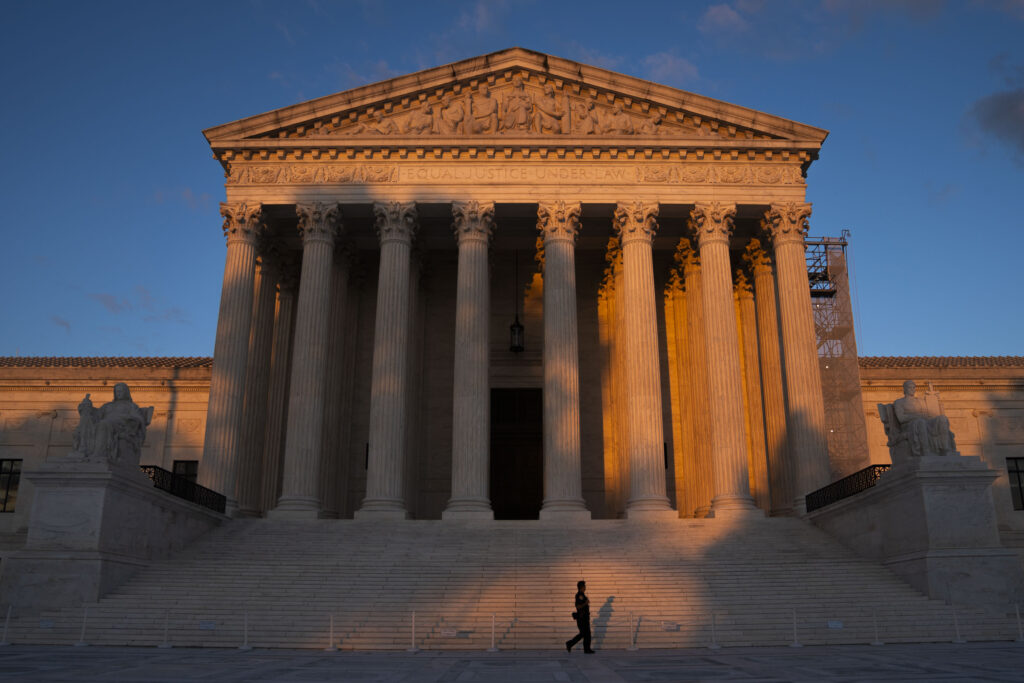
The Supreme Court on Tuesday wrestled over whether to lift limits on how much political parties can spend in cooperation with candidates, in a case that could change how money flows through the campaign finance system.
Republican leaders are asking the court to remove limits on how much parties can spend in coordination with federal candidates on items like advertisements and campaign expenses. They say the existing limits hinder the parties’ free-speech rights and put parties in a weaker position than outside groups like Super PACs.
The Democratic party opposes that bid, arguing that lifting the limits on party spending would lead to a greater potential for quid-pro-quo corruption, allowing wealthy donors to dodge individual contribution limits by donating through parties instead.
Individuals can give $3,500 to a candidate during an election cycle but can give $44,300 per year to a national party committee. Allowing parties to spend unlimited amounts in coordination with a candidate would give donors much more opportunity to curry favor with candidates, supporters of the existing limits argue.
Other experts and reform groups, however, say allowing parties to spend unlimited amounts on candidates could counter the influence of outside groups like Super PACs, which are often criticized for fueling polarization.
The court’s liberal justices appeared most concerned about the ramifications of lifting the restrictions. Justice Sonia Sotomayor attacked the arguments from Republican lawyers who said there is no evidence that wealthy donors launder money through political parties to give to candidates in return for favors.
“If there’s a lack of evidence, it means our umbrella is working,” Sotomayor said, adding Republicans are now asking the court to “take that umbrella completely away.”
Conservative justices were comparatively silent on that issue, focusing instead on whether Democrats and Republicans have been aligned on lifting the limits.
Over the past two decades, the Supreme Court has greatly loosened campaign finance regulations. In the 2010 Citizens United decision, the court ruled that corporations and other outside groups can spend unlimited amounts on candidates. Four years later, the court lifted the cap on how much wealthy donors can give to federal candidates, political parties and committees.
Currently, the amount political parties can spend in coordination with candidates on advertisements is capped.
Vice President JD Vance and congressional Republicans are asking the high court to eliminate those limits. They say spending caps restrain parties’ constitutional free-speech rights. Republicans also argue that spending limits are obsolete in light of the Supreme Court’s previous loosening of campaign finance restrictions.
In 2022, Vance and Republican leaders sued the Federal Election Commission when Vance was running for an Ohio senate seat. They asked the Supreme Court to hear the case last year after a lower court upheld the coordinated party spending limits.
The Supreme Court will probably strike down the coordinated spending limits, campaign finance experts predict, given the court’s prior willingness to lift restrictions.
Critics of the existing limits say they have increased the clout of outside groups, like Super PACs. “[W]hen outside groups have more influence, the legislative process becomes more dysfunctional,” New York University law professors Richard Pildes and Bob Bauer wrote in a June article about potential ramifications of Tuesday case.
They noted that lifting limits on how much parties can spend in coordination could strengthen parties and foster stability. And with the rise of outside political spending, a challenge to coordinated spending limits was “inevitable,” Pildes and Bauer wrote.
Super PACs now dominate American elections, taking on many of the campaign tasks traditionally handled by candidates and parties. In the 2024 election, independent expenditures made up over a quarter of total spending — up from 3 percent in 2008 — driven by super PACs such as the pro-Trump MAGA Inc., according to a Post analysis of OpenSecrets data.
Wealthy donors also dominate elections. Since 2000, political giving by the wealthiest 100 Americans to federal elections has gone up almost 140 times, well outpacing the growing costs of campaigns, a Washington Post analysis found. In 2000, the country’s wealthiest 100 people donated about a quarter of 1 percent of the total cost of federal elections, according to a Post analysis of data from OpenSecrets, which tracks federal spending.
By 2024, they covered about 7.5 percent, even as the cost of such elections soared. In other words, roughly 1 in every 13 dollars spent in last year’s national elections was donated by a handful of the country’s richest people.
Beth Reinhard contributed to this report.
The post Supreme Court weighs further loosening campaign finance limits appeared first on Washington Post.