The Trump administration has spent much of the year dismantling federal climate policy and attacking the clean power industry. As a result, the growth of renewable energy like wind and solar power has slowed across the United States.
Installations of solar, wind and batteries grew this year, but at the slowest rate in more than a decade. Solar installations rose just about 10 percent, and wind installations have essentially stagnated. Some $28 billion in clean energy projects have been delayed or canceled this year.
But there’s at least one American renewable energy company that has found a way to buck this trend: Sunrun.
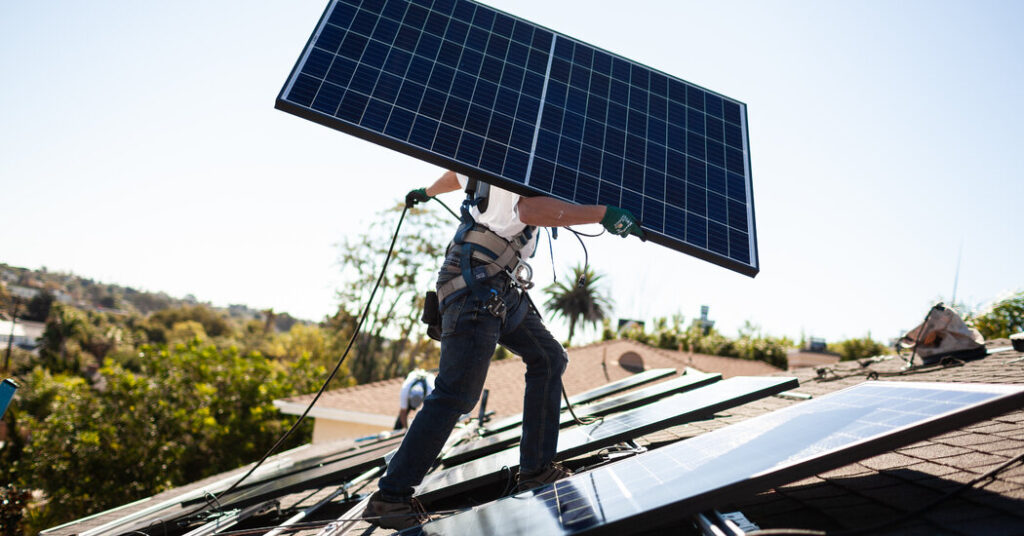
The San Francisco-based company has carved out a niche in a struggling industry with an innovative business model. Instead of selling solar panels direct to consumers, it leases them, offering “energy as a subscription service,” and significantly lowering upfront costs.
And at a moment when many clean power companies are under attack from the White House, Sunrun is trying to position itself as a partner in President Trump’s energy agenda.
Solar as a service
Sunrun came on to the scene in 2007 with an innovative twist on solar energy. Rather than simply selling solar panels and installing them on homes, it offered a subscription service.
Homeowners pay a set fee for the energy generated by the solar panels on their house, while Sunrun owns, installs and maintains the panels. Sunrun makes money through these fees, selling energy back to the grid (it gives consumers a cut), and by taking advantage of tax credits.
In 2021, Mary Powell took over as chief executive and expanded. Instead of just offering solar, the company would now offer battery storage, too.
That differentiation proved helpful this year, when Republicans worked to dismantle Biden-era policies that benefited the clean energy industry.
As lawmakers hashed out details of the new tax law, Powell said she was on Capitol Hill, making the case that Sunrun wasn’t just another solar company, but rather an energy storage company that could help smooth out demand on the grid.
“That really is what resonated when I was in Washington during the whole budget bill process,” she said. “Our political leaders realized that what Sunrun was doing was ensuring that we were actually achieving our goals on American energy independence.”
It helped that she positioned Sunrun as an ally in the administration’s energy agenda.
“What we do for America is delivering on our president’s agenda” she told Fox Business this year. “We are all about delivering jobs in America, we’re all about manufacturing in America.” Critically, she added, the company doesn’t use imported solar panels from China.
Her efforts paid off. Republicans eliminated the direct consumer tax credit that homeowners could use to offset the cost of installing rooftop solar panels.
But the Republicans’ law preserved the investment tax credit for solar leases that Sunrun relies on through 2030, and the credit for storage through 2033, giving the company a crucial boost.
Investors took note. Sunrun stock is up 75 percent this year, and the company has added roughly 30,000 new customers for each of the past two quarters.
“It’s made us a stronger company,” Powell said of the bill.
She added that her strategy was not simply about adapting to this administration. “Politics shifts and moves constantly,” she said. But in recent studies, she added, the overwhelming number of Americans “believe that solar and storage is really important for how to power lives and power the grid.”
Bringing down prices
Powell said her work at Sunrun was the continuation of a career-long quest to bring down energy prices for consumers. Before taking over Sunrun, she worked at Green Mountain Power Corporation, Vermont’s main electric utility, for 21 years, rising to the role of chief executive. There, Powell helped bring more renewables on to the grid and encouraged consumers to install batteries in their homes.
As we’ve been reporting all year, the Trump administration is waging war on the offshore wind industry, electric vehicle adoption has slowed, and China is racing ahead of the U.S. in delivering clean energy to the world.
But the story of Sunrun shows that with the right combination of technology, a money-saving value proposition and narrative, renewables can keep gaining ground, even in an inhospitable policy environment. It helped that Powell framed herself as an ally of the administration, not a climate activist.
“There is no stopping, from a big picture perspective, this consumer led revolution toward a better way to power homes, lives, and the grid,” she said. “Full stop.”
OuR oceans
A Times reporter traveled to Greenland to hunt for an ocean tipping point
From the deck of a ship off eastern Greenland, the most majestic presence isn’t the whales, the icebergs or even the towering, glacier-wrapped mountains.
It’s the parade of frigid, midnight-blue water, 75 miles wide, that streams down the coast from the Arctic Ocean. Farther south, these currents mingle with tropical water swinging up through the Gulf Stream, and together they set ocean temperatures throughout the North Atlantic, like hot and cold taps on a giant bath.
Now, though, mankind is fiddling with the taps. Rapid warming caused by greenhouse gas emissions is making the Arctic rainier and melting its ice, both on land and at sea.
If too much of this excess water makes its way into the North Atlantic, scientists fear it could disrupt the processes that draw warm water up from the tropics. The consequences for the climate would be far-reaching: frostier winters in Britain, stronger hurricanes in the Eastern United States and, perhaps most troublingly, shifts in the rain belts that feed people across Africa, South America and Asia.
To better understand this threat, a team of researchers sailed from Iceland to Greenland’s east coast this summer with a shipload of data-gathering equipment. Observing ocean currents as they change is critical to fleshing out scientists’ understanding of how and when they might reach critical tipping points. — Raymond Zhong
Quote of the day
“If our enemies were to write a plan on how to poison Americans and prevent us from growing our own food, this would be it.”
That’s from Zen Honeycutt, the founder and executive director of Moms Across America, a group closely linked to the “Make America Healthy Again” movement, responding to a series of decisions by the Environmental Protection Agency to loosen restrictions on harmful chemicals. Honeycutt is among the several prominent MAHA activists that are urging President Trump to fire Lee Zeldin, the E.P.A.’s administrator, over the moves. In a petition circulated on social media, the activists wrote that Zeldin “has prioritized the interests of chemical corporations over the well-being of American families and children.” — Maxine Joselow
The Trump administration
Federal judge finds Trump’s halt on wind energy is illegal
A federal judge on Monday struck down President Trump’s halt on approvals of all wind power projects on federal lands and waters. The judge wrote that the president’s sweeping executive order was “arbitrary and capricious,” violating federal law.
Trump, a longtime critic of wind power, issued the executive order on his first day back in office in January. At the time, states like Maryland, Massachusetts, New Jersey and New York had been planning to build more than a dozen large wind farms in the Atlantic Ocean to meet their renewable energy goals. It’s unclear whether the Justice Department will appeal the ruling.
But even if the decision withstands a challenge, it could have limited effects, according to a research note by analysts at ClearView Energy Partners, a consulting firm. That’s because the courts typically cannot compel federal agencies to approve new projects and developers may be reluctant to propose new wind projects. — Maxine Joselow and Brad Plumer
One big number
More than 300 billion barrels
Venezuela sits on more oil than Saudi Arabia, Russia, the United States and every other country. Yet it produces and sells only about 1 percent of the crude the world is using.
The country has more than 300 billion barrels, or 17 percent of the world’s known oil reserves, Rebecca F. Elliott and Lazaro Gamio report. President Trump’s recent threats against the Venezuelan government and his administration’s strikes on boats in the Caribbean Sea have cast fresh attention on the country’s energy wealth, which has tantalized generations of oilmen.
More climate news from around the web:
-
2025 is on track to be the second-warmest year on record, according to the Copernicus Climate Change Service, the European Union agency that monitors global warming.
-
The Washington Post reports on a new study that shows the risks of exposure to forever chemicals on babies. “Mothers in New Hampshire who were downstream of sites contaminated with ‘forever chemicals,’” they write, “experienced triple the rate of infant deaths and had more premature births or babies with low birth weights.”
Read past editions of the newsletter here.
If you’re enjoying what you’re reading, please consider recommending it to others. They can sign up here.
Follow The New York Times on Instagram, Threads, Facebook and TikTok at @nytimes.
Reach us at [email protected]. We read every message, and reply to many!
David Gelles reports on climate change and leads The Times’s Climate Forward newsletter and events series.
The post A Rare Bright Spot for U.S. Solar: Subscriptions appeared first on New York Times.