Lawyers for a Democratic lawmaker on Wednesday requested an emergency hearing in federal court over whether the abrupt closure of the John F. Kennedy Center for the Performing Arts violates a judge’s earlier order that barred the institution from shuttering.
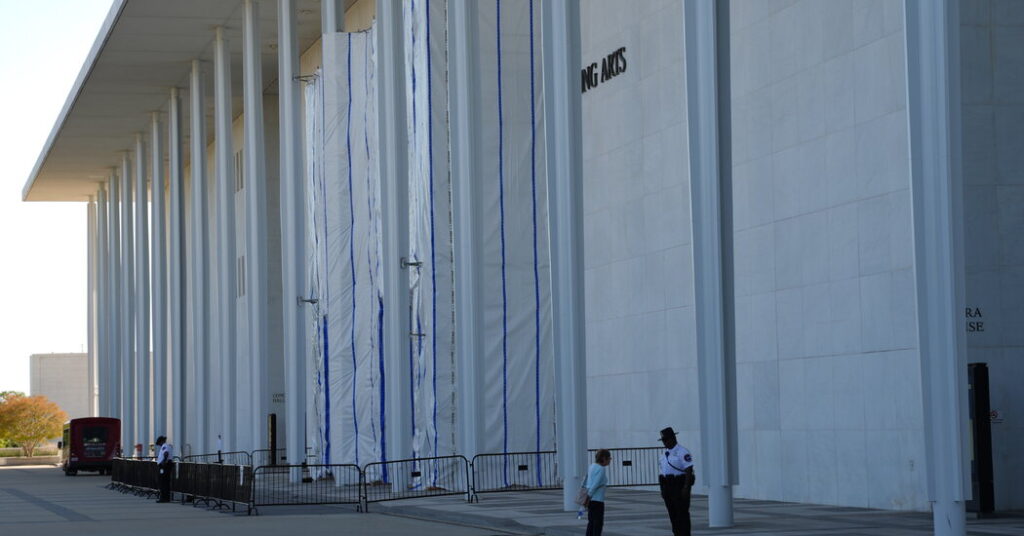
On Tuesday, the center announced it was temporarily closing to the public over what officials described as dire safety concerns after a five-foot section of ceiling plaster fell to the ground during a storm. President Trump, who has pushed for months for the building to be closed for a $257 million renovation project, said the building was in a “virtual state of collapse.”
Lawyers for Representative Joyce Beatty, who is suing the center as an ex officio board member, said that the move appeared to run afoul of a judicial order in May, in which Judge Christopher R. Cooper temporarily blocked the center from closing because of what he described as a lack of meaningful scrutiny over the decision from its Trump-allied board.
“The board cannot simply ignore Judge Cooper’s rulings whenever it suits them,” Ms. Beatty’s lawyers, Norm Eisen and Nathaniel Zelinsky, said in a statement on Wednesday.
In a response to the filing, Judge Cooper asked the center to respond to Ms. Beatty’s request by Thursday morning, and said he would then decide whether a hearing is necessary.
Kennedy Center officials did not immediately respond to a request for comment, but they have defended the closing decision as legally sound and urgently needed. The center said in a statement on Tuesday that a more extended closure of the building would not begin until the court has given its approval.
The Justice Department, which is representing the center in court, did not respond to requests for comment about whether a temporary closure can be authorized without a sign-off from Judge Cooper.
In his ruling, Judge Cooper of Federal District Court in Washington temporarily blocked the board’s initial approval of Mr. Trump’s closure plan, finding that the board had not done a diligent effort to study its impacts. But he said he would revisit the issue if the trustees continued to pursue it and undertook a formal review.
The board later hired consultants and has twice voted to confirm the closure, but the Justice Department has yet to submit a formal motion asking Judge Cooper to lift his order.
Roma Daravi, a spokeswoman for the center, said on Tuesday that the board’s decision “reflects sound judgment and a clear prioritization of safety above all else” and that “the center remains committed to pursuing a safe and efficient renovation through all legal means.”
Although the main Kennedy Center building is closed, a smaller addition to the campus that opened in 2019 — known as the Reach — remains open. This week it is slated to host free performances, including a concert by an indie musician and a magic show.
The center is hoping that its plan to keep the Reach open will satisfy Judge Cooper, who, in his May ruling, said that the institution must, by law, maintain the center as a living memorial to President Kennedy with some performing arts programming. In his order, the judge seemed to leave some room for the center to close temporarily, suggesting that the board would have authority to close it “for certain periods of time or for certain justified purposes.”
Ms. Beatty’s filing highlighted the confusion that followed Mr. Trump’s announcement that the building would be closing “immediately.” An announcement blared over the P.A. system on Tuesday telling the public to exit the main building, but when Ms. Beatty’s lawyer asked the Justice Department for an explanation, one of its lawyers said the fire alarm had been “improperly triggered,” according to the court filing.
But security soon lined up outside the building to prevent the public from going inside. Employees traded confused text messages asking whether they were expected to come into work. Some staff members trickled into the building on Wednesday morning without any trouble. But they were given no official instructions regarding the closure until the afternoon, when employees received an email telling them to wear hard hats in certain areas of the building, including where the plaster had fallen on Sept. 4.
The duration of the closure is unclear. In an email on Wednesday, Ms. Daravi said it was expected to last “until we can be 1,000 percent sure” that the public is not at risk and that “some other piece of ceiling won’t fall and kill them.”
The White House shared a glossy video with swelling music that provided a justification of the closure, pointing to problems such as “chronic water intrusion” and outdated equipment that Matt Floca, the center’s executive director, said leaves the facility “vulnerable to catastrophic mechanical failure.”
The board’s vote on Tuesday — the third time it had approved the Kennedy Center’s closure — prompted objections from Democratic lawmakers, who have accused the center of using the prospect of renovations to paper over the exodus of artists, donors and audience members since Mr. Trump’s takeover at the start of his second term.
“Donald Trump only cares about the Kennedy Center for his vanity,” said Ms. Beatty, whose lawsuit challenged the closing.
Mr. Trump and his allies have been pushing to have his name attached to the building to recognize his work in securing money for the renovations. But Judge Cooper ordered his name removed months ago and on Tuesday barred the center again from inscribing his name on the front of the center.
In a social media post on Tuesday, the president accused the judge of bias and threatened to cancel the renovation project if an appeals court did not allow his name to be restored.
The drama continued into the evening, as the center’s chief financial officer, Donna Arduin Kauranen, resigned. (Ms. Arduin Kauranen and the center did not respond to requests for comment about her reasoning.)
Shutting the doors of the Kennedy Center is far less significant than it would have been months ago, when touring Broadway shows and the National Symphony Orchestra were still performing at the venue. Since July, when the closure was initially slated to begin, the center’s performance calendar has been largely bare and the building a mostly empty shell.
The post Emergency Hearing Sought Over Kennedy Center Closure appeared first on New York Times.