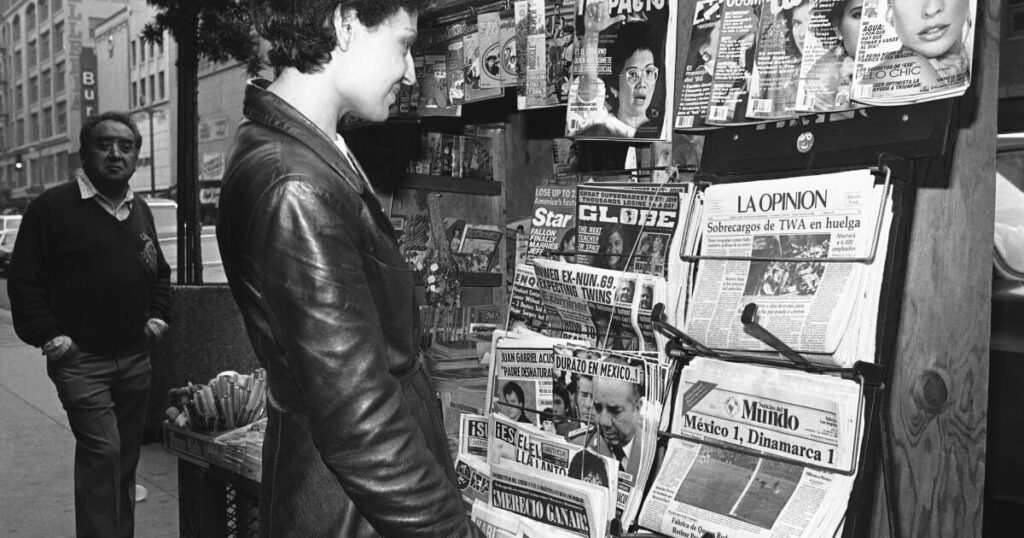
About a dozen Spanish-language newspapers were operating in Los Angeles when Ignacio E. Lozano Sr. launched La Opinión.
It was Mexican Independence Day in 1926, a few years before the Great Depression and the forced removal of Mexicans and Mexican Americans that followed.
Through it all, La Opinión stood the test of time. It chronicled the lives of the city’s growing Mexican community for generations, reaching huge levels of influence in the 1980s and 1990s as immigration from Mexico and Central America reshaped the region in profound demographic and political ways.
This week, the paper reached a milestone, marking a century covering L.A.’s increasingly diverse Latino community. Though it has faced struggles similar to other newspapers, it remains a presence, including last year when Los Angeles was roiled by the Trump administration’s immigration crackdown.
The paper’s centennial is “an amazing feat,” said David LiCalzi, chief operating officer of MyCode, the company that has owned La Opinión since 2022. It’s a reminder of the company’s responsibility in stewarding one of the country’s longest running Spanish-language newspapers, he said.
In today’s world of news apps and social media, it’s easy to forgo the influence newspapers like La Opinión had. For many immigrants who did not speak English, a Spanish-language newspaper was a lifeline to figure out what was going on as well as to find a job, rent an apartment and buy a car.
La Opinión was also a voice during turbulent times for Latinos, including immigration crackdowns and political issues such as Proposition 187, which would have denied many benefits to people living the country illegally.
“I think a lot of us who grew up in the era of the ’80s certainly remember how tough those times were and how vital the local newspapers were, particularly La Opinión” said Dunia Elvir, president of National Assn. of Hispanic Journalists, recalling those days. “They served as a voice for those who were living in fear.”
She said the paper’s stance made Latinos feel like they belonged in the city.
“I dare to say La Opinión was vital; it was like medicine for the spirit,” she said in Spanish.
Still, the celebration is bittersweet moment for the paper that for decades expanded, contracted and, like many of its newspaper peers, is struggling amid an ever-changing media landscape that is marked by layoffs, revenue losses and a drop in readership.
Today, the paper operates with about 50 full-time employees and freelancers, a major decline from years past when the staff was in the hundreds. The paper still publishes a print edition, though it is in a tabloid format — smaller in size and more compact.
To mark the historic occasion, LiCalzi said, the paper launched Somos L.A. Columna, a series of 100-word columns that will publish on the paper’s website and in print. They will also be shared on the paper’s social media accounts.
LiCalzi said the short columns are heartfelt messages from elected officials, community leaders, athletes, artists, business owners and activists who have helped shape the city.
“We’ve spent 100 years writing about the city and for the centennial, we wanted to hear from it,” LiCalzi said.
He said the Spanish phrase Somos L.A. Columna is a nod to Angelenos who make up the backbone of the city. He said having people write shorter messages required that people sit and think about why L.A. is important to them.
Among the list of contributors is Antonio Villarraigosa, former mayor of Los Angeles; Gustavo Dudamel, former music and artistic director of the L.A. Philharmonic; and Byron Vásquez, president and director at Casa de la Cultura de Guatemala in Los Angeles.
The columns will be accompanied by a short video reflecting the paper’s history in L.A. The video opens with as simple line in Spanish: “We’ve always been here.”
City and company officials say the former site of La Opinión at 302 N. Los Angeles St. will be featured in the city’s online inventory of historic places, HistoricPlacesLA Revealed: Latino Los Angeles, a city initiative that highlights places that reflect the history and heritage of the city’s Latino population.
A QR code will be placed by the building to direct visitors to an online multimedia page about La Opinión’s history, according to the city officials.
Los Angeles Mayor Karen Bass celebrated the paper’s centennial in a written statement.
“For a century, La Opinión has been a trusted source of news and information for generations of Latino Angelenos,” she wrote. “Spanish-language media is an essential part of Los Angeles. It tells the stories of Angelenos, reflects the people and neighborhoods that make our city what it is.”
Los Angeles County Board Chair Hilda Solis said that when she was growing up in a family of immigrants, Spanish-language media was part of her everyday life.
“La Opinión helped families like mine stay informed about what was happening in our communities and gave Spanish-speaking Angelenos a voice,” she said in a written statement. “That role is just as important today. At a time when there are efforts to divide our communities and question our sense of belonging, ethnic media helps ensure people have access to information they can understand and trust.”
Adding to the celebratory theme, the centennial comes on Hispanic Heritage Month.
Every year on Mexican Independence Day, the paper celebrates its humble beginnings when Lozano Sr. launched the paper from a modest office in downtown Los Angeles.
Lozano Sr. had already founded La Prensa in San Antonio when he arrived in L.A. and saw a city in need of a Spanish-language newspaper equal to U.S. mainstream papers.
“It was a golden age of Spanish-language newspapers in Los Angeles,” said Félix Gutiérrez, professor emeritus of journalism at USC.
At the time, he said, most of the papers aligned themselves with a political party or a specific movement. He said La Opinión distinguished itself by sticking to journalism.
“They were committed to journalism and to reporting and reflecting the best of Mexicans in the U.S. through its authors,” Gutiérrez said. “That was the original vision and you know La Opinión lasted all these years.”
Upon Lozano’s death in 1953, Ignacio E. Lozano Jr. became publisher of the paper, continuing a family legacy that would span three generations.
Under Lozano Jr., the paper expanded and shifted from foreign news to covering local issues that affected Latinos, topics that were either ignored or misinterpreted by its English-language counterparts.
In 1976, President Ford appointed him as U.S. ambassador to El Salvador. Lozano and his wife embarked to the Central American country for nine months, leaving La Opinión in the hands of their son and daughter, Jose Ignacio and Leticia.
During the 1980s, Los Angeles saw another influx of Latin American immigration, including Mexicans and Central Americans fleeing poverty and war. La Opinión grew during this period, strengthening its commitment to civic journalism by opposing Proposition 187 and promoting citizenship and immigrant rights.
But the paper was also struggling financially. In 1990, then-owner Times Mirror Co. acquired a 50% interest in La Opinión. The partnership ended more than a decade later.
In 2004, the Lozano family founded ImpreMedia, a national media company that owned several Spanish-language newspapers across the country including La Opinión. That same year, Monica Lozano served as the paper’s chief executive and publisher.
Lozano said the paper had always served as bridge between Latinos and the people who were in position of power and influence.
“I would say the paper had a dual mission: One was to represent our community and the growing influence it was having,” she said. “But to also defend and make clear that we needed to be seen as an immigrant community that came with aspirations and dreams to provide for our families, contribute to the country and top be considered a fundamental part of the fabric of society.
“I’ve said over the years that what started as a Mexican-owned business became an American institution,” she added.
In 2012, the Lozano family sold its interest in the company to a subsidiary of the Argentine media company La Nación.
Lozano, who serves as the board chair of The LA Local, a nonprofit news organization, said it wasn’t long after that she left company. She went on to serve in various leadership roles.
Lozano said she remains optimistic that the paper will continue to thrive under its current owners so long as it stays committed to serving and understanding the community it writes for regardless of how the content is consumed.
“The need for outlets like this has become even more critical, people are searching for content that they can trust and is community focused,” she said.
LiCalzi echoed that sentiment.
“One hundred years is truly incredible, and I want this [paper] in whatever format it exists to keep serving the community for many more decades,” he said. “And that’s the goal.”
The post La Opinión, the chronicler of Latino life in L.A., reflects on a century of change appeared first on Los Angeles Times.