In the 50 years since the first black hole was spotted, astronomers have discovered millions of these objects, so dense that their gravity prevents anything, even light, from escaping.
Black holes occupy places where dying stars collapsed, drifting through the universe and sitting at the heart of most large galaxies, including our own. Despite their ubiquity, the way different types of black holes grow and evolve remains a mystery.
“They are everywhere in our universe, but we still don’t know how they are formed,” said Sunmyon Chon, an astrophysicist at the Max Planck Institute for Astrophysics.
In a study published on Wednesday in Nature, Dr. Chon describes a simulation of the early universe that links black hole formation with a newfound phenomenon that has become a topic of debate in astronomy: so-called little red dots.
The simulation shows that massive black holes might form naturally from the chaotic swirls of material available in the early universe. As the holes rapidly pick up that material, Dr. Chon’s team found, their light emissions appear like the little red dots astronomers see today.
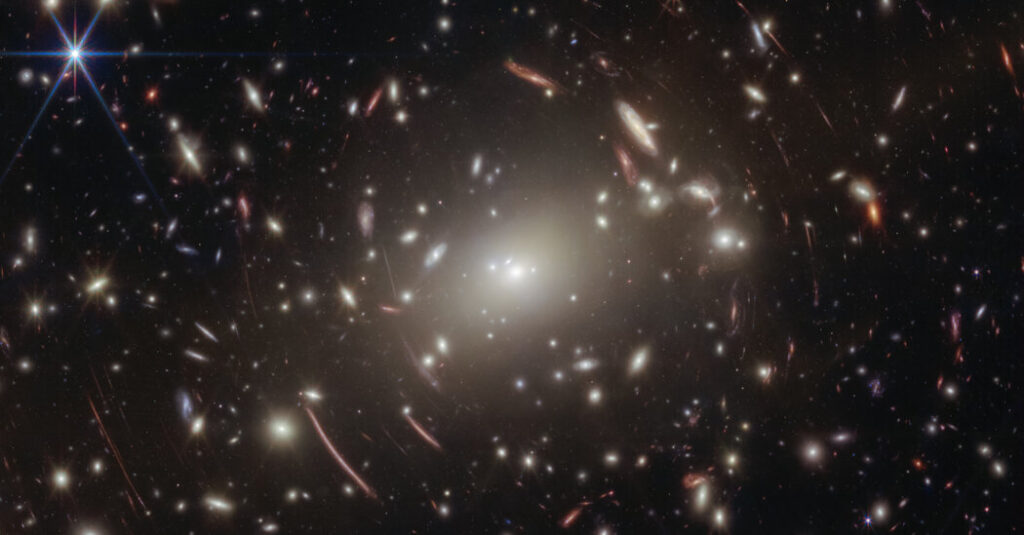
Little red dots, first seen through the James Webb Space Telescope and mentioned in a 2023 draft paper, are a series of red-tinted astronomical objects that date back about one billion years after the Big Bang. They’re tiny, each taking up about one pixel in the telescope’s photos, but they’re common.
“The little red dots were really a huge surprise out of J.W.S.T.,” said Rohan Naidu, an astronomer at the University of Hawaii who was not involved in the new study. “We were seeing them in basically every single image that the telescope was taking.”
At first, the research community wasn’t sure what to make of these dots. Many astronomers thought that they might be the bright cores of extremely massive galaxies from the early universe. But now that many more observations and studies have been completed, most scientists agree that the dots are black holes of some kind and that the red lights are clouds of dust being sucked inside.
Still, the research community has yet come to agree on what type of black hole these dots might be. Dr. Naidu and his research team have theorized that they might be an entirely new phenomenon: recently formed black holes covered in shrouds of brightly burning hydrogen gas, such that they resemble stars. This “black hole star” explanation would account for the dots’ massive — yet compact — lights traveling through the universe.
Some other astronomers think the dots might be something more familiar. A theory favored by Roberto Maiolino, an astrophysicist at the University of Cambridge, is that the red dots illustrate a missing step in the evolution of a typical black hole, in which bright dust and gas are being rapidly subsumed into the young black hole, allowing it to reach large masses just a few hundred million years after the beginning of the universe.
“I find this scenario appealing because it is essentially an extension of a population of objects that we already know exists, using known physics,” said Dr. Maiolino, who wasn’t involved in the new research.
The study’s simulations rely on known physics to recreate the environment during the first billion years after the Big Bang. Researchers focused on building the large- and small-scale structures that black holes are found in, adding the structure of dark matter particles, as well as the metals and gasses found in the early universe and the rates at which different materials are known to heat, cool and evolve.
The simulation showed that, under the right conditions, little red dots might have formed naturally in the first billion years after the universe began, before becoming more typical black holes.
“At 500,000 years, it looks like a little red dot, but after maybe one million years or so, the surrounding gas is mostly accreted into the black hole,” Dr. Chon said.
As telescopes continue to gather new observations of the universe, Dr. Chon hopes to fine-tune his model, hopefully further clarifying the connection between black holes and little red dots and shedding light on other unusual processes, such as gravitational waves and black hole binaries (systems of two black holes orbiting around each other until they eventually merge). Still, he’s open to other explanations for the dots.
“We don’t want to claim that all the little red dots come from what we’ve modeled,” Dr. Chon said. “So many new kinds of findings are coming out and it’s good news for new simulations.”
The post Massive Black Holes May Have Started as Little Red Dots appeared first on New York Times.