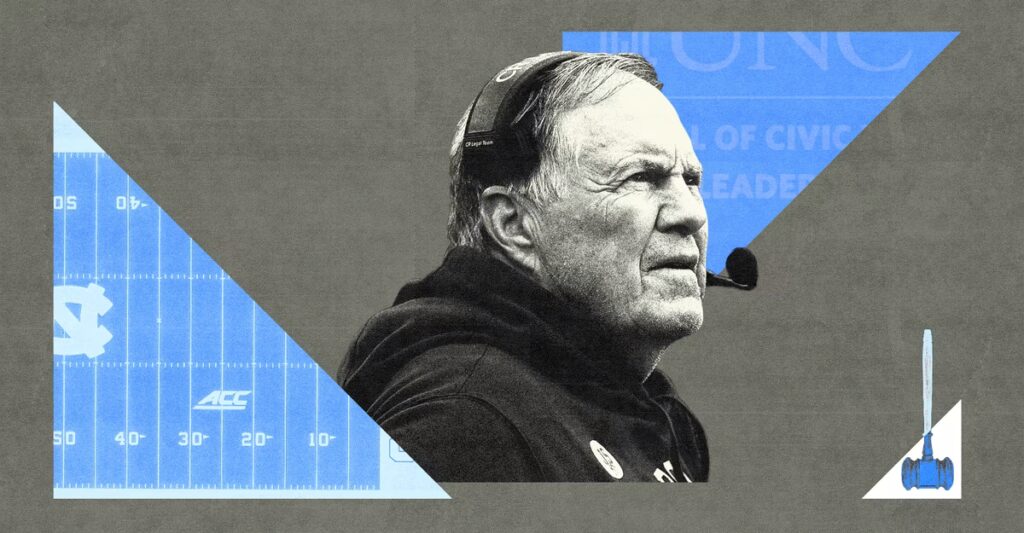
Ever since Bill Belichick, that aging football Caesar, arrived at the University of North Carolina roughly two years ago with his eight Super Bowl rings, the knives have been out. He is one of the greatest coaches in NFL history, but his hiring was controversial: Despite no experience leading a college team, he was given a five-year, $50 million contract—$30 million of it guaranteed—to vitalize a dowdy old southern program and lift it to championship level. From the beginning, he has been fighting a two-front battle: one on the field, and another against internal opponents, a contingent of powerful Carolina traditionalists who never wanted him there, resent his outsize presence, and wish UNC to remain a quaint, basketball-first school. “It is an internal civil war,” John Preyer, the former chair of UNC’s board of trustees, who helped hire Belichick, told me.
For several weeks now, Belichick’s program has been the subject of a messy, reputation-threatening internal investigation, even as his team shows promising signs in early competition. On August 5, UNC announced that it had hired outside attorneys to help with an evaluation of a personnel complaint against Belichick’s general manager, Michael Lombardi. That has since grown into a sprawling, open-ended probe of Belichick’s entire office culture, with unsavory lines of questioning. One person interviewed by the lawyers who asked not to be named for fear of retaliation told me they were asked whether they thought anyone drank on the job. The person said they were also asked about staffers’ sexual relationships, and about possible drug use by Belichick’s son Steve, who serves as his defensive coordinator but is currently on indefinite medical leave for unstated reasons. (I was not able to reach Steve Belichick for comment.) His father said at a press conference last week, “I love all my kids but I’m not going to comment on a medical situation.”
[Read: The quiet desperation of Tom Brady]
Lombardi, whose attorney has denied that his client committed any wrongdoing, resigned on September 3, but the university announced that the investigation would continue anyway. What the school did not announce was that two of the attorneys engaged by the university to investigate Belichick’s program, Nate Huff and McNair Nichols, are the subjects of whistleblower complaints over a separate investigation into the university’s School of Civic Life and Leadership (SCiLL).
In that matter, two faculty members have accused university leadership of using the lawyers as company men rather than impartial evaluators, and of tailoring the investigation’s scope, despite promising an “independent review.” According to billing documents from the SCiLL investigation that I obtained, Huff and Nichols took “instructions” from top UNC administrators. “Review strategy in light of instructions from client,” one billing memo read. Another read, “Develop new investigation timeline and strategy to comply with client instructions.” Eventually, the lawyers produced a 400-page report that UNC then refused to make public.
Internal investigations are not unusual, of course. All kinds of institutions conduct them into a wide array of personnel scandals—real and perceived—all of the time. Yet multiple people at UNC told me that there is reason to doubt the intentions and objectivity of the Belichick inquiry. Dustin Sebell, a SCiLL professor of the history of political thought who has filed a formal wrongful-conduct complaint with the university over the SCiLL investigation, told me in an email that the Belichick probe has an “eerie similarity” to what he experienced. Sebell said that he participated in the SCiLL investigation based on assurances from university administrators about its independence and objectivity—assurances, he wrote in his complaint, that turned out to be “false.” Another SCiLL faculty member has filed a complaint on similar grounds.
When I asked Sebell whether he thinks Belichick can expect a fair and independent review, he responded, “If history is any guide, the University is now asking for a trust it forfeited the last time around.” UNC’s vice chancellor for communications, Dean Stoyer, told me of the Belichick investigation, “I can confidently say that it has been managed independently. I can tell you that it is thorough and ongoing.” Huff replied to questions about his and Nichols’s independence by saying, “We cannot discuss any of the work we do for our clients.”
Belichick was hired in 2024 over the objections of the athletic director at the time, Bubba Cunningham, who favored younger, likely cheaper, candidates. Cunningham was overruled by Chancellor Lee Roberts and members of a search committee who wanted an electrifying hire to uplift a football program that had long been an also-ran. Cunningham, an eminence who served as the chair of the NCAA men’s basketball-tournament selection committee, has since stepped down as athletic director, but he remains a powerful figure on campus, with the title of senior adviser to the chancellor and athletic director. Although he outwardly accepted Belichick’s hiring, several people told me that he has never been happy about it. Neither have others who see Belichick as encroaching on their personal power or resources. Cunningham did not respond to a request for comment.
[Read: The man who broke physics]
For 24 seasons with the New England Patriots, Belichick exercised dictatorial control. In his negotiations with Carolina, he extracted promises of autonomy over his program and more money for acquiring players and paying staff salaries. Around the time Belichick was hired, the school also said it would increase its spending on football by millions, upgrade its football facilities, and build a virtual-reality training system for quarterbacks. This has been a threat to old-guard donors who feel disenfranchised, and others who want Carolina to remain focused on basketball, in the tradition built by Dean Smith—the late, legendary basketball coach with a reputation for modest virtue. “Dean is Banquo’s ghost,” Preyer told me, summoning Macbeth—a spirit haunting the athletic department. It didn’t help that Belichick’s first season ended with just four wins in 12 games, and that his personal life has regularly been in the tabloids.
It is possible that Belichick presides over an unruly office that requires broad scrutiny, and that real wrongdoing has taken place. But his football team looks improved this season thanks in part to the way he’s instilled in his players a quality he’s well-known for: discipline. A team that lost by 34 points to Texas Christian University last year beat the same opponent in this year’s opener 15–10 with a superbly controlled display. The team won again on Saturday, 35–3, against East Tennessee State University. But its real test lies in the coming weeks, as it enters Athletic Coast Conference play, with games against Clemson, Notre Dame, and Miami—of which the latter two are ranked in the top five nationally. Asked last week in a press conference if he is in “control” of his program—much of his time with reporters was consumed by questions about the investigation—Belichick answered curtly in the affirmative: “If you’re around here every day, I think you’d see it.” He also said, “We want to run the program in the very best way. And if there’s things we need to do to correct it, then we’ll obviously do them.”
One source with knowledge of the inquiry who asked not to be named because of their position with the university told me that Lombardi was found to have made a handful of minor NCAA-rules violations. One example: allowing recruits to have their picture taken on the field. The source said that taken as a whole, the violations were “not of the nature that would necessitate firing”—but Lombardi, a brusque New Jersey native, had alienated high-dollar donors and athletic-department officials with his way of getting things done. A friend and longtime associate of Belichick’s, Lombardi had been earning $1.5 million a year at UNC, making him the highest-paid general manager in college football, despite not having worked in college athletics since 1984.
[Read: Fifty years after history’s most brutal boxing match]
Stoyer, the UNC vice chancellor for communications, did not elaborate on the state of the investigation, or when it might conclude. Through a spokesperson, Belichick declined my requests for comment. For the time being, he will continue coaching under an ugly cloud. Last week the local Raleigh TV station WRAL reported that one line of questions had to do with whether a woman on the recruiting staff had a relationship with a player. Lombardi’s lawyer also said publicly that Huff and Nichols were digging into “inappropriate relationships,” but that his client was not aware of any. Nevertheless, a social-media account for the site Polymarket Football picked up the story and ran with it, posting pictures of multiple female UNC athletic staffers on X along with baseless speculation about whether they’d had inappropriate relationships with players. (The post has since been deleted.) “Anyone associated with Chapel Hill right now is a black cat,” the source who was interviewed for the investigation told me. The syndicated radio-show host Jim Rome had a particularly brutal take, accusing Belichick of turning Carolina into “some kind of crackhouse, or brothel, or both, allegedly.”
Some problems in Carolina football surely exist. Every major football program struggles with how to supervise more than 100 athletes in various stages of maturity, many with car keys and access to marijuana and alcohol. Human-resources issues are also common among overworked, pressure-cooked staff looking for release. But the broad, indiscreet nature of this inquiry—“a puppet investigation,” in the words of the source with knowledge of the inquiry—makes getting to the truth difficult. It’s hard to know what is of substance and what is noise. It’s also hard to know what’s really driving this mess: actual wrongdoing; plain infighting; or possibly an attempt by the university to avoid paying out the remaining guaranteed money on Belichick’s contract, should the school decide to fire him.
The Belichick experiment is a fascinating one. The question when he started was: Can a 74-year-old legend known for his stoniness and uncompromising need for control transfer his expertise to unformed young athletes on a campus rampant with doubters and dissenters? Now the question seems to be whether he will have a chance to succeed or fail on the merits.
The post How Long Will Bill Belichick Last at North Carolina? appeared first on The Atlantic.