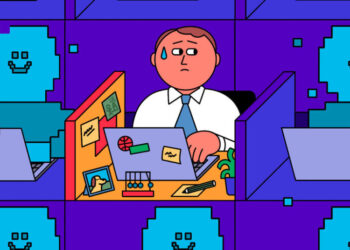
This weekend, the AI executives Sam Altman, Elon Musk, and Dario Amodei agreed with the need to slow the pace of AI development. In light of the potentially apocalyptic capabilities of the products they have created, the AI titans would like a little more time to figure out how to safeguard the systems they have been rushing to build.
A smattering of employees throughout the industry have quit their jobs and expressed alarm over the rapidly evolving technology. One Anthropic researcher claimed recently that there is a greater than 10 percent chance that AI could “kill all humans,” aggravating fears created by recent incidents in which OpenAI, Anthropic, and Meta models reportedly hacked into other companies. OpenAI recently revealed that some of its own models colluded for months to break into and steal information from Hugging Face, a website that offers tools for AI developers.
But surely the job of addressing the perils of AI shouldn’t be left to executives who stand to earn billions from the technology. Ideally, the federal government would regulate these companies, creating the guardrails necessary for the industry to operate safely. Short of that, some tools to address the harms from AI already exist: States have civil and criminal laws against conduct that threatens the security of life and property, and against commercial products that pose a danger to consumers. This includes new technology, as Meta’s recent $17 billion settlement over claims its products harm children makes clear. The work now before prosecutors and enforcement agencies is to create a precedent for holding AI companies responsible for what their models do.
Prosecutors should hold AI companies legally accountable for creating models that behave in ways that would be obviously unlawful if committed by a human being: hacking into banks to steal funds, impersonating a human to harvest sensitive personal data, breaking into an air-traffic-control system. By imposing legal penalties on AI developers for relatively modest offenses, prosecutors will force these firms to internalize the legal risk of more dramatic and dangerous crimes. In an essay posted online Saturday, Amodei proposed that every major AI firm collaborate on common safety practices and allow third-party agents to monitor compliance. In theory, the threat of prosecution and other legal sanctions could hinder companies from coming clean about how their models are trained and where they go wrong. But ultimately, oversight won’t prove effective if AI companies bear no legal responsibility for what their models do in the world.
[Will Oremus: AI’s code-red moment]
The rapid development of AI has caused widespread speculation about what will happen when the technology “goes rogue.” This metaphor should be retired, because it implies that the companies and individuals that build and deploy these models aren’t culpable for building products that are supposedly too smart to control. Dealing with autonomous technology may be unprecedented, but creating a product that might “kill us all by the end of the decade,” as a former Anthropic employee has warned, surely qualifies as a criminally negligent harm.
Skeptics may wonder whether AI CEOs are expressing apocalyptic concerns as a backhanded way of boasting about the colossal power of their technology. The companies’ behavior on a variety of fronts does not indicate that humanity’s safety is their top concern. Some AI executives in the United States have donated millions of dollars to benefit President Trump, who has largely dismissed concerns about AI safety and has already said that he has no intention of stepping in. The Anthropic CEO’s essay praised his own company for prioritizing “prudence over profit”—and yet he is steering it toward what may be the biggest IPO in history.
[Toluse Olorunnipa: AI is running laps around our political system]
AI firms will resist efforts to use the legal system to constrain their conduct. An OpenAI lawyer recently argued that “post-hoc law enforcement is a terrible tool” to manage the potential harms of generative AI. This would certainly be true in the case of a mass-extinction event, if no one is left to file charges. But despite what seems like an alarming consensus about the stakes of AI, the CEOs appear to be calling for some unenforceable “code of conduct” and a slower pace for developing the technology, whatever that means. If the dangers they are warning about are indeed real, then our criminal statutes should ensure that the offenders can be prosecuted. Given that vague threats about the perils of AI have not yielded meaningful changes in how these companies behave, perhaps the prospect of prison time will spur AI companies to take safety precautions more seriously.
“There’s no AI exemption from laws already on the books,” Lina Khan, the former head of the Federal Trade Commission, recently noted. Criminal prosecutions have occurred after oil spills, airline disasters, and toxic-waste dumps. The criminal liability was obvious in those instances. AI companies deserve no special treatment.
When AI executives warn of a catastrophe, they are not describing a product that is “going rogue.” Rather, the product is using capabilities that they have created. And if this product behaves negligently or criminally, its creators should face the consequences.
The post Destroying Humanity Is Against the Law appeared first on The Atlantic.